
Migrants taken to Dover after more than 30 hours at sea
-
Published
A total of 51 migrants arrived in Dover on a small boat after spending more than 30 hours at sea.
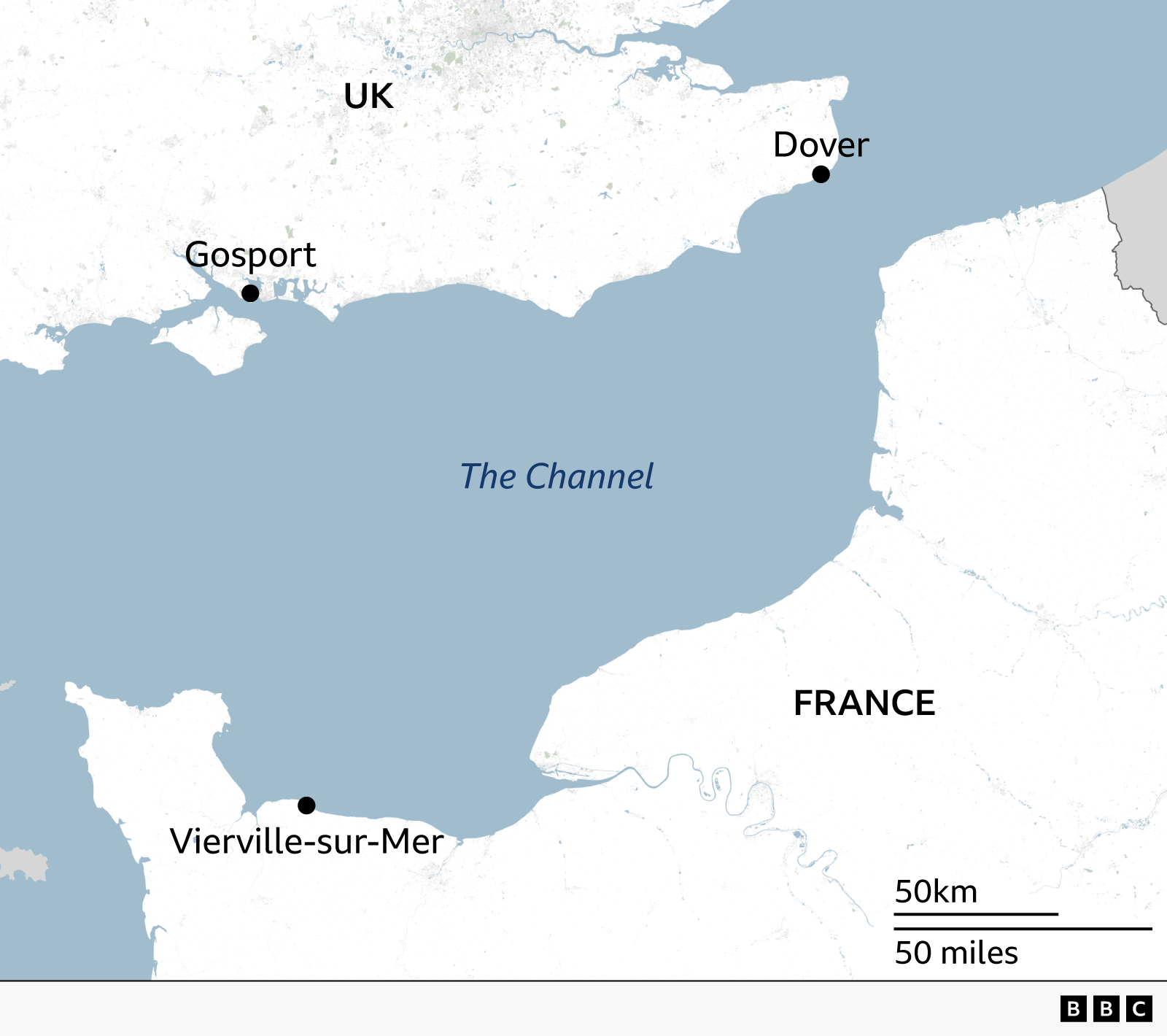
The arrival at 00:30 BST came after protesters gathered in the Hampshire town of Gosport on Tuesday evening as it was initially believed this is where they would be brought ashore.
The boat left the Normandy coast on Monday morning and the French coastguard, which shadowed it, said the migrants were in “precarious conditions” and refused help as they were “determined to take all risks to reach” the UK.
British rescue boats were sent to collect those on board, who were then transferred to Border Security Command.
A government spokesperson said Border Security Command worked “around the clock to protect our border and will continue to detain, check and process every small boat arrival”.
The French coastguard said the migrants had been on the small boat for more than 33 hours.
The Royal National Lifeboat Institution (RNLI) said it was tasked by HM Coastguard with assisting those on board “out of concern for their safety and deteriorating health”.
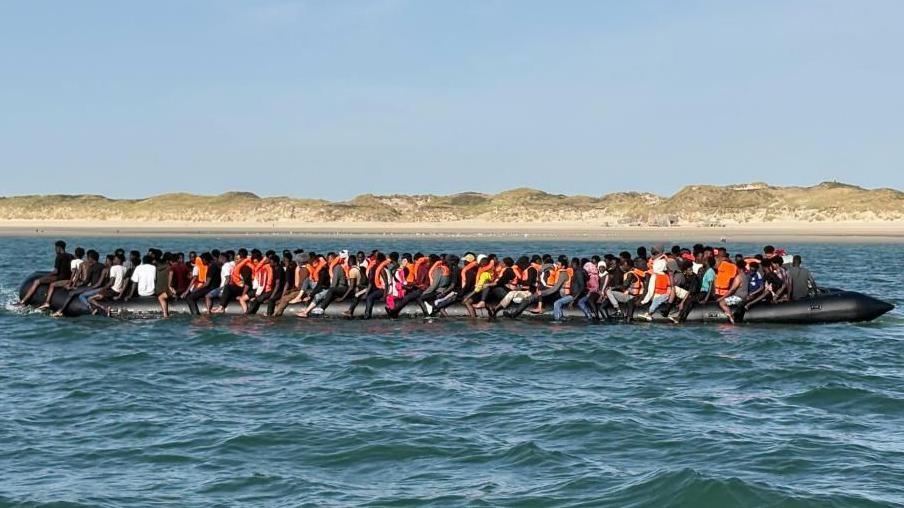
Migrants could later be seen disembarking in Dover wearing orange life jackets and carrying personal belongings.
About a dozen protesters were spotted in the area, with local police having blocked off a nearby road.
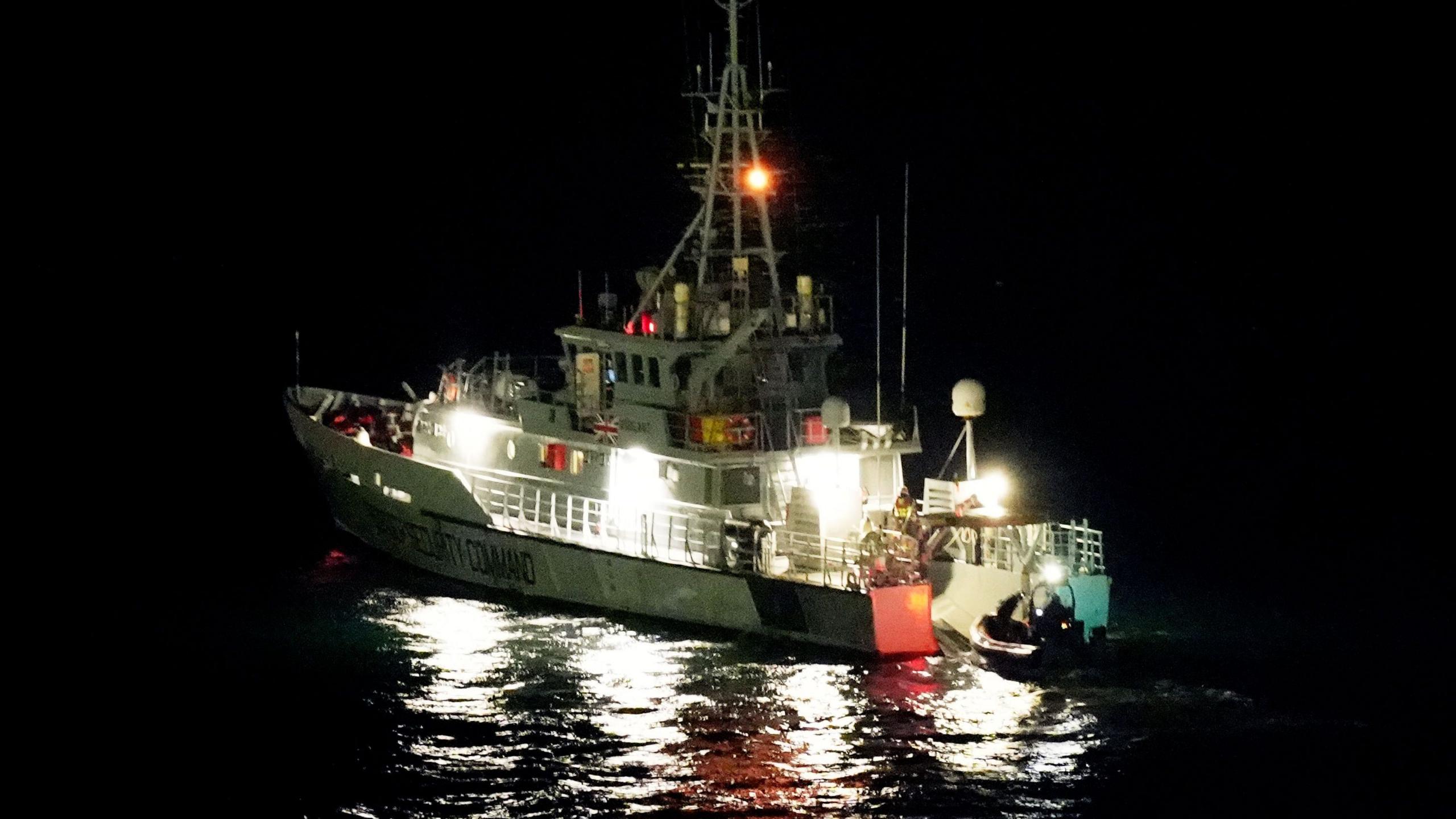 Image source, PA
It was initially expected the migrants would be taken to the Portsmouth area after local MP Dame Caroline Dinenage said the Home Office had said this was “increasingly likely”.
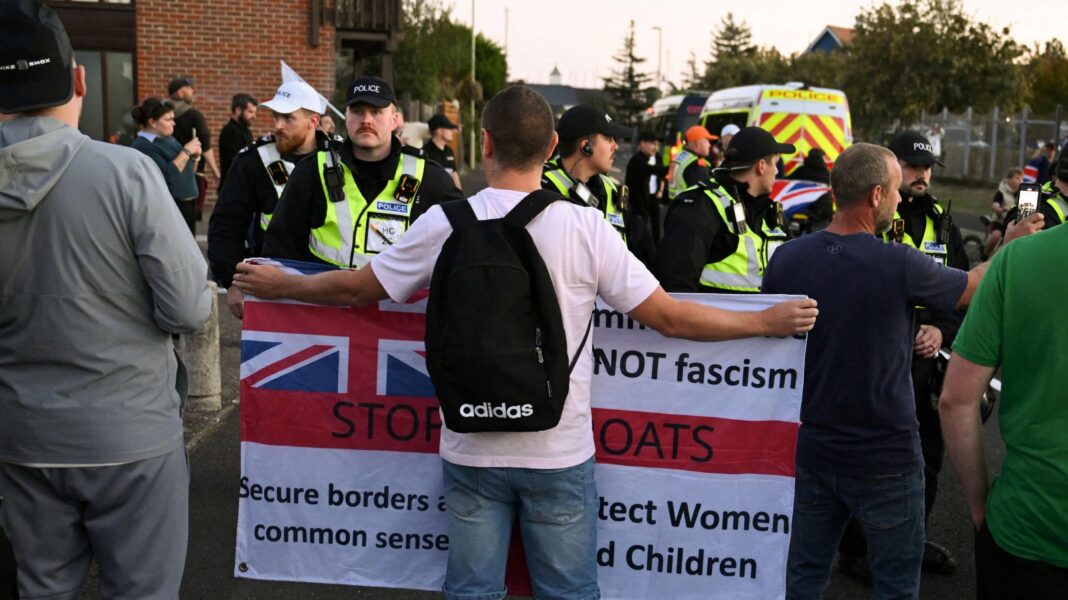
Hundreds of anti-migrant protesters, surrounded by police, gathered near Gosport marina on Tuesday evening after the initial reports.
A number of men wearing black, several with face coverings, were at the front of the crowd. Some were chanting “send them back”.
Hampshire & Isle of Wight Constabulary said six people were arrested after protesters “became hostile towards officers”.
“They remain in custody at this time and our inquiries into these incidents continue,” a spokesperson added.
Daniel Thomas, known as Danny Tommo, shared a YouTube livestream of the boat from the Channel.
Thomas – a long-term campaigner against migrants – organised recent protests in Portsmouth and Dover.
The migrant dinghy appeared to have set off from close to the village of Vierville-sur-Mer, west of Bayeux.
It is rare to see small boat crossings depart from so far west.
Earlier this month, a dinghy was met by lifeboats from the Isle of Wight having set off from the Cherbourg area, triggering protests in Portsmouth.
It is thought to have made one of the longest journeys of any small boat in the Channel. Officials said at the time they believed it was a one-off rather than a sign of new tactics.
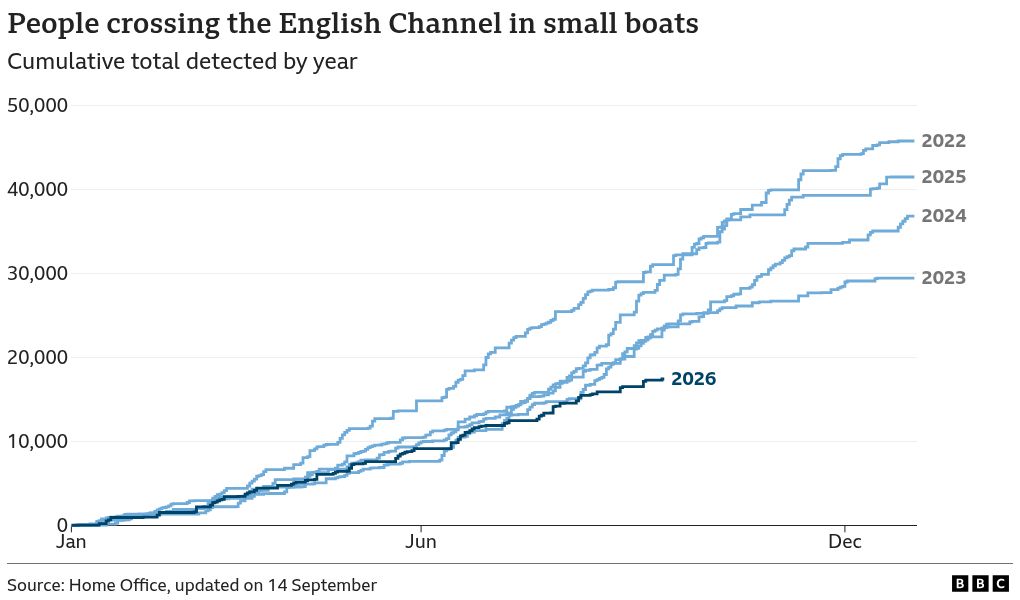
How many people cross the English Channel in small boats?
Between 1 January and 14 September 2026, a total of 17,425 people crossed the English Channel by small boat from France. This was down by 44% on the same period the previous year.
These crossings have become the most common way for people to be detected entering the UK illegally since 2020.
Nearly all those who arrive by small boat claim asylum. Under international law, this means they are allowed to stay in the country while their asylum application is considered.
Small boat arrivals made up 40% of asylum applications between July 2025 to June 2026.
Boats that arrived in the UK from 15 September 2025 to 14 September 2026 carried an average of 68 people. This has more than doubled since 2021.
Experts say overcrowding in boats makes crossings riskier. At least 84 people died while attempting to cross the Channel in 2024, according to the United Nations (UN).
When looking at the scale of small boats crossings, the number of these arrivals is about 5% of the size of total immigration into the UK from January 2025 to December 2025.
The government has pledged to “smash the gangs” behind these crossings in order to reduce the numbers.
Who is arriving in the UK on small boats?
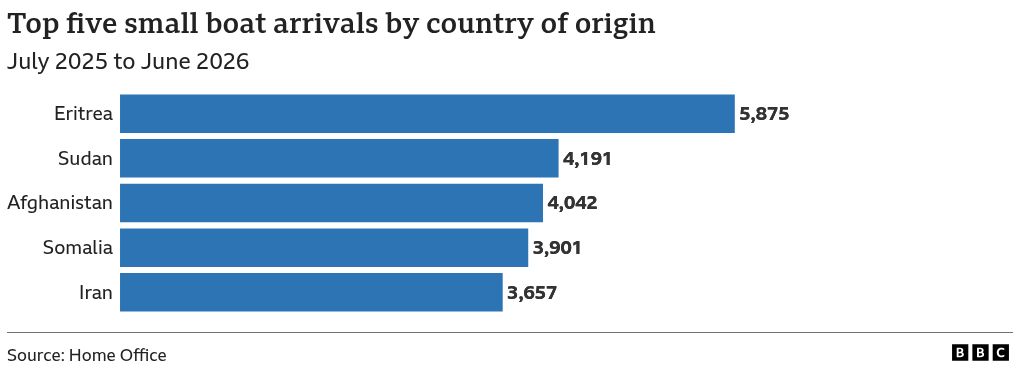
People from Eritrea accounted for 18% of all arrivals from July 2025 to June 2026.
In the latest figures covering January 2025 to December 2025, at least 2,335 people who arrived by small boat were found to be potential victims of human trafficking or other forms of modern slavery, according to the Home Office.
How else do people stay in the UK without permission?
Another 4,712 people were detected entering the UK without permission via other methods including hiding in vehicles, travelling on ferries or through airports from July 2025 to June 2026. This was down by 17% on the same period the previous year.
There are also individuals who arrive legally, for example via a work or study visa, and then overstay their limit.
The total number of people who live in the UK illegally after arriving legally is not known.
On Monday, some 17,480 migrants had arrived in the UK after crossing the Channel by boat so far this year.
That total was 46% down from the same time last year.
The National Crime Agency recently said the reduction was down to law enforcement activity, though one expert said other factors, such as improving security in Syria, may also be behind the decline.
Many migrants come from some of the poorest and most chaotic parts of the world.
They almost always ask to claim asylum once they are picked up by the UK authorities.
On Tuesday, defence minister Luke Pollard insisted the UK’s borders were secure after a migrant boat reached the Kent coast without being intercepted.
Five people were detained and passed to Border Security Command after the dinghy made it to shore at Folkestone on Monday – the first undetected landing for a year.
Additional reporting by PA Media
Follow BBC Kent on Facebook, external, on X, external, and on Instagram, external. Send your story ideas to southeasttoday@bbc.co.uk, external or WhatsApp us on 08081 002250.
-
-
Published25 August 2025

-
-
-
Published7 March
-
-
-
Published10 August
-