
This post was originally published on this site.
Helen Burchelland
Emma Baugh,in Northampton

Paramedics missed the opportunity to take an amateur footballer to hospital who later died from sepsis, a coroner has said.
Luke Abrahams, from East Hunsbury, Northampton, died on 23 January 2023 after also developing necrotising fasciitis, which is a type of flesh-eating disease.
After a four-day inquest at The Guildhall in Northampton, assistant coroner Sophie Lomas noted that surgical intervention 24 hours earlier “can make a difference” but said she could not say whether “earlier conveyance” would have prevented his death.
The ambulance service said it was “deeply sorry” it missed the opportunity to take Abrahams to hospital.
The 20-year-old was initially diagnosed with tonsillitis and prescribed antibiotics, however his condition deteriorated and he became immobile with severe leg pain.
In the early hours of 20 January, he had a video consultation with an out-of-hours doctor, who diagnosed sciatica.
However, 12 hours later, his family called for an ambulance, but despite a high temperature and blood sugar level, the crew decided he did not need to go to hospital.
Two days later, he was admitted to hospital – and died the next day.
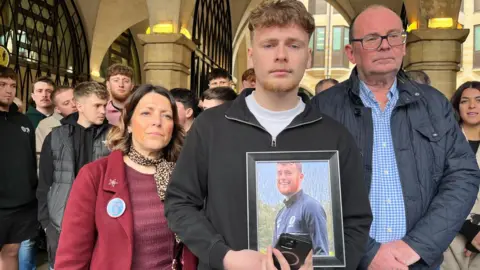 Emma Baugh/BBC
The coroner said Abrahams had been affected by the extremely rare Lemierre’s syndrome which was very difficult to diagnose.
His parents believe errors in his care – including an initial misdiagnosis – may have contributed to his death.
But Lomas said: “Due to the nature of the infection, the challenges of diagnosing the condition and the high mortality rate, it was not possible to determine on the evidence available, on balance of probabilities, whether an earlier conveyance to hospital would have prevented Luke’s death.”
She recorded a narrative conclusion, and said he died following a cardiac arrest due to septic shock.
East Midlands Ambulance Service NHS Trust (EMAS) head of patient safety, Susan Jevons, had told the court that Abrahams’ blood sugar levels and pain score “warranted a transfer to hospital”.
‘We failed’
Family solicitor Elizabeth Maliakal said the inquest had been “immensely difficult” for her clients, concluding on the third anniversary of his death.
“They have heard evidence from witnesses from the hospital, NHS 111 and the ambulance service, some of which detailed how more could and should have been done to help their much-loved son and brother.
“They’ve also heard apologies for the poor way they were supported, as Luke was fighting for his life in hospital.
“He was assessed by health professionals on five separate occasions before finally being admitted to hospital.”
Maliakal added that although the inquest had brought answers and apologies, “it has not brought accountability”.
Speaking after the inquest, Radd Seiger, acting as adviser and spokesperson for the family, said the ambulance service should have conveyed Abrahams to hospital 48 hours earlier.
“We believe that there was a good chance that Luke could have survived had that happened,” he said.
Seiger said the family would launch a civil claim against EMAS.
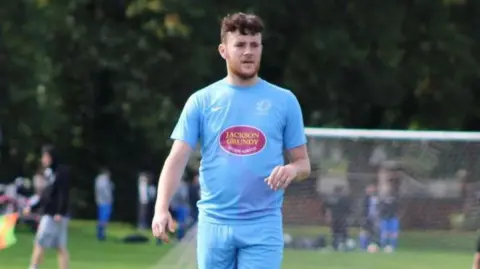 Richard Abrahams
 Keeley Sheldon, director of quality at EMAS, said: “I am deeply sorry that we missed the opportunity to take Luke to hospital on 20 January 2023.
“We failed to provide the level of care he deserved.
“My condolences are with Luke’s family and all who loved him, particularly today on the third anniversary of his tragic death.”
An investigation was carried out that year and the trust took actions, Sheldon explained, and she said her team would review the coroner’s findings to “identify further steps we can take to prevent this happening again”.
NHS Northamptonshire Integrated Care Board also said it was “deeply sorry” for the family’s loss.
“[We] will work with all our partners and involved organisations to continue to take all steps necessary across our whole system to improve in those areas identified,” said chief nursing officer Maria Laffan.
The Abrahams’ spokesman Seiger added supporters intended to “move forward and get [the family] accountability – and that’s through a civil claim against the ambulance service”.