
Nobel Prize awarded for showing inner workings of the brain
-
Published
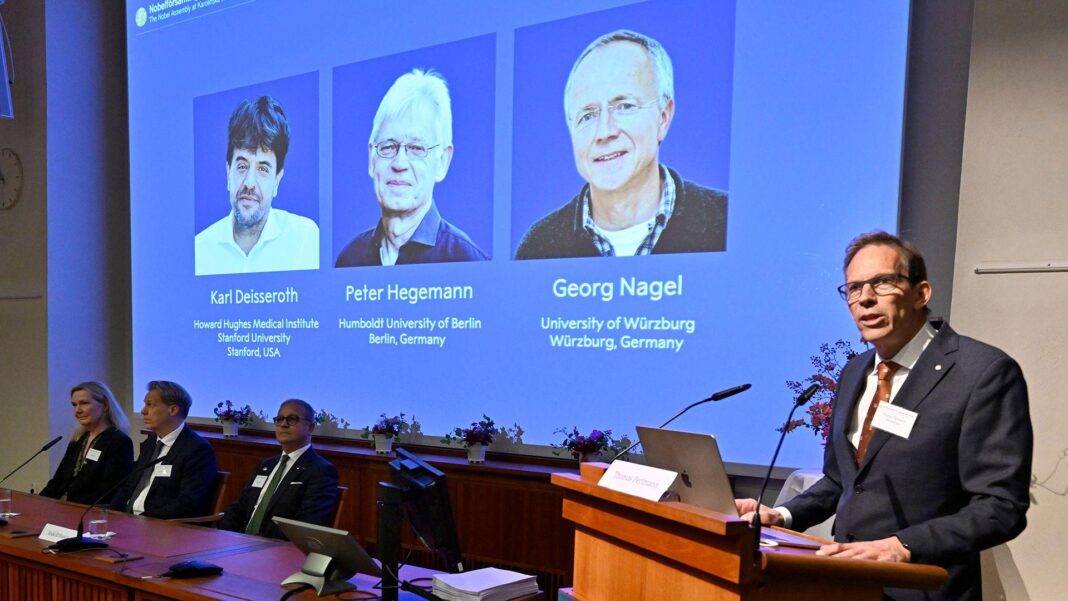
US psychiatrist and neurologist Karl Deisseroth and his German colleagues Peter Hegemann and Georg Nagel have been awarded this year’s Nobel Prize in Physiology or Medicine for their work in the field of optogenetics.
Their research has helped scientists learn more about the inner workings of the brain, to better understand how the human mind works.
The Nobel Committee, external praised the trio for laying the foundation of a new era in neuroscience by revealing how to switch on and off neural circuits behind “specific memories, feelings, and behaviours relevant for neurological and psychiatric disorders”.
In clinical medicine, researchers are using the method to try to restore sight in people with visual impairment.
‘Absolutely wonderful’
“Optogenetics has fundamentally altered our understanding of the brain,” the Nobel Assembly said.
“Every day brings new discoveries, helping to solve one of humanity’s great mysteries: how our incredible brain works.”
The winners said it was “absolutely wonderful” to get the award, and that it was an honour to share the accolade with friends.
The three men will also share the £900,000 (12 million Swedish kronor) prize money.
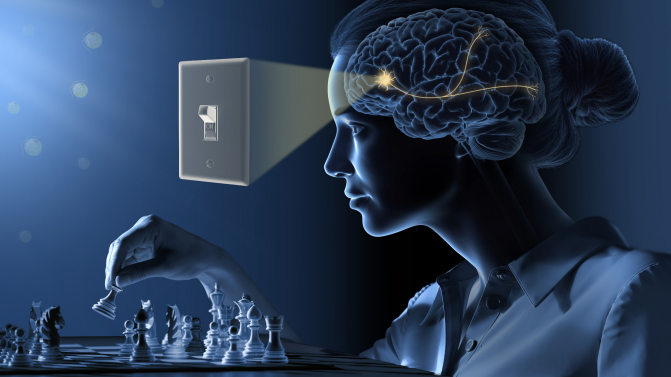 Image source, The Nobel Committee for Physiology or Medicine. Ill. Mattias Karlén
What is optogenetics?
Per Svenningsson, chair of the Nobel Committee for Physiology or Medicine, explained: “Optogenetics provides opportunities for mapping the brain in a way that we could once only dream of.”
Before, the inner workings behind feelings, behaviours and bodily functions were more of a mystery to scientists.
Optogentics is a way to illuminate brain pathways, using a special protein borrowed from algae that scientists use to control cell electrical activity using light.
In the early 2000s, Hegemann and Nagel discovered channelrhodopsin, the algal protein with unique properties.
Deisseroth worked out how to use this light controlled protein to switch on nerve cells in the brains of mice.
Researchers have since been able to study nerve cells and pathways in animals to see and discover more about what they do.
The Nobel Committee said: “Using light, researchers are now able to switch individual neural circuits on or off in the brain. They can bring memories to life, create feelings, drive behaviours and study the types of neurons that are involved in various psychiatric and neurological disorders.”
That is providing important insights into how the nervous system interacts with various cells in other areas of the body, such as in the heart and gut, the committee added.
Restoring people’s sight
Researchers have also taken “the first steps” towards using optogenetics as a medical treatment, the committee explained.
In ongoing clinical trials, scientists have been working to restore vision in people who have become blind due to retinitis pigmentosa, a disease that destroys the eye’s rods and cones.
By inserting a special protein in the damaged region of the eye, the patient regained some vision when wearing special glasses emitting light. This switched on the therapeutic algae proteins.