
This post was originally published on this site.
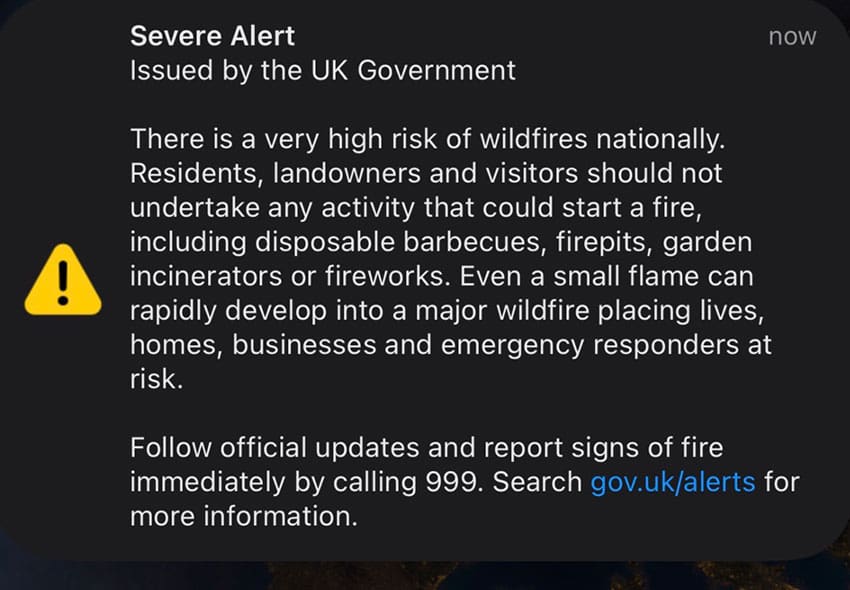
At seven o’clock on Friday evening, every mobile phone in England and Wales went off at once. Not a ring. Not a polite buzz. The screech. That ten second government klaxon previously reserved for floods, incoming missiles and, we now discover, the disposable barbecue.
An entire nation shot two feet into the air. At the Royal Albert Hall, one imagines the Proms audience concluding that Russia had hacked every handset in the stalls to give the 1812 Overture an unusually literal opening. In a thousand pub gardens, overlooking lawns the colour and texture of a digestive biscuit, men quietly lowered bags of charcoal back into their boots with the practised calm of getaway drivers returning the loot.
It was a severe alert. Very high risk of wildfires nationally, it said. No firepits, no garden incinerators, no fireworks, and under no circumstances a barbecue.
Every family in Britain used to contain an uncle of a very particular sort. Call him Derek. Forty Rothmans a day, a good number of them in bed, and yet, to be entirely fair to him, the finest domestic smoke alarm network in the Home Counties.
Detectors in every room, tested each Sunday before lunch. An interlinked system, so that a crisp packet smouldering in the kitchen would summon a full choir upstairs. A heat sensor in the garage, though the garage contained nothing but paraffin and old copies of Exchange and Mart. No man in the land took fire detection more seriously.
What Derek would not do, under any circumstances, was stop smoking in bed. Prevention, he felt, was a job for the alarms.
I raise this great British archetype because on Friday the government officially became him.
Consider Friday’s running order. In the evening, Whitehall pressed the big red button on the most extensive emergency alert ever sent for a live incident, a warning triggered by a drought that has left nearly three quarters of England officially parched after the driest July in 190 years, and by fires that had already taken 19 homes in Stourbridge. That very same day, the Department for Transport opened a consultation asking whether the 2030 electric car sales targets remain, in its word, practical, with ministers briefing that the 80 per cent goal could soften towards 50.
Nor was that the only quiet loosening of the week. Ministers also let it be known that public contracts worth £5 million or more may soon be scored more heavily on jobs and training than on net zero and diversity measures. Each move is defensible on its own terms, no doubt. So, Derek would tell you, is one cigarette.
Same government. Same week. One hand on the fire alarm, the other patting its pockets for the lighter.
And the fire is not hypothetical. Reservoirs are at 69 per cent and falling, 27 million people are under hosepipe bans, and this summer’s heatwaves have already cost the economy £4.4 billion in lost output. I wrote earlier this summer about Britain’s browning fields, and they have only got browner since.
Business readers will recognise the arrangement, because every one of us has sat in that meeting. The risk register says severe. The mitigation budget says deferred. If a FTSE board flagged a threat as critical, texted every employee about it, then diluted the one policy addressing its cause in the same afternoon, the auditors would be through the door by Monday and the share price through the floor by lunch.
And here is the question someone should force a minister to answer. If the consequence is grave enough to interrupt the Proms, why are the causes a matter for leisurely consultation? A wildfire is not weather, it is arithmetic. Emissions warm the planet, the warming dries the land, and the dry land sits waiting for a spark. You cannot classify the bottom line of that equation as a national emergency while filing the lines above it under red tape.
Yet that is the official position. Sirens for the symptom, consultations for the causes. Transport remains Britain’s largest source of the emissions doing the drying, and the message it received this week was: as you were. An emergency that changes nothing except the volume of your phone is not a policy. It is a ringtone.
No business would survive run this way. When the warehouse is smouldering, you do not commission a review into whether the sprinkler budget remains practical.
Derek’s alarms, I should record, worked flawlessly. They sang like a cathedral choir right up to the night the mattress finally caught. He escaped in his slippers, the bedroom did not, and the man from the Prudential asked the only question that ever mattered. You knew the risk. You measured the risk. You wired the whole house to scream about the risk. So why were you still feeding it?
Next time my phone screeches on a Friday evening, I shan’t wonder whether there’s a fire. I’ll wonder who is still smoking in bed.