


This post was originally published on this site.
 Getty Images
You could not make it up, really. Just 24 hours after Manchester City had a goal controversially ruled out through VAR, Arsenal saw theirs stand.
Two EFL Cup semi-finals, two pretty similar offside situations, two different outcomes.
Supporters crave consistency, so it is understandable that questions are being asked.
How can the video assistant referee system chalk off a goal in one instance but allow it to stand in the other?
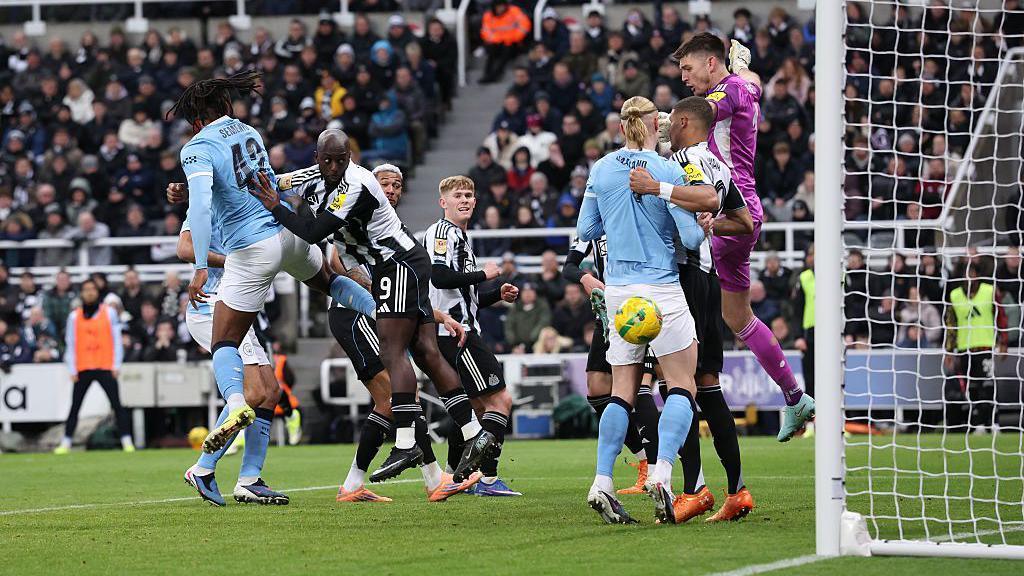
When Manchester City‘s Antoine Semenyo thought he had scored a second goal in Tuesday’s 2-0 win at Newcastle United, no-one seemed to have a clue there was anything untoward.
Then the VAR, Stuart Attwell, told referee Chris Kavanagh that an offside Erling Haaland was having an impact on Malick Thiaw’s defending as the ball went past en route to goal.
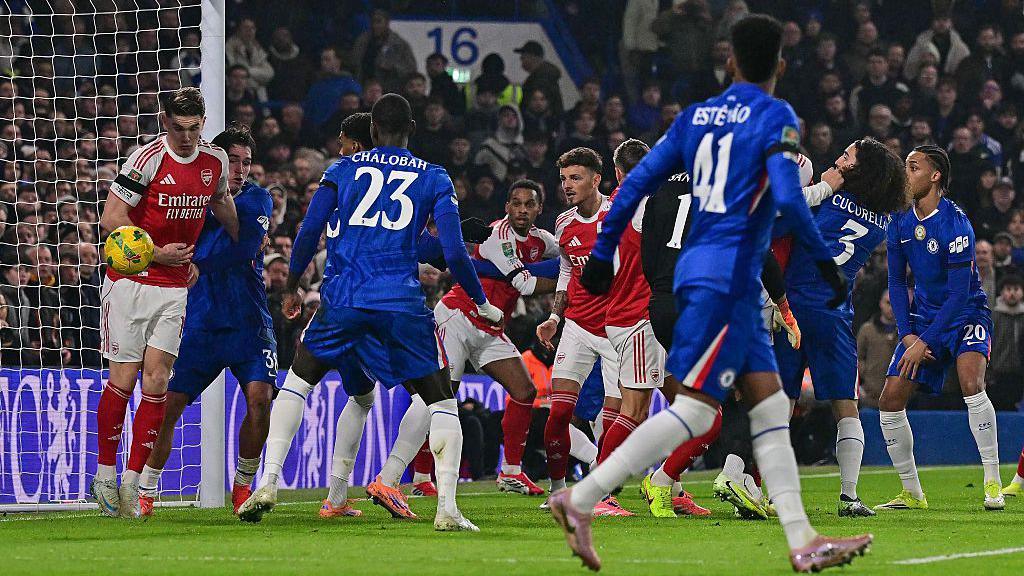
Fast forward to Wednesday and Ben White’s goal in Arsenal‘s 3-2 victory at Chelsea. The ball had evaded an offside Viktor Gyokeres, who was jostling with Chelsea‘s Marc Guiu. The VAR stayed out of it.
Giving offside against Haaland is technically correct in law but it is a VAR over-reach. It is not the kind of intervention we have come to see in the Premier League, so by extension the same would be expected for the Carabao Cup.
The goal incidents were comparable but not the same. Haaland was effectively protecting the path of the ball and could be considered to have been stopping Thiaw from getting to it.
Guiu, however, had his back to play when White headed the ball and was not looking at the ball. It is harder to say the Chelsea player was in a position to stop the goal.
 Getty Images
Benchmark for consistency should not be a bad decision
A couple of years ago the VAR failed to give a penalty against Manchester United goalkeeper Andre Onana. He had crashed into Wolves striker Sasa Kalajdzic.
When Onana made a similar challenge later in the season the VAR did not stay out of it to be consistent with an earlier error. This time the spot-kick was awarded.
The benchmark for consistency was not an incorrect decision or a bad VAR outcome. Referees were told what was expected of them and adjusted their decision-making.
This happens all the time and can be applied to the Carabao Cup offside calls. But by being markedly different just 24 hours apart it is clearly going to raise questions.
Two things particularly frustrate supporters with VAR: decisions which come as a surprise and those which take far too long.
With the Haaland offside, they got both. It did not sit well at Professional Game Match Officials Limited (PGMOL), the body that oversees refereeing in England’s professional leagues.
Since arriving as the head of referees three years ago, Howard Webb has repeatedly said that his officials should not be too forensic. A VAR must have confidence in their decision-making to be effective.
Delays cause frustration and place doubt into supporters’ minds. Quick and efficient reviews, on the whole, seem to be more trusted.
There has been a significant reduction in the time taken for VAR reviews, down to around 50 seconds on average. But the long stoppages like at St James’ Park, leaving fans in the ground in the dark, will rightly get attention.
Let’s say the VAR had decided within 90 seconds that Semenyo’s goal should have been disallowed. There would still have been controversy but perhaps not quite so much noise.
At Stamford Bridge it was a much more efficient check by the VAR, Jarred Gillett. He did not dally, perhaps mindful of what had happened the night before.
The Haaland decision sticks out partly because the Premier League has the lowest VAR intervention rate in European football. VARs do try to stay out of the more subjective decisions.
The Premier League’s Key Match Incidents Panel says there have been only two incorrect interventions out of 47 so far this season. That is the lowest there has been at the halfway stage.
But whenever an incident like the Haaland case crops up, whether in league or cup, it puts another dent into VAR’s reputation.
Related topics
-
-
17 October 2025
-
-
-
16 August 2025

-


