
This post was originally published on this site.
Nick Triggle,Health correspondentand
Chloe Hayward

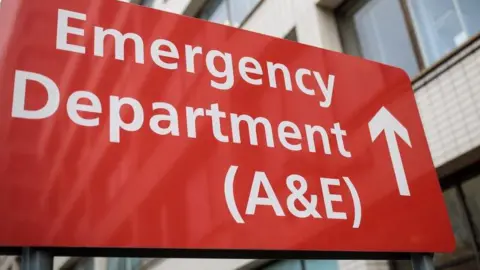
One in 10 patients who attended major A&E units in England last year spent more than 12 hours there, a BBC analysis shows.
During 2025, 1.75 million patients waited that long to be treated and discharged or found a bed on a ward – only marginally better than in 2024.
It comes as the Royal College of Nursing warned long waits and corridor care – where patients are left for hours in make-shift areas – was having a devastating impact.
The union published testimonies from members across the UK describing unsafe and undignified care, with one nurse saying animals were treated better at vets.
The government said it was unacceptable, but it was still dealing with the legacy it inherited.
Health Secretary Wes Streeting acknowledged corridor care remained a problem, saying the NHS was “falling short”.
“It should never be normalised,” he added.
He said he was committed to ending the practice before the end of the parliament and would soon start publishing data on it to ensure transparency.
But he said on some measures, such as ambulance response times, there had been improvement compared to last year.
And in other areas of care he said patients were “starting to feel the difference”, pointing to progress being made on the hospital waiting list.
On corridor care, RCN members described feeling ashamed and embarrassed about the situation, saying patients were being crammed into corridors and treated in kitchens, dining areas and side rooms.
In one case a nurse reported how a patient had died after choking undetected in a corridor, while others said they had to hold up sheets around patients while performing intimate procedures.
One nurse in the north west of England said: “It breaks my heart being in work and there being a patient, usually elderly, on the corridor and coming back two days later and them still being there.”
Another for the south west described the system as broken and patients having to go through a “type of torture”, while another nurse added: “We would not treat animals like this in a veterinary practice, so why in a hospital?”
RCN general secretary Prof Nicola Ranger said the testimonies showed the “devastating human consequences” of the pressures in hospitals.
She was speaking after a spate of hospitals declared critical incidents during the first two weeks of the new year.
At one – Nottingham University Hospital – managers warned there were patients on corridors and apologised for the “significant and unacceptable delays” in A&E.
The BBC has seen the impact of the pressures first hand. This month our teams have filmed inside Leicester Royal Infirmary where staff describe “relentless pressure” and the daily challenge of “maintaining a patient’s dignity whilst on a corridor”.
Doctors and nurses told the BBC they were struggling to find beds for some of the hospital’s most vulnerable patients, with older people often left waiting overnight on plastic chairs for eight or nine hours.
Among them was Patricia, in her seventies, who had fallen and was experiencing severe chest pain. She spent nine hours waiting on a chair.
She said she felt “so tired” and “confused about what was happening”.
Another patient, Ann, arrived by ambulance and was being treated for an infection and dehydration. She had been waiting 48 hours for a bed on a ward.
Although she praised the care she had received, specialist staff were going to have to come to the emergency department to oversee her rehabilitation because no appropriate bed was available.
“This is not the level of care we want to give,” said Scott Knapp, a consultant in the emergency department.
“We’ll make the best we can for her, but it puts extra pressure on the system and extra pressure on the nursing team within the emergency department.”
The trust has not had to declare a critical incident, however, and says patients needing urgent care should still come forward.
Monthly data on 12-hour waits is published by NHS England. In 2024, 10.5% of patients waited 12 hours or more at major A&E units from arrival to the point where they were treated and discharged or found a bed on a ward if they needed to be admitted. In 2025 it was 10.1%.
Waits are measured slightly differently elsewhere in the UK, but the other nations are all experiencing problems too.
Crisis
Dr Ian Higginson, of the Royal College of Emergency Medicine, said the pressures being seen were taking an “immense toll on patients”.
“They are being forced to endure these conditions, often for hours, if not days, because hospitals are full to bursting.”
This week the Liberal Democrats proposed giving patients a legal right to be admitted or treated and discharged within 12 hours to help end what they said was a “deadly corridor care crisis”.
Figures have also been published on the waiting list for planned hospital treatments, such as knee and hip operations.
At the end of November 7.31 million patients were on the waiting list – down from 7.4 million the month before – the lowest it has been since February 2023.
And NHS England has published an evaluation of its programme of support for areas with the highest rates of economic inactivity.
NHS trusts in the 20 areas with the worst joblessness have been given extra support with specialist teams of doctors and managers sent into to try to get the waiting list down.
Over the past year the waiting list has fallen by 4.2% – three times faster than elsewhere.