
Only one female scientist named in GCSEs, research finds
-
Published
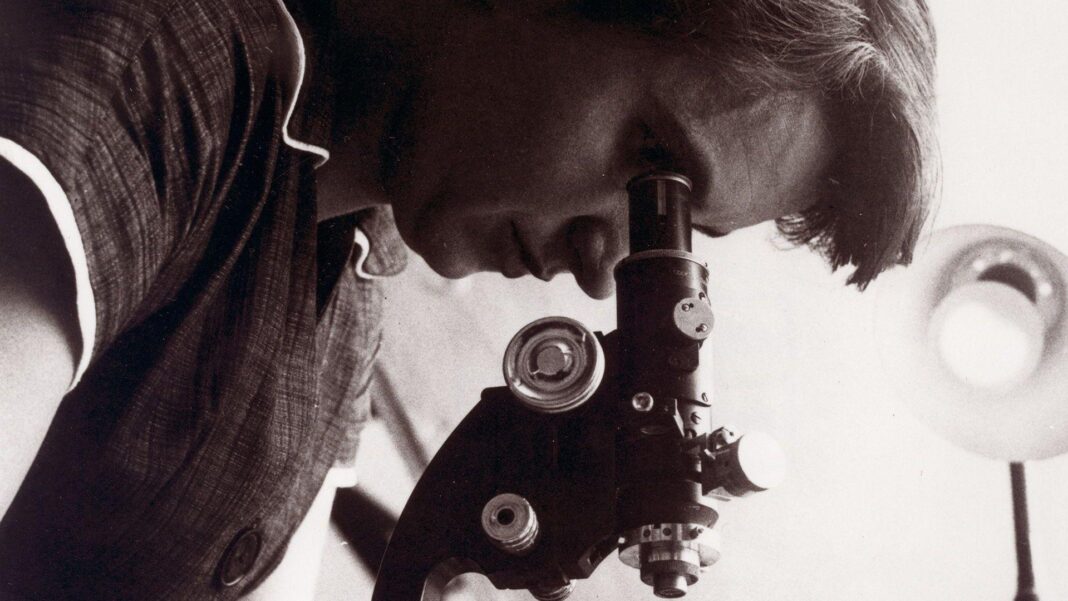
Rosalind Franklin is the only female scientist named in GCSE and National 5 science exam specifications in the UK, according to new research.
A Cambridge study found that of the 86 scientists named by UK exam boards, the English chemist, whose work in the 1950s helped reveal the structure of DNA, was the only woman.
Exam specifications set out the skills and knowledge students are expected to have gained by the end of their course and how they will be assessed.
Exam boards said there was “a clear need for greater representation in science qualifications”.
Academics from the University of Cambridge, along with institutions in the US and Australia, examined how many women were mentioned in specifications for biology, chemistry, physics, environmental science, geology and astronomy.
Their work, published in the British Educational Research Journal, looked at six exam boards in the UK:
-
AQA
-
Cambridge OCR
-
Pearson Edexcel
-
WJEC
-
CCEA
-
Qualifications Scotland
At Key Stage 4 and equivalent, including GCSEs and National 5s in Scotland, Franklin was the only woman among the 86 scientists mentioned.
She was also one of three women mentioned at Key Stage 5 and equivalent – including A-levels, AS-levels, National Highers and National Advanced Highers – out of a total of 181 scientists.
Marie Tharp, an American cartographer who created the first map of the floor of the Atlantic ocean in the 1950s, and Inge Lehmann, a Danish seismologist who discovered the existence of the Earth’s inner core in the 1930s, both feature in the Cambridge OCR’s A-level Geology.
Franklin, who was named in Cambridge OCR’s GCSE Biology and Scottish Highers Biology, produced a famous DNA image known as Photograph 51.
Cambridge scientists Francis Crick and James Watson used the image to work out the following year that DNA has a double-helix structure.
Watson, Crick and Franklin’s colleague Maurice Wilkins received the 1962 Nobel Prize for the discovery. Franklin had died four years earlier.
Academics who wrote the paper found that “several major scientific breakthroughs” in specifications were made by women, but they were not explicitly mentioned.
The paper said: “Many of the scientific discoveries and explanations were developed in the 1800s and early 1900s, a period when scientific and mathematical practice was largely, but not solely, dominated by men.
“Our findings confirm that the UK science specifications reflect this historical imbalance: although women made significant contributions to major scientific breakthroughs, this fact is rarely acknowledged.”
The academics recommended that Franklin should be included “in all specifications when teaching DNA structure”.
They also said specifications should refer to Marie Curie, who discovered radium and polonium and coined the term radioactivity, and nuclear physicist Lise Meitner, who discovered nuclear fission, among others.
Stephanie Buttigieg, one of the authors, said: “Relatable role models can help keep more girls in STEM by strengthening their sense of belonging in science and fostering positive attitudes towards scientific careers.”
A spokeswoman for the Joint Council for Qualifications, which represents AQA, Cambridge OCR, CCEA, WJEC and Pearson, said: “Exam boards recognise that there is a clear need for greater representation in science qualifications, and this is an area they will be focusing on as these qualifications are reformed.”
Qualifications Scotland said the Curriculum Improvement Cycle offered “an opportunity to consider gender representation within our future qualifications and assessments”.
The Department for Education in England said “girls should see the contribution women have made in STEM”, adding it was “committed to improving the school curriculum over the coming years, and as part of that will make sure every girl can see where their learning can take them”.
The Scottish Government said it was “committed to closing the gender gap in STEM and will carefully consider the findings of this research”.
Additional reporting by Marthe de Ferrer and Rahib Khan
-
-
Published22 April
-
-
-
Published6 February 2020
-
-
-
Published28 April 2022
-