
This post was originally published on this site.

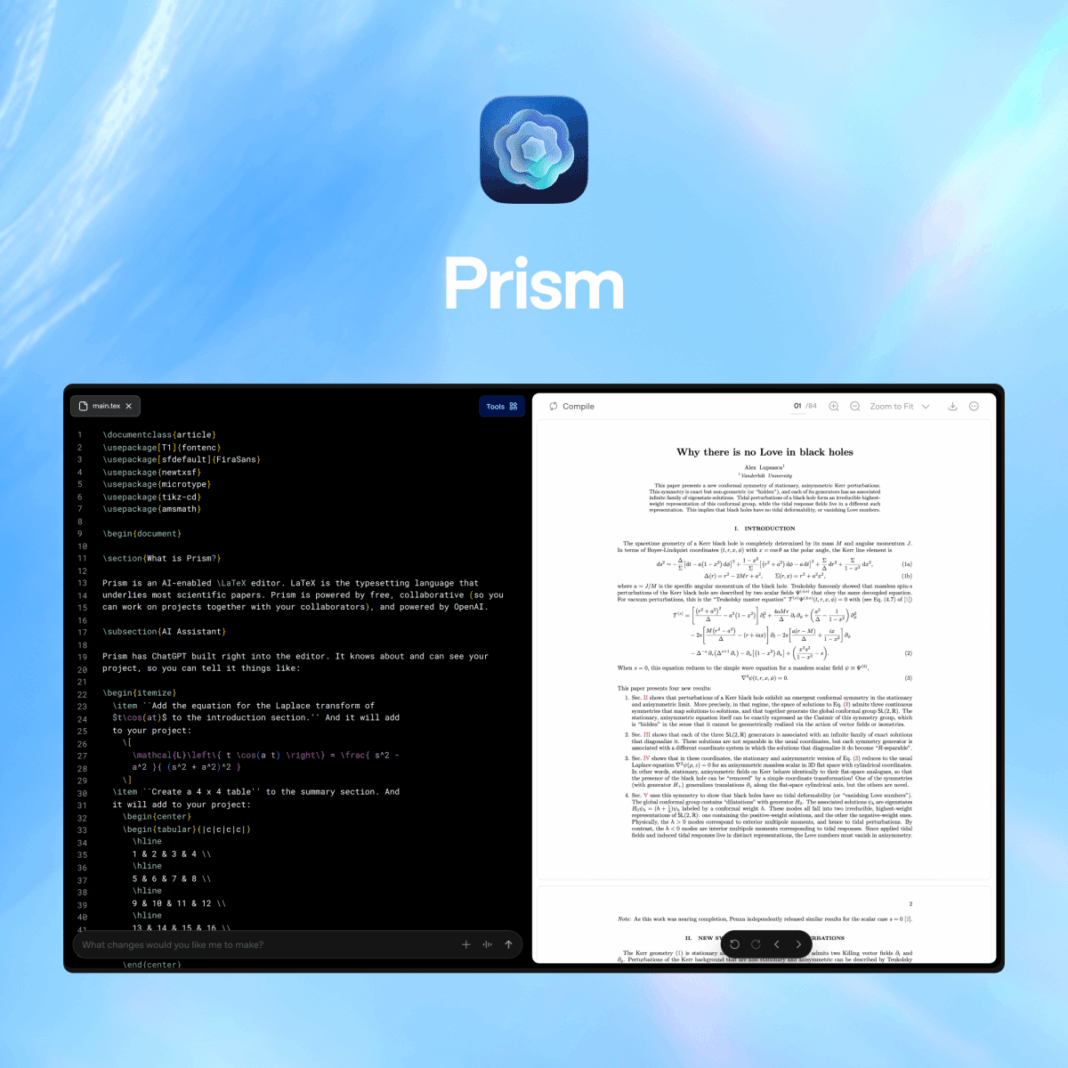
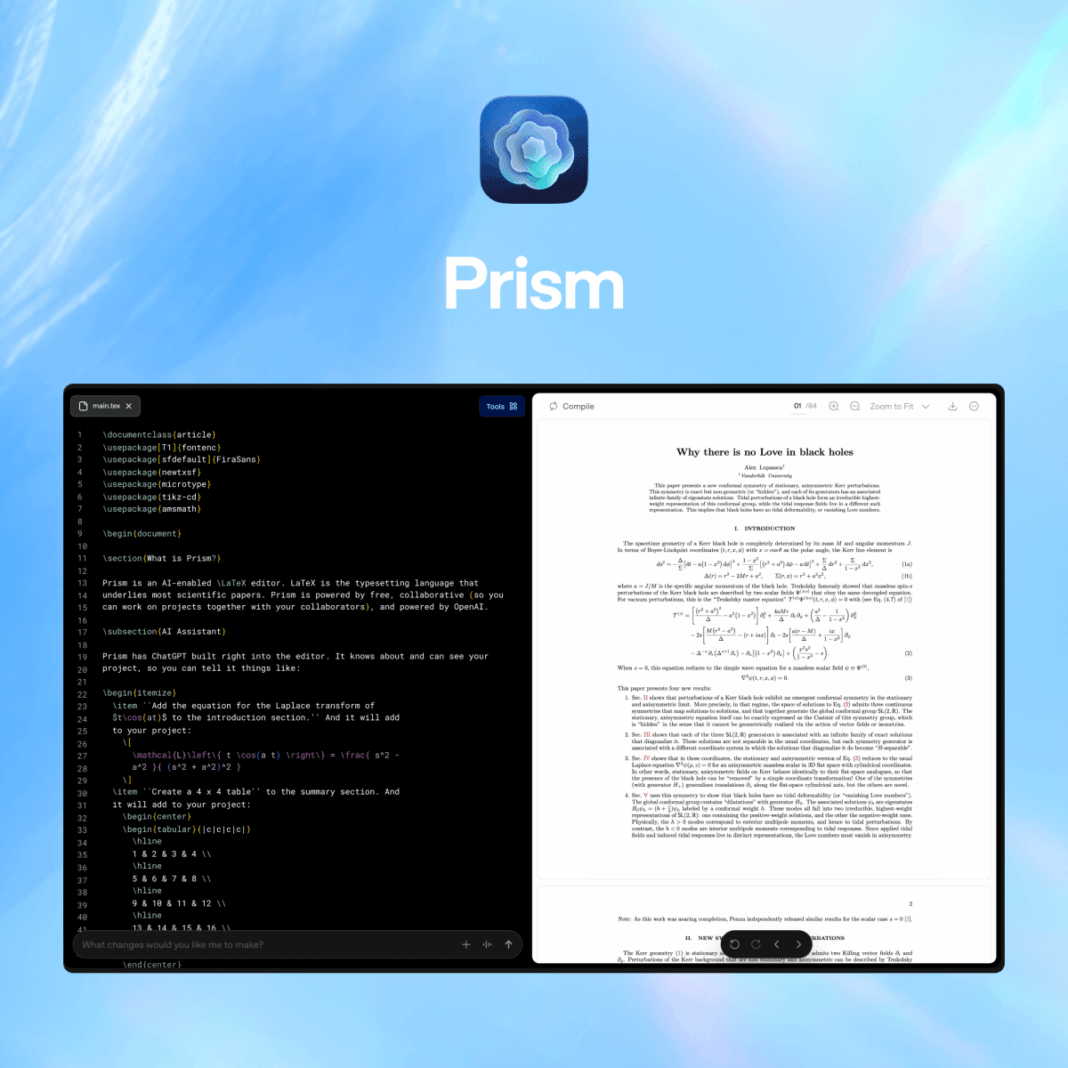
OpenAI launched on Tuesday a new scientific workspace program called Prism that is available for free to anyone with a ChatGPT account. Designed as an AI-enhanced word processor and research tool for scientific papers, Prism is deeply integrated with GPT-5.2, which can be used to assess claims, revise prose, or search for prior research.
Prism isn’t designed to conduct research on its own and without human guidance. Executives believe it will accelerate the work being done by human scientists and compared Prism to coding interfaces like Cursor and Windsurf.
“I think 2026 will be for AI and science what 2025 was for AI and software engineering,” Kevin Weill, VP of OpenAI for Science, said in a press call announcing the tool.
The new software, which is accessed via a web app, comes as OpenAI is seeing a flood of scientific queries coming to its consumer products like ChatGPT. The company says that ChatGPT receives an average of 8.4 million messages a week on advanced topics in the hard sciences — although it’s difficult to know how many are from professional researchers.
AI-assisted research is also becoming more common among academic researchers. In mathematics, AI models have been used to prove a number of long-standing Erdos problems through a combination of literature review and new applications of existing techniques. While the significance of the proofs is still hotly debated, the results have been an early victory for proponents of AI models and formal verification systems.
A statistics paper published in December used GPT 5.2 Pro to establish new proofs for a central axiom of statistical theory, with human researchers only prompting and verifying the model’s work. OpenAI applauded the result in a blog post, presenting it as a model for human-AI collaboration in research going forward.
“In domains with axiomatic theoretical foundations,” the post reads, “frontier models can help explore proofs, test hypotheses, and identify connections that might otherwise take substantial human effort to uncover.”
Techcrunch event
San Francisco
|
October 13-15, 2026
Much of the value of OpenAI’s new system comes from simple product work on existing standards. Prism integrates with LaTeX, an open-source system used to format and typeset scientific papers, but goes significantly beyond most available LaTeX software tools. The program also leverages GPT 5.2’s visual capabilities to allow researchers to assemble diagrams from online whiteboard drawings, which can be a significant pain point with existing tools.
Perhaps the most powerful feature comes from combining the usual powers of an AI model with more rigorous context management. When users open up a ChatGPT window through Prism, the model can access the full context of the research project, making responses both more germane and more intelligent.
Much of that would be possible for a savvy user of GPT-5.2, but OpenAI is hoping that a cleaner interface will draw in scientific researchers more quickly. Weill described it as the same combination of factors that made AI tools so powerful in software engineering.
“Software engineering accelerated in part because of amazing models,” he told reporters, “and in part because of deep workflow integration.”