
This post was originally published on this site.
Pioneering treatment saves identical twins from rare pregnancy condition
 Image source, Brioney Garrett
-
Published
A pioneering procedure using high-powered sound waves has the potential to treat identical twins affected by a serious but rare condition during early pregnancy, a study has found.
Blood flow between babies with twin-to-twin transfusion syndrome (TTTS) is uneven, leaving one baby dangerously small and the other too large, putting their survival at risk.
Brioney Garrett’s identical girls’ lives were in danger during her pregnancy before doctors at a London hospital used the treatment to seal blood vessels causing the problem, without needing an operation.
Following the world-first treatment, Nancy and Margo were born healthy and, now aged four, will soon start school.
Half of the 10 women who took part in the trial required further treatment, and 12 of 20 twin babies survived following the treatment, as reported in the American Journal of Obstetrics & Gynecology, external.
The researchers, from Queen Charlotte’s and Chelsea Hospital, said it was “extremely exciting” to have a non-invasive method to treat the condition, without the need to put a needle or telescope into the mother’s tummy.
But before the procedure can be offered more widely, larger studies on more pregnant women are needed to show it can be an effective treatment.
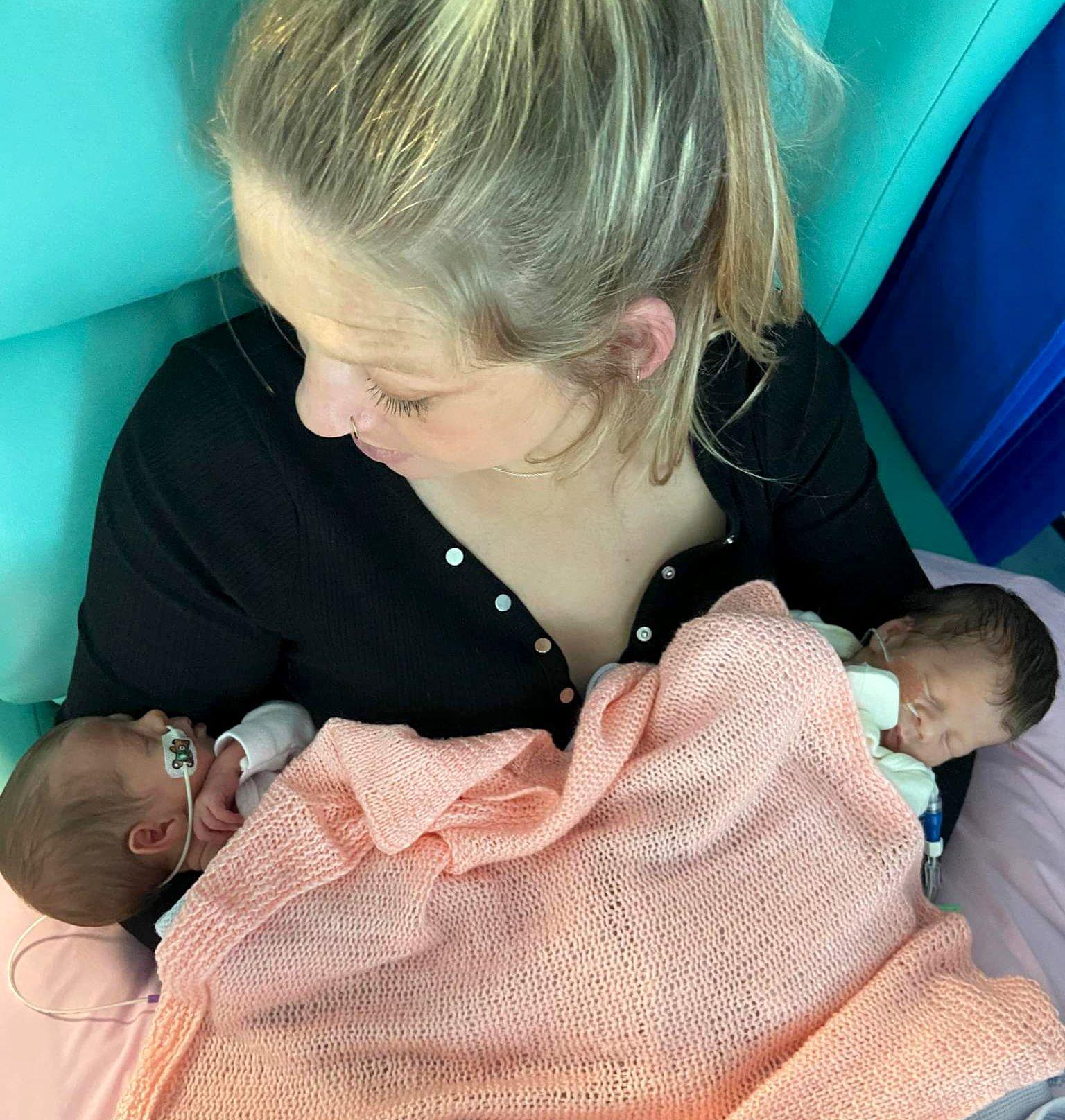 Image source, Brioney Garrett
Brioney said her daughters were “my miracle twins”.
“We were in a very dire situation and I don’t forget that,” she said. “It stays with me always how things could have been. Every day I still count my blessings.”
TTTS affects between 10-15% of identical twins that share a placenta – about 300-400 pregnancies each year in the UK.
The unbalanced blood flow between babies leads to a build-up of excess fluid around the larger recipient baby and a dangerous lack of fluid around the smaller donor baby, potentially harming both.
Usually, treatment involves inserting a needle into the womb to either drain some of the fluid or seal blood vessels using a laser.
Block blood flow
For Brioney, the procedure was more straightforward and took about 20 minutes. She lay flat as a specially-designed machine fired high-powered ultrasound waves at tiny blood vessels in her placenta. “It was very quick and pretty painless,” she said.
Brioney and the other pregnant women, who were from the UK and across Europe, took part in the study after scans detected the condition during early pregnancy.
Prof Christoph Lees, head of fetal medicine at Imperial College Healthcare NHS Trust and professor of obstetrics at Imperial College London, said the research was “very promising”.
“If this could work in a fully-fledged study, it could give hope to a lot of women who otherwise might have to have quite invasive treatment,” he said.
Ultrasound is regularly used in medical scans to produce images of the body, and is known to be very safe – but this type of ultrasound is completely different and much more focused.
The heat created by its beams can seal blood vessels just 2mm in diameter, about 5-6cm below the skin.
The procedure blocked blood flow in 90% of the blood vessels treated as part of the study, and there were no unwanted side-effects.
 Image source, Brioney Garrett
The charity Twins Trust, which supported the study, said the new approach could make a real difference.
“Any procedure that is non-invasive and can potentially identify TTTS earlier and improve outcomes for our families with this life-threatening condition could be a turning point,” said Helen Peck, head of healthcare engagement and research.
Weeks after Brioney’s scan, it was clear the procedure had worked – the blood flow to the babies had been rebalanced, although there were other issues during the course of her pregnancy.
Scans showed Margo, who did not have enough fluid around her, “was in a much better position”, Brioney said, and “the strain on Nancy’s heart had eased”.
The twins were born at nearly 34 weeks – Nancy weighing 3lbs 7 and Margo 3lbs 3 ounces.
“They were both healthy, and Margo wasn’t as small as we worried she was going to be,” Brioney said.
In September, they start primary school. “They’re funny, smart, energetic little girls that just fit right in with their age group,” Brioney said.