
This post was originally published on this site.
Dan HuntEast Midlands

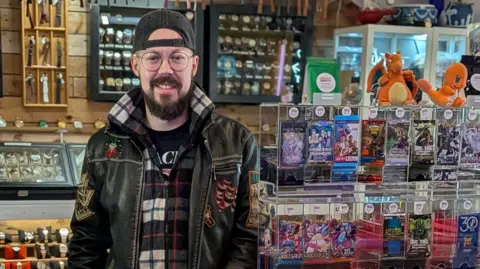 Ashley Hudson
Pokémon is a globally recognised name, from games, to TV and trading cards – it has had a huge influence on the world since it was created and launched in 1996.
As the cultural phenomenon approaches its 30th birthday on 27 February – a spate of thefts has been reported recently across England, targeting gaming stores that sell the world-famous trading cards.
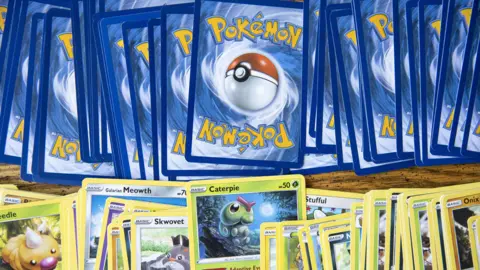
The cards, related to the hugely popular Japanese animation franchise, have soared in value over recent years – with some being sold for thousands of pounds.
But why have they become so desirable, and what causes some of the collectable items to, as one trader put it, be bought “like stocks”?
The UK county of Nottinghamshire has seen four high-profile crimes involving Pokémon cards in recent weeks.
On 29 December, police made two arrests after thieves smashed through a brick wall to steal Pokémon cards worth an estimated £10,000 from a warehouse.
Using CCTV footage, police were able to track the van to a storage yard, where two men were “caught red-handed” moving the boxes of cards.
Four days later, the BBC reported a trading card shop owner’s “heartbreak” after a burglary at Jakes Breaks trading card shop in the county.
CCTV footage showed two people smashing their way into the shop and stealing thousands of Pokémon and other collectable trading cards, before fleeing and dropping some of the items as they left.
Police said they were pursuing several lines of inquiry in relation to the Nottinghamshire break-ins.
Ch Insp Paul Hennessy said: “We have identified a number of potential suspects – and our inquiries remain ongoing.
“The instances are clearly very similar in nature, and at this time, although we are not linking them, we are keeping an open mind.”
A day later, Nottinghamshire Police confirmed inquiries were under way after thieves targeted The Dice Jail in Southwell on 25 December, and Sanctuary Gaming Centre & Coffee Shop in Sutton-in-Ashfield on 26 December.
Cash and cards from Pokémon, Star Wars, Spider-Man and Warhammer were among the items stolen.
Thefts related to the franchise have not been confined to Nottinghamshire, though, with Pokémon cards targeted from stores and private collections around the country – and across the globe.
In May, a man was arrested by Greater Manchester Police after officers discovered a stolen haul of rare Pokémon cards worth an estimated £250,000.
And in November 2024, Sussex Police said it returned a stolen rare Pokémon card worth up to £30,000 after it was listed for sale on Facebook.
Ashley Hudson, director of antique shop Silver Fox – based in Nottingham – has a Pokémon cards section called Zone 21.
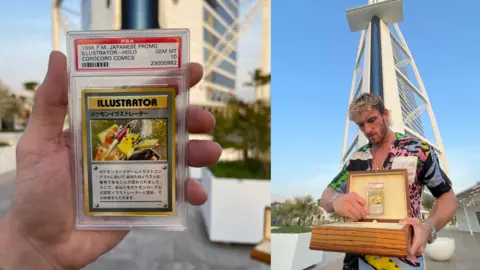
He believes a lot of recent interest in the cards stems from YouTuber Logan Paul wearing a Pikachu illustrator card – which is regarded as the rarest Pokémon card – around his neck for WrestleMania, a major wrestling event in April 2022.
“That ignited the Pokémon market overnight,” Hudson said.
He added there was a “celebrity culture” around the cards with Jake Paul, Logan Paul’s brother, and others opening packets of them on TikTok, which he said caused an “instant blow-up” in demand.
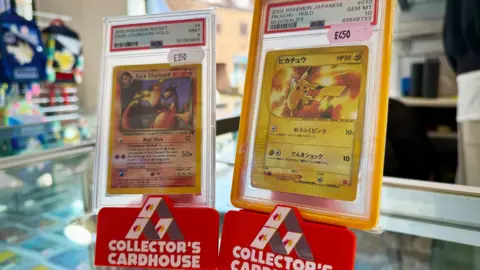
The Pikachu illustrator card worn by Logan Paul is now under the hammer until 16 February, with bids worth more than $5m (£3.7m) having been placed.
But Amy Wosley, manager of Dice Cup – a board game cafe based in Nottingham – was less sure interest from these high-profile internet figures had a “large impact” on prices.
However, she felt it brought their fans into the world of Pokémon – with mixed consequences.
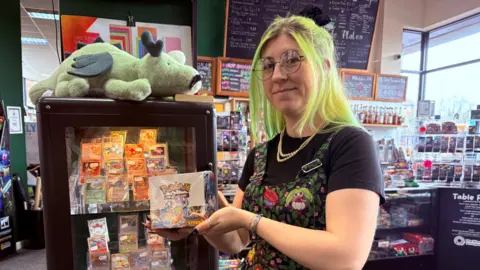 Amy Wosley
“They don’t like the hobby. They’re not into the hobby for the passion, for the Pokémon and for the nostalgia that we’ve built over the years,” Wosley said.
“They are trying to make a quick buck and unfortunately, I think some of those influences have been large, especially when you have the likes of Logan Paul who are saying, ‘look how much money these cards are worth’.”
Wosley compared the buying and selling of Pokémon in this manner to the trading of limited edition trainers.
“Pokémon’s almost become a little bit like that,” Wosley said.
Playground trading
Another element Hudson attributed to their rise in desirability were the cards becoming a “vintage” product to many.
“To us that’s strange because I’m a ’90s kid, and to be told something like that is now vintage is bizarre,” he said.
“So, it became vintage and then everybody started getting interested and there was just a massive revival.”
Lee Fowler is the director of Phantom Cards UK – which has been running pop-up stores over the last three years, but is now opening a store in nearby Chilwell in Nottinghamshire.
He said when he first started selling cards, he could get hold of the collectable items without a problem, but now found it more difficult.
“It gets hard for me to get packets now,” he added.
Fowler listed nostalgia as a key reason why demand for cards had risen and said he got back into the card franchise after finding his old Pokémon collection in an old Quality Street tin at his parents’ house.
He believes people are nostalgic for the cards as it brought back memories of trading them in the playground as a kid.
“Most of us were mad for Pokémon back in the day and it just brings back all the memories,” he said.
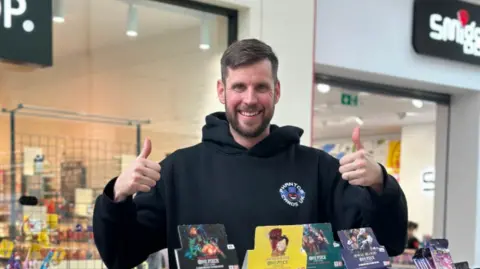 Lee Fowler
According to Wosley, demand for Pokémon cards “went off the rails” when the Surging Sparks set was released in November 2024, and said prices “boomed out of nowhere”.
“That led to a huge spike,” she said. “It was colossal and it was so unexpected from both stores and from what we can tell from our suppliers, they were shocked by it too.
“People knew it was going to be popular, but we didn’t expect this huge surge of new Pokémon players and collectors – even the kids were getting back into it on the school playground.”
Wosley added the number of cards entering the market had now increased, which she said should settle down the market and stabilise prices as it reduced the scarcity element of some items.
 Getty Images
But business owners like Hudson believe the cards remain a “liquid asset”, which mean they can easily be turned into cash at full-market price.
“So if someone steals a Pokémon card they can resell it,” he said. “That’s where this whole problem is ignited from.
“This, and people are buying Pokémon cards as if they are stocks.”
According to a report published by Research and Markets, the industry was valued at $7.8bn (£5.8bn) last year, and was forecast to be worth $11.8bn (£8.9bn) in 2030.
 Nick Jarman
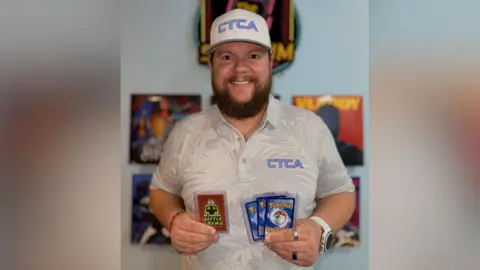
The Certified Trading Card Association – based in the United States – said there had been a “large rise” in the number of thefts targeting US trading card stores.
Chief executive Nick Jarman explained Pokémon cards had become “high value”, as well as a “highly liquid” product, which were “really hard” to trace on secondary markets.
“We’ve seen the continued growth of online resale, and so that’s really lowered the friction for criminals because stolen goods are being moved very quickly across platforms and borders,” Jarman added.
Prof Emmeline Taylor, a criminologist at City St George’s, University of London, told the BBC amid a “retail crime epidemic”, criminals were operating with an “increased precision focus” on items they can steal in bulk “relatively easily” and sell on for profit.
“I think that’s where we’re seeing this step change and that emphasis on items that are very desirable, collectable and also increasing in price,” Taylor said.
 City St George’s, University of London
Shoplifting offences recorded by police in England and Wales were up 13% in the year to June 2025, with 529,994 instances recorded, according to the Office for National Statistics.
Taylor added: “Anything that has that collectable element means that not only can you generate an instant resale of that stolen item, but you might potentially be able to sell it on for more than the RRP [recommended retail price] because suddenly it becomes a rare or particularly desired issue or edition.
“In terms of collectables, we know that there’s this growing market, so I’ve called the criminals that have latched on to this the shoplifting entrepreneurs.
“They’re individuals that we would not necessarily expect to steal or commit other offences.”
She explained that “shoplifting entrepreneurs” knew how to sell a product they were familiar with into the right market “almost immediately”.
“That’s why we’re seeing this sort of shift in criminal behaviour,” she added.
 Danny Fullbrook/BBC
Back in Nottinghamshire, Wosley added her business, The Dice Cup, had also been targeted by thieves “a lot” in recent years, with their most recent break-in about a year ago.
“It’s just really disheartening because it’s such a delightful hobby and it’s so wholesome and then moments like that really break your heart,” Wosley said.