
This post was originally published on this site.
Glenn Webbe was a hugely popular Wales rugby international who became an interior designer after retiring. Then, everything chnaged
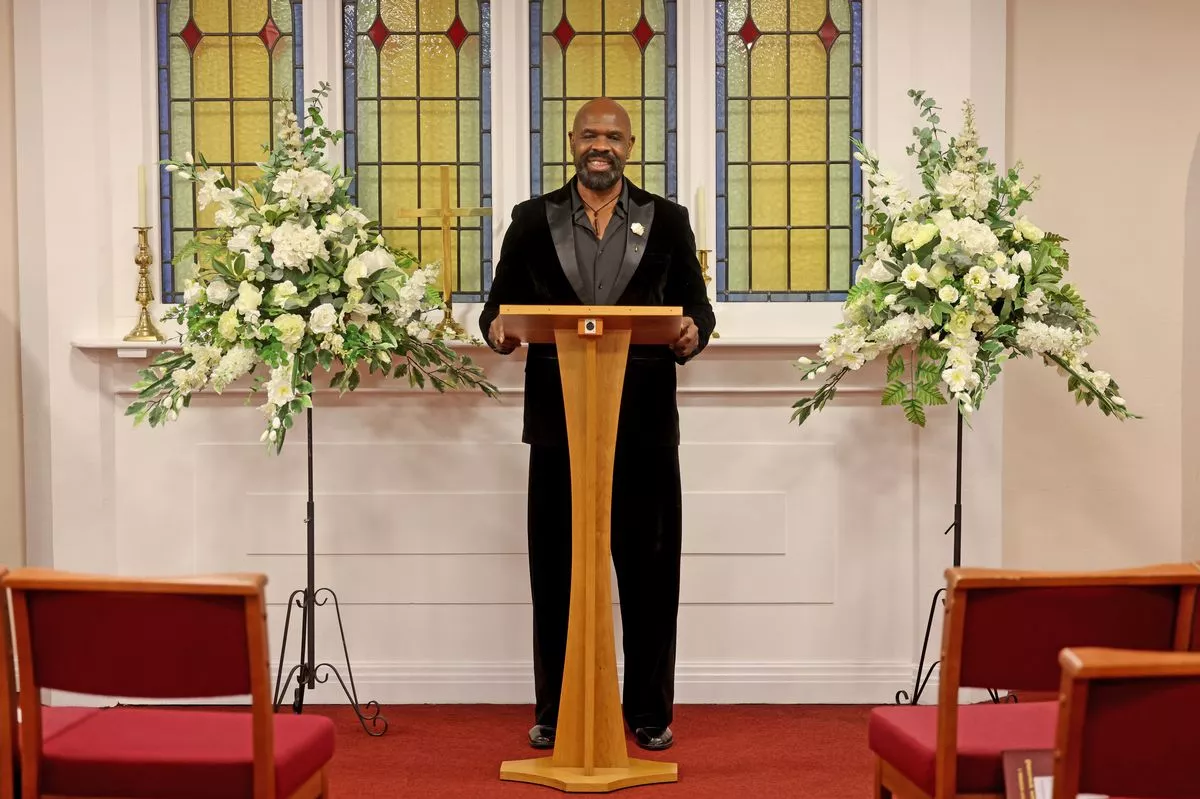
Former Wales rugby star Glenn Webbe has changed his purpose in life(Image: Jonathan Myers)
Having finally recognised his own achievements, Glenn Webbe is now celebrating the lives of others.
By his own admission, he hadn’t always fully appreciated a rugby career which saw him battle away to become one of the first black men to play for Wales. It also took him a long time to overcome the nerves and lack of confidence which afflicted him both as a player and after hanging up his boots.
But now he has done just that by making a radical career change to become a celebrant, specialising in fronting bespoke funeral services.
It’s some shift after years of working in interior design, but it’s a new role which he finds hugely rewarding.
As he reveals during an open and honest conversation, the seeds were sown by a couple of instances involving people who were coming towards the end of their lives.
“A friend of mine had stage four cancer and wasn’t given long to live,” he explains.
“One day, I saw him in the supermarket, but he didn’t see me.
“I was a bit embarrassed and wasn’t sure what to say to him really. It would have been an awkward situation, so I scarpered basically without speaking to him or asking about his welfare.
“He passed away a couple of weeks after that and I just felt awful.
“I had made it about me. He’s dying and there’s me thinking ‘Oh, I don’t know if I’ve got the time to spare’.
“That really rankled with me and I was thinking ‘Why did I do that?’
“I knew I should have spoken to him and, ever since, I have been putting myself out there, awkward conversations or not.
“Then earlier this year, a good friend of mine, Gordon Pritchard, who used to be director of rugby at Caerphilly, passed away.
“With the other incident in mind, I went to see him in Velindre Hospital towards the end.
“He was just so pragmatic and so dignified. He had accepted his situation, his fate. He had come to terms with it. That made it so much easier for me and I was able to ask him questions which I thought were relevant.
“I asked him if he had any regrets and he said ‘Yeah, there’s a couple of people I wish I had knocked out!’
“Gordon was always a straight-talker!
“Four days later he passed away. Just before he died, he sent me a lovely message and I still look at it and it fills me with joy.
“It made me think I wanted to do something to help people deal with loss and grief and to celebrate the lives of their loved ones.”
The former winger continued: “I had been involved with interior design for years. I had a company for 20 odd years, doing kitchens, bedrooms, everything. That took a tumble during Covid.
“My dad passed away and then my relationship took a tumble after I had been married for 30 odd years.
“It seemed like I had reached a fork in the road.
“I got to the point where I decided I was just going to start doing things.”
So Webbe undertook a training course with the academy of professional celebrants and has set up a business called Cradle to Grave Celebrations.
He can officiate at weddings or funeral services, with the latter being his primary focus.
“I find doing funerals more rewarding,” he says.
“I will arrange a family meeting beforehand and it’s amazing seeing it go from sorrow to joy.
“They are talking about their loved one for an hour or so and remembering things they had forgotten.
“In the end, they are so happy and that’s what memories do. The good times outweigh the bad times.
“I then put together a bespoke service. It’s whatever the wishes of the bereaved and their family are. It’s making it personal to them.
“Sometimes they want a couple of hymns or their favourite songs. In some cases, they don’t want people to wear black and want them to wear a colour instead. It’s fulfilling the wishes of the deceased.
“Sometimes, a family member will want to say something or read a poem.
“Then I will generally do a eulogy, speaking about the person that has passed away. It’s an honour to do it.
“You are celebrating a life. You stitch it all together from speaking to friends and family to get the real rounded picture of the person. Everybody learns something at a funeral that they didn’t know about the person that has passed away.
“It’s telling someone’s life story. It’s very rewarding. I love doing it. It’s celebrating a life well lived.”
Webbe knows from personal experience just how hard the grieving process can be.
“When my mother passed away in 2011, I wasn’t feeling as sad as I thought I should and I couldn’t understand why,” he reveals.
“Then six months later, out of the blue, I just thought of her and I hit the floor and was crying like a baby.
“The grief came pouring out. I had been on automatic pilot up to then. A lot of people are like that where they don’t know how to deal with grief.
“But grief will always come out in the end.
“So I think you have to feel what you feel when you are feeling it really and not suppress it because if it does force its way out it can be damaging.
“I wanted to do something to make it ok to grieve and to help people with the process. I suppose I have reached a fork in the road where I give a damn now. It’s a funny old thing.”
The 63-year-old former Bridgend star also conducts Living Wakes, celebrating the life of a terminally ill person.
“It’s the closest thing to attending your own funeral. It’s a kind of ‘This is your life’ type of event,” he explains.
“It’s to celebrate their lives while they are still here with us.
“It tends to be people who are in the terminal stage, but who have come to terms with it.”
Webbe’s new career involves a lot of public speaking, something he would never have imagined himself doing in years gone by.
He readily admits that he used to suffer from worries and anxieties as a player.
“People used to call me a bit of a joker, but that’s how I used to deal with it and dilute it,” he says.
“I would have a laugh and try to make light of certain things.
“But, behind it all, I was concerned about my performance and getting everything right. People think I am a confident fella, but we all doubt ourselves.
“I have always used humour as much as I can. That’s how I tackled things really, a bit of deflection I suppose.”
The lack of confidence continued once he finished playing as he avoided the spotlight.
“People used to come on to me and ask if I would speak at such and such an event,” he says.
“For years, I was getting those opportunities, but I wouldn’t do it because I was too nervous and I didn’t think what I had to say was relevant or valid.
“So I would say ‘Better than that, I will get Jonathan Davies to speak’.
“People would end up coming to me to try and get guest speakers. I would get somebody to do it, hiding the fact that I was a coward and too scared to do it myself. I was just too nervous to speak.
“I have been a best man about seven times and people would say I was great when I spoke. But I was so nervous every single time. It would kill me. I couldn’t eat, I would be sweating for ages beforehand.”
Then, however, came something of a eureka moment.
“A few years back, someone asked me to do a dinner where there was a Q&A and I said ‘Ok, I will do it’.
“They asked me a question and I thought ‘I know the answer to this. This is about me, that’s fine’.
“It turned out all the questions were about me and I knew the answer to those! That was the moment the penny dropped.
“I wasn’t going to be compared to Jiffy or Phil Steele. That’s not what they were asking for. Basically what they wanted was my opinion, my story. That was a bit of a revelation and I went on to do quite a few events.”
So when it came to his new career as a celebrant, Webbe was able to take on speaking duties with a fresh mindset.
“I have enjoyed doing it. I have put my big boy pants on and put myself out there,” he said.
“I have basically changed my nerves to excitement. That’s what gives me the courage to do it.
“I convince myself I am excited rather than nervous and it seems to do the trick.”
He is also able to see his rugby career in a different light now.
When our conversation moves on to that subject, I point out to him that next year will mark the 40th anniversary of him winning his first Wales cap.
“Wow!” he exclaims in response.
“It shows that time really does go, doesn’t it?
“Who would have thought it? It doesn’t seem like that length of time.”
Webbe was born in Cardiff, as the only boy among eight children, with his parents Mike and Islyn having been part of the Windrush generation, travelling from St Kitts on the Queen Mary and settling in Ely.
Starting out his rugby journey with Canton RFC, he went on to make his name as a prolific try scoring winger with Bridgend.
But, despite his exploits, the Wales call didn’t come his way for a number of years.
“It was very difficult for me to get selected for whatever reason,” he says.
“It was weird. I just couldn’t get in. It was a funny old thing. I didn’t feel like I was wanted.
“I trained harder and fought harder than most people because I knew I had to swim upstream to get what I wanted. I was always trying to show what I could do, running hard, tackling hard. The ambition was always there driving me on.
“In the 1984-85 season, I scored four tries against Llanelli, a hat-trick against Cardiff and two against Aberavon.
“But when they announced the Wales squad for the game against Fiji in the autumn of 1985, I wasn’t in it, while the wingers who I had scored against were.
“People were always saying to me ‘Why aren’t they picking you? It’s because you’re black, isn’t it?’
“I knew I was always going to be black. That was never going to change, so I couldn’t allow myself to think like that.
“But that omission made me think ‘Right ok, it’s true what people have been saying’.”
As a result, Webbe decided to head for foreign fields.
“I had an invitation to go and play for Biarritz out in France and I decided to go over there.
“In those days, you had to apply to the WRU for a licence to play abroad. So I applied, but they wouldn’t give it to me.
“I was thinking ‘They don’t want me, but they don’t want anyone else to have me, what’s going on?’
“It was really unfair. I was scoring tries for fun and I just wanted to go where I was appreciated, but I couldn’t move.”
However, in the summer of 1986, his fortunes finally changed when he was called up for the tour of the south seas, making his Wales debut as a replacement against Tonga and starting the Test versus Western Samoa.
“It was based on the fact I was going to leave, I suppose,” he says.
“It felt like it was by default in the end. There was just nobody else left for me to beat!”
Webbe went on to start three games in the 1987 Five Nations, including the 19-12 victory over England in Cardiff, a game remembered for its violent opening, with four English players subsequently being suspended by the RFU.
Then came that summer’s inaugural World Cup and an outing against Tonga in Palmerston North on New Zealand’s North Island
Webbe scored a hat-trick of tries, but, to this day, he has no recollection of his third having been knocked out some minutes earlier.
“Back in the day, you could only have two substitutes and we had used both of ours,” he says,
“So if I had gone off, we would have been down to 14 men.
“I was knocked unconscious and I should have been taken off, I should have gone to hospital. But they revived me and put me back on the field.
“I have seen my third try so many times, it’s like a second hand memory. It’s not a real memory. Ringo passed me the ball and I ran the length and scored the try. But I didn’t know where I was.
“The next morning then, they came in and said I was going to have to go home. They said they were thinking of me and that it was for my own good.
“I said ‘If you were thinking about me, you would have taken me off when I got knocked out and sent me to hospital’.
“They kept me on because otherwise we would have been down to 14 men and could have lost.
“There was no concern when I got home, not even a card to say how are you, no follow up to make sure I was ok.
“It just shows how much the game has changed.”
The following season, Webbe figured as a replacement in the 1988 Grand Slam decider against France in Cardiff and started the first Test of the summer tour of New Zealand, lining up versus the mighty All Blacks in Christchurch.
Then, in December of that year, he won his tenth and final Wales cap against Romania.
He carried on playing for Bridgend, with his illustrious 14-year stint with the club finally coming to an end when he called it a day in 1995.
So, some three decades on, does he look back at his career with pride?
“I do now. At the time, when you are a certain age and you are just doing it, it’s other people that give you the acclaim. You don’t realise the magnitude of your achievement.
“You are trying to get validation, the pats on the back. You want people to validate you for what you have done.
“But now it’s an internal thing and it’s pride. I can say look what I achieved against the grain, against all odds. Most of the people I know haven’t played rugby for Wales.
“I am quite proud of myself for what I achieved because of how it had to happen for me, being the colour that I am.
“I look back now and although I was privileged to play for Wales, I know it wasn’t a short cut. I took the long way round.”
As for what rugby gave him, he says: “It’s definitely the friendships and the camaraderie, without a shadow of doubt. That was everything for me.
“I stayed in the game because of the fun and the friendships. Basically, the fun I had playing with Canton Youth was exactly the same fun I had playing with Mark Ring on the world stage.
“I do think rugby offers something. It is like a religion to a degree. Wherever you are in the world, no matter what level you play at, if you bump into someone that plays rugby, you compare journeys. It’s amazing, it really is.
“It’s like life itself the way the game is structured. You can’t do it all on your own. You have got different people with different qualities, different strengths and abilities, but they all have to come together to create a whole.
“This is why the best team will always beat the best players because there is that unity, that understanding and commitment.
“Looking back, I would do it all over again, absolutely.”