
This post was originally published on this site.
Should Argentina take Messi off penalties?
-
Published
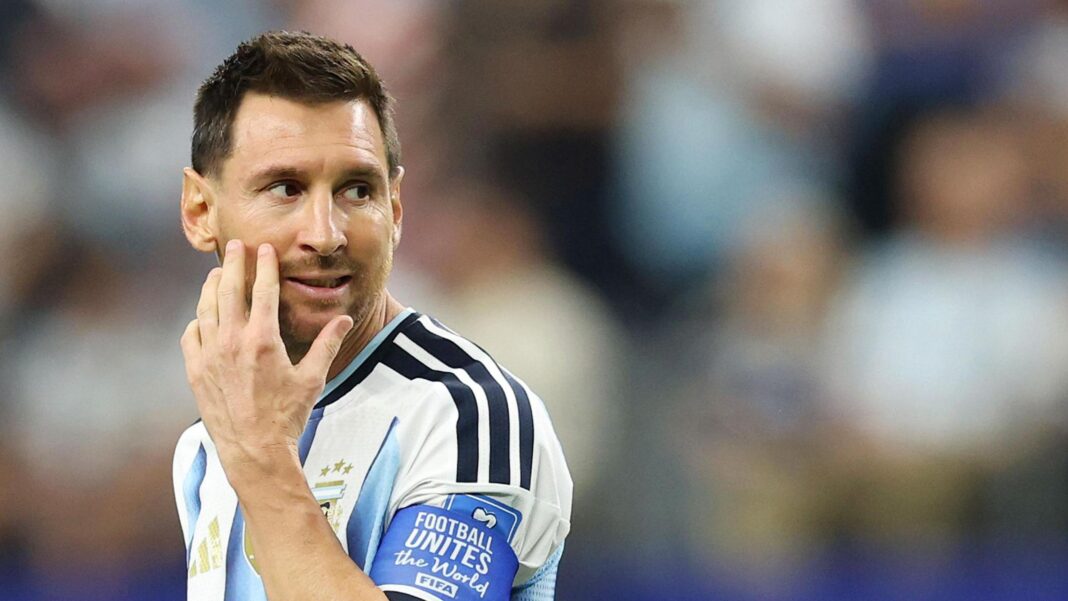
With every game that passes at the 2026 World Cup, Lionel Messi strengthens the case that he is the greatest footballer the game has ever seen.
The Argentina captain once again dragged the defending champions deep into the knockout rounds.
Against Egypt in the last 16, he produced another match-defining performance, scoring once and creating another as Argentina recovered from 2-0 down with little more than 10 minutes remaining to complete one of the most incredible comebacks in World Cup history.
Along the way he broke even more records. He became the oldest player ever to score and assist in a World Cup match, extending a record he already held.
It was the fifth time he had both scored and assisted in a World Cup game, with no other player managing the feat more than three times since records began in 1966.
In addition he moved clear as the competition’s all-time leading assist provider with nine, overtaking Diego Maradona, while his latest strike was another addition to his growing collection of knockout-stage goals.
But he also set another, unwanted, record from the spot.
So, amid another exhibition of genius, one question refuses to disappear. Should Argentina take penalties away from him?
It feels almost absurd to ask about a player who has spent more than two decades redefining footballing excellence. Messi has scored virtually every type of goal imaginable and has won everything there is to win.
But from 12 yards, the numbers tell a very different story.
To play this video you need to enable JavaScript in your browser.
This video can not be played
-
Is it time to give record-breaker Pickford the credit he deserves?
-
Published6 hours ago
-
-
Who am I? Guess World Cup star No 34
-
Published2 hours ago
-
-
England set for open-air Miami heat – but do Norway hold the edge?
-
Published6 hours ago
-
Messi’s one remaining weakness
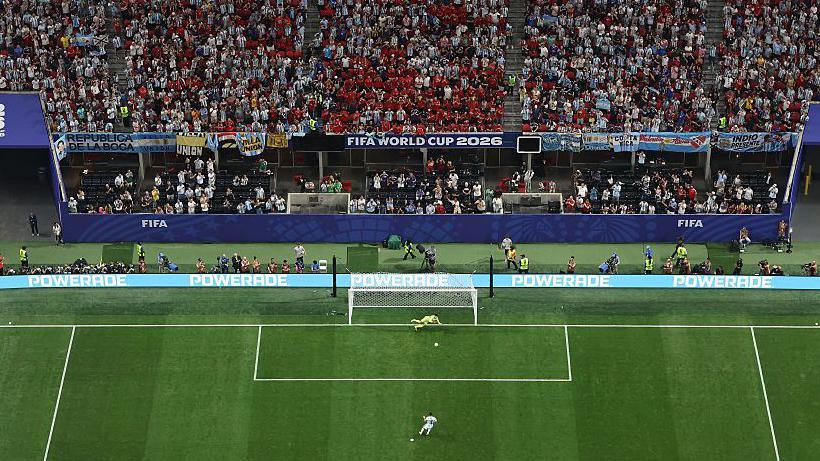 Image source, Getty Images
Against Egypt, Argentina were handed the ideal chance to respond after Nicolas Tagliafico was brought down in the penalty area with the score at 1-0.
Messi stepped forward, but his effort lacked both power and placement. Goalkeeper Mostafa Shobeir guessed correctly and made a comfortable save.
It ultimately did not cost Argentina. Messi inspired their astonishing comeback, with Cristian Romero reducing the deficit before the eight-time Ballon d’Or recipient equalised and Enzo Fernández completed a dramatic 3-2 victory in stoppage time.
But for much of the afternoon it looked as though the missed penalty would define Argentina’s exit.
It was also Messi’s second missed penalty of the tournament after failing from the spot against Austria in the group stage. No player in World Cup history has ever missed two penalties in normal time at a single edition.
Across his World Cup career, excluding shootouts, Messi has now converted only four of his eight penalties.
Messi himself acknowledged the latest miss weighed heavily on him. The 39-year-old admitted he broke down after the final whistle despite Argentina’s dramatic victory. “I cried because I felt that I let my team-mates down because of the penalty I missed, and the way I took it,” he said.
Numbers behind the misses
The broader numbers are hardly stellar either. Including penalty shootouts, Messi has converted 117 of his 151 penalties for Barcelona, Paris St-Germain, Inter Miami and Argentina, missing 34.
Excluding shootouts, Opta records show he has scored 114 of his 148 attempts, a conversion rate of 77%. That would be respectable for most players, but it is merely average compared to the best.
Across the ‘Big Five’ European leagues, the Champions League and the World Cup, Harry Kane has converted 90.7% of his penalties, Cristiano Ronaldo 85.2%, Erling Haaland 84.1% and Kylian Mbappe 81.0%. Messi’s corresponding figure is 78.8%.
Opta values every penalty at approximately 0.79 expected goals, reflecting the historical reality that about 79% of spot-kicks are converted. So, by that measure, Messi has actually scored penalties at a slightly lower rate than the average player.
The contrast with his finishing from open play is striking. At World Cups, Messi has scored 17 non-penalty goals from chances worth approximately 13.1 expected goals, outperforming expectation by almost four goals.
Few players have ever finished chances better than Messi. Few elite forwards have underperformed penalties quite like him. So why?
One common misconception is that left-footed players are naturally less reliable from the penalty spot. The evidence suggests otherwise. While left-footed penalty takers are less common simply because left-footed players are rarer, goalkeepers generally find them slightly harder to read.
Interestingly, the actual reason may also lie in the very qualities that have made him a phenomenon.
Messi’s genius has always been rooted in improvisation. Penalties, however, demand almost the opposite. The qualities that make Messi virtually unstoppable in open play may, paradoxically, make him less consistent from 12 yards.
Unlike renowned penalty specialists such as Kane and Poland’s Robert Lewandowski, who rely on highly repeatable routines, Messi frequently varies his approach. Often, he waits for the goalkeeper to commit before deciding where to place the ball.
The theory is simple: wait for the goalkeeper to move, then place the ball into the opposite corner.
The drawback is equally straightforward. If the goalkeeper refuses to commit early, the penalty taker is forced into a late decision while taking his eyes off the ball at precisely the wrong moment, increasing the margin for error.
That challenge has only grown in the modern game. Goalkeepers and analysts now have access to extensive video footage, data and penalty maps, allowing them to study opponents’ run-ups, body shape and preferred techniques in forensic detail.
Does Scaloni make the change?
There is, however, another complication. Replacing Messi as Argentina’s designated penalty taker is far easier in theory than in practice.
Who tells arguably the finest player the sport has ever produced that somebody else should take responsibility?
Former Manchester United and Republic of Ireland captain Roy Keane admitted during ITV’s coverage that he no longer expects Messi to score penalties.
“For a great player,” Keane said, “he almost lacks belief in himself.”
Ian Wright was less than convinced Argentina could simply hand the job to somebody else.
“Can you imagine being in that dressing room?” Wright asked. “Who’s going to say to Messi, ‘No, I’ll take them’?”
Argentina are not short of alternatives. Among current members of Lionel Scaloni’s squad, Leandro Paredes has converted 92.9% of his competitive penalties, while Alexis Mac Allister and Enzo Fernandez have each scored 91.7% of theirs. Julian Alvarez sits at 89.5%.
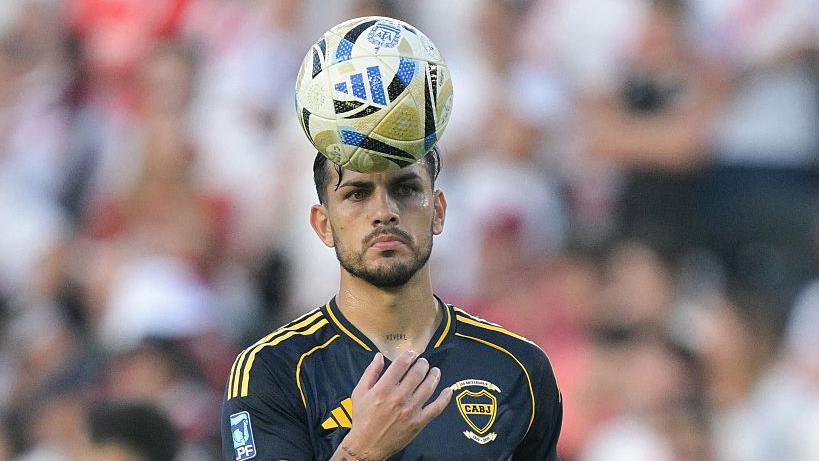 Image source, Getty Images
Messi has taken penalties in World Cup finals, Copa America finals and Champions League knockout ties.
He has taken Argentina’s opening penalty in nine shootouts, converting seven, with his only misses coming against Chile in the 2016 Copa America final and Ecuador in the 2024 Copa América quarter-final.
Perhaps that explains why Lionel Scaloni has shown no inclination to make a change. Asked directly on the eve of Argentina’s quarter-final against Switzerland whether Messi should remain on penalties, the Argentina coach offered an unequivocal answer.
“First of all, Leo will take penalties if he wants to,” Scaloni said. “We have other players capable of taking them, but if he wants to take them, he’ll take them.”
It is also worth remembering that Messi’s greatest tournament from the penalty spot came only four years ago.
At Qatar 2022 he converted six of his seven penalties, including setting Argentina on their way by scoring the opening kick in the shootouts against both the Netherlands and France en route to lifting the World Cup.
This tournament has been different. The misses have returned. On both occasions, Messi has rescued himself, but the debate is unlikely to disappear.
No team have been awarded more penalties across the last two World Cups than Argentina. They have received eight since 2022 – double the tally of any other side – including a record five during their victorious campaign, and three already in 2026.
On both occasions Messi has missed from the spot in this tournament, Argentina have survived. A third opportunity may not bring the same outcome. The margins will only become finer.
And that is why, uncomfortable though it feels, there is now a genuine conversation to be had. Not about Messi’s place among football’s immortals, but about whether, for the remainder of this World Cup, somebody else should be taking penalties during normal play.
-
-
Published5 hours ago

-
-
-
Published2 July

-