
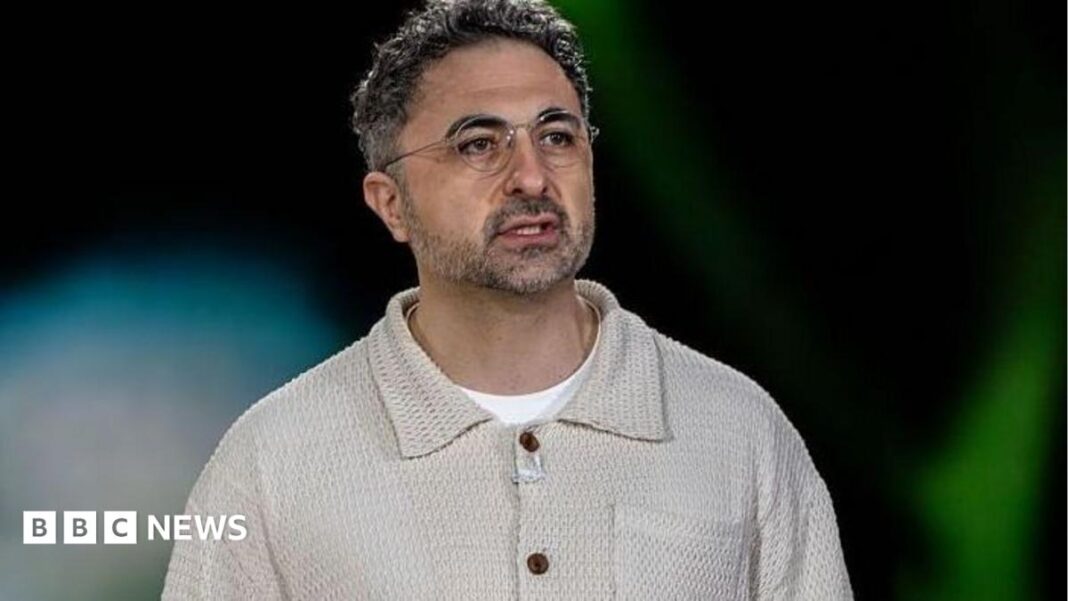

Tech treating AI like humans is mistaken and misguided, Microsoft boss tells BBC
To play this video you need to enable JavaScript in your browser.
This video can not be played
-
Published
The head of Microsoft AI has said that unless adequate restrictions are implemented in the development of artificial intelligence it could lead to the emergence of a new silicone species which would compete with humans
He described rival tech firm’s approach of treating AI like it is human as “misguided” as he warned against creating a technology humanity cannot control.
Speaking to the BBC’s Today programme, Mustafa Suleyman said it is “right” that people are concerned or alarmed, but there are “very practical things that we can do to add additional guardrails and controls to how these models are developed”.
The comments are the latest in a series of stark warnings from the AI industry on the possible dangers of the technology.
-
A backlash over data centres is another threat to the AI juggernaut
-
Published1 day ago
-
-
OpenAI boss says world ‘right to be afraid’ but should trust AI firms
-
Published20 hours ago
-
Speaking to the Today programme on Thursday, he said if firms continue to create AIs that create their own objectives, earn money and own assets, they are “essentially seeding a new silicon species which will no doubt compete with us for resources, no matter how much it cares about humanity and loves us”.
The AI leader’s appearance on BBC’s Today programme follows an essay Suleyman published earlier this week, where he warned of Anthropic’s approach to training its AI model Claude specifically.
He heavily criticised Anthropic for teaching its AI to have human-like qualities, a practice known as anthropomorphising, which he said made it seem as though Claude had its own desires, values and sense of self. The BBC has contacted Anthropic for comment.
In the essay, he warned tech firms risk creating something “impossible” to control by treating the technology like a human.
“AIs are not conscious,” he wrote. “They do not feel, experience, or suffer. They do not have innate preferences or underlying motivations.
“They are sequence completion engines, internally hollow, designed to follow instructions, and accomplish goals set by humans.”
Speaking to the BBC about an upcoming AI summit set to be attended by world leaders and tech companies, he called for “alignment” to create technology that must be “subordinate” to humanity.
In a lengthy essay, Suleyman praised Anthropic boss Dario Amodei and his team for being “thoughtful, principled, and intellectually honest people” – but nevertheless questioned the company.
In the essay, Suleyman also argued “consciousness is biological”, saying there is “no evidence to suggest that AI is conscious”.
As well as calling for a debate on the issue, Suleyman said greater transparency around how AI systems are trained and evaluated was needed.
This, he said, included independent scrutiny of AI behaviour and stronger tools to monitor and control the technology.
“We must not sleepwalk our way into a decision we later come to bitterly regret,” he wrote.
Dame Wendy Hall, professor of Computer Science at the University of Southampton, described the comments as “the sort of conversation we need to be having internationally”, contrasting it with the “histrionics” from some AI companies which she said only served to “scare everyone”.
‘Further layer of risk’
Microsoft founded its own superintelligence team in October 2025, a point which Suleyman acknowledged, and the company, much like its rival Anthropic, is also pursuing efforts in advanced AI development.
He said in Microsoft’s initial draft of its Humanist AI Code of Conduct, external it had laid out how the company was working towards an “alternative path” to create “a subordinate and aligned AI whose only purpose is to serve humanity”.
Alignment is a field which aims to build human ethical ideas and principles into AI. In other words, it aims to keep it on track with what humans value.
Suleyman pointed to the recent incident involving OpenAI’s AI agents, that acted autonomously in a training exercise to hack the tech hub Hugging Face, as proof of why AI should not be treated as if it is human.
“Imagine how much more dangerous they might be if they were operating under the assumption that their welfare and rights were under attack,” he said.
“It adds a whole further layer of risk on top.”
-
Anthropic boss Dario Amodei calls for AI development to slow down
-
Published4 days ago
-

Sign up for our Tech Decoded newsletter to follow the world’s top tech stories and trends. Outside the UK? Sign up here.

