

This post was originally published on this site.
Tech trouble leaves Chelsea game ref without comms
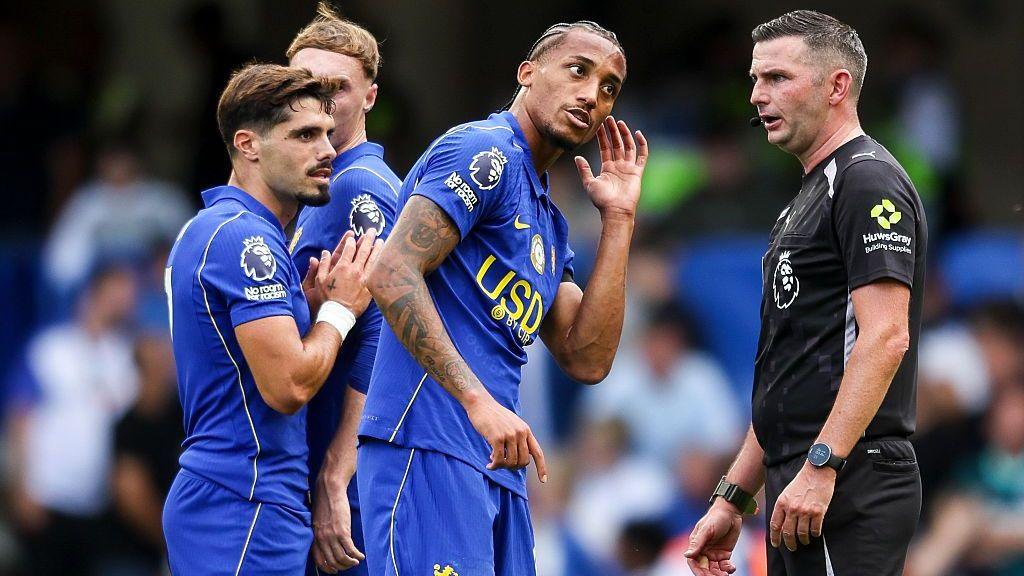 Image source, Getty Images
-
Published
When referee Michael Oliver emerged for the second half at Stamford Bridge on Sunday, something important was missing – his communications pack.
For 45 minutes as Chelsea beat Brighton 4-3, a set of Premier League officials had to work without radio sets for what may have been the first time in 20 years.
The referee, his assistants, the fourth official and the video assistant referee (VAR) team at Stockley Park could not talk to each other.
Referees were first fitted with a microphone and an earpiece at the start of the 1999-2000 season, and while this did not become permanent initially, an upgrade allowed for more sophisticated radio technology to be introduced from the 2006-07 campaign.
There have been problems with the battery packs or the communication link in the past. We have seen games held up while a technician fiddles with the device strapped to the arm of the referee or his assistant.
But this is the first time it was decided the situation was not salvageable, and the officials would have to do their job the old school way.
BBC Sport understands the crowd noise was not filtering out on the system, meaning it was difficult for Oliver, assistants Stuart Burt and James Mainwaring, and fourth official Tom Bramall to hear what they were saying to each other.
Usually the chanting, shouting and singing of fans is suppressed, enabling clear communication.
With headsets ditched, another obvious problem was created: how could the VAR, Andrew Kitchen, do his job if he could not talk to Oliver?
A referee being able to speak to the VAR and describe an incident – like a penalty or a red card – is a cornerstone of the protocol.
Kitchen had to continue working via a back-up system using messages sent to the referee’s watch. He could also talk to Bramall using radio communication.
It did mean the VAR had to work slightly differently, with checks based purely upon the video official’s own assessment – rather than having the referee’s view to take into account.
In an era where referees are asked to carry more and more kit – including invisible spray and RefCam gear – it might have been a relief to go out on the pitch a little lighter.
And perhaps Oliver and Co enjoyed rolling back the years to how their careers began in the grassroots game.