
This post was originally published on this site.

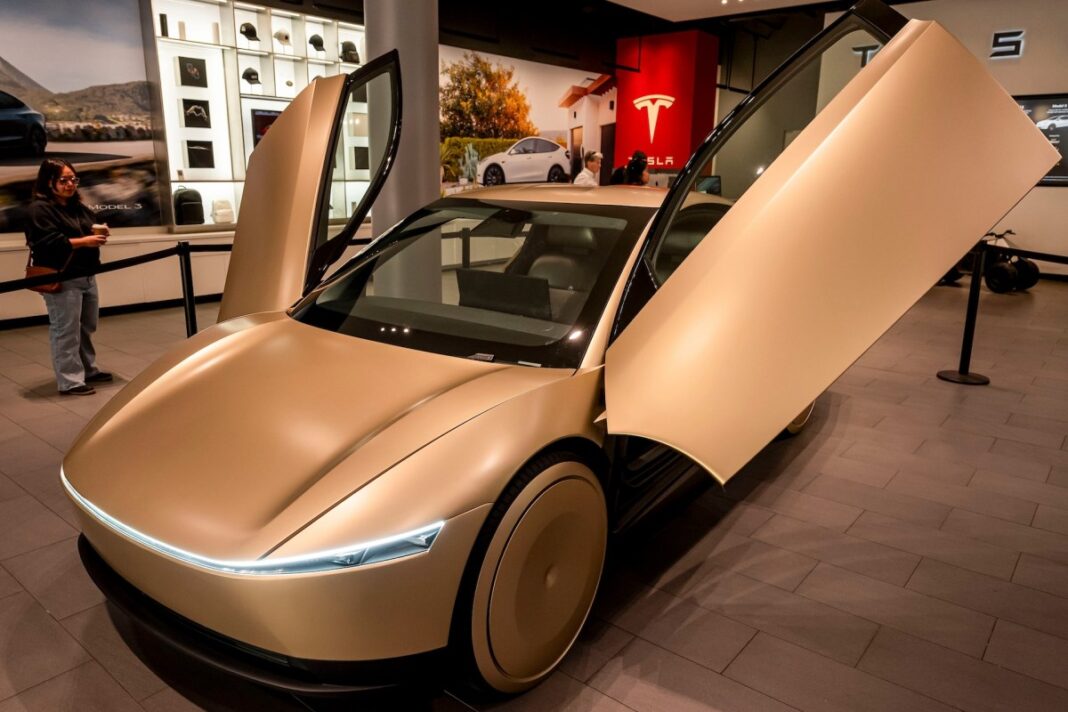
Tesla has begun testing a production version of its Cybercab that has two seats, but no steering wheel or pedals, in Austin, Texas. For now, the testing is being done with a safety monitor in the right passenger seat, according to a video posted on X, the social media platform owned by the electric car maker’s CEO Elon Musk.
This test is happening nearly two years after Tesla revealed the design of the Cybercab, which is meant to be a fully autonomous robotaxi that can be hailed through Tesla’s app. Roughly a year ago, Tesla began testing a Tesla Robotaxi service in Austin with Model Y SUVs that have, at times, used safety monitors.
Tesla has been testing prototype versions of the Cybercab, equipped with a steering wheel and pedals, in a number of cities around the United States in recent weeks. It has also been parking hundreds of the vehicles in parking lots in some of those cities, sparking speculation that the company was finally going to launch a truly scaled-up robotaxi network.
One of the hurdles to realizing that idea is likely about to be removed. Last week, the National Highway Traffic Safety Administration revealed a proposal that would not mandate brake pedals in “vehicles designed to be driven exclusively by automated driving systems.” The proposal is still in the public comment period, but it is expected to go through later this year.
Musk and other Tesla executives have argued that they will be able to out-compete the current robotaxi leader, Waymo, for a number of reasons. Foremost among those reasons is that Tesla is building the cars and the driving software, which is expected to give it far greater control over costs compared to Waymo, which relies on partnerships with brands like Jaguar and Zeekr for vehicles. Tesla is also trying to make the Cybercab fully autonomous using only cameras, whereas Waymo uses a much more complex suite of sensors, including lidar and radar.
Tesla — and Musk — have spent years promising that the company would be able to make a fully autonomous car, but it’s yet to deploy one at scale. The closest it has come is the robotaxi service in Austin, which has seen its size wax and wane in the year it’s been live. Some of those vehicles have been involved in a number of minor crashes, at least two of which were caused by remote operators.
Of course, Waymo’s robotaxis have also gotten into minor crashes, and as that company scaled, it has encountered a number of problems and edge cases, some of which it is still working through. The Alphabet-owned company’s robotaxis currently can’t take highways because they were struggling to maneuver around construction zones, leading to a recall (which was not designed to fix the problem, only avoid highways). Waymo’s vehicles have also struggled to avoid flooded areas during periods of heavy rain, which led to another recall. And they’ve had problems driving legally around school buses.
Tesla has had its own growing pains with the Austin robotaxi network, but some of those have flown under the radar simply because it is using very lightly modified versions of its consumer Model Y SUVs. Waymo’s sensor-laden I-Pace SUVs (and its light blue Zeekr vans, which are starting to hit roads now) are far easier to spot when they are doing something wrong.
Rolling out gold-colored, two-seater Cybercabs will put an even greater spotlight on Tesla’s push to develop a nationwide robotaxi network, making both its struggles and successes much more visible.
When you purchase through links in our articles, we may earn a small commission. This doesn’t affect our editorial independence.