



This post was originally published on this site.
The Premier League’s new plan to end corner chaos
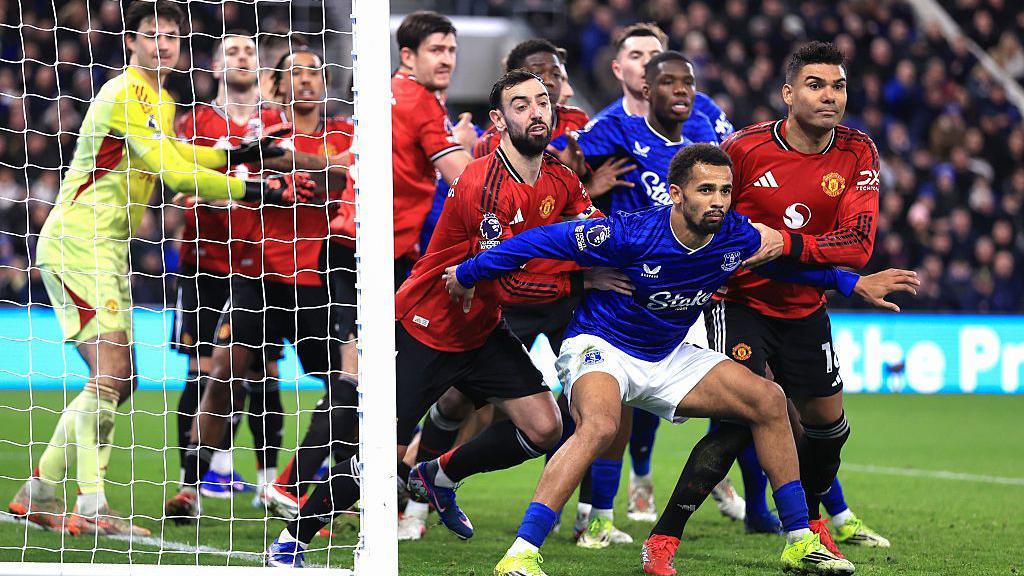 Image source, Getty Images
-
Published
Holding, pushing, shoving, jostling and grappling inside the penalty area became something of an epidemic in the Premier League last season.
“You get the feeling now that referees really don’t want to get involved in any of it,” Everton boss David Moyes said after a particularly fractious game against Manchester United in February.
“It’s really poor that they’ve not tried to deal with it.”
Then came West Ham’s disallowed goal against Arsenal in May, when up to five potential fouls happened at the same time.
It was one of the key topics when captains, coaches, referees and other stakeholders were consulted in the summer.
So now, try to deal with it they will.
The Premier League season will get under way on Friday night when champions Arsenal host promoted Coventry, with referees instructed to be stronger, stricter and more ready to penalise clear non-footballing actions.
What does this mean? Will it be successful? And are the players and coaches on board too?
How set-pieces will be refereed differently
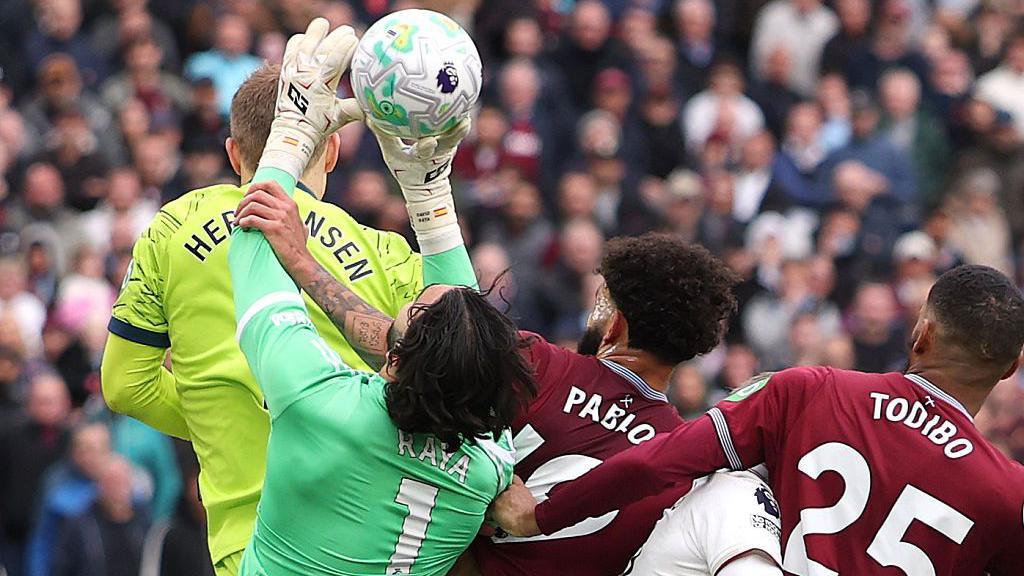 Image source, Getty Images
The fabric of the laws has not changed but the focus on player behaviour has.
Officials – including in the English Football League and the Women’s Super League – will now pay more attention to ‘holding actions that have clear material impact’.
The greatest focus will remain on players who are prevented from playing the ball, as that affects the passage of play.
Yet of the 20 missed VAR interventions last season, a quarter were penalties not awarded when a player had been wrestled to the ground off the ball.
So there will be an increased emphasis on those ‘non-footballing holding actions that have no place on the football pitch’.
This includes where a player is:
-
Only focusing on the opponent (not looking at the ball)
-
Making no attempt to play or challenge for the ball
-
Holding an opponent with both arms
-
Committing sustained and/or impactful holding of an opponent or their clothing
That means a defender who has their back to where a set-piece is coming from and whose only intention is to prevent an attacker’s movement will be penalised.
Howard Webb, the Premier League referees’ chief, said he wants referees to be more proactive.
“We’re trying to get the officials to be as confident as they can be to penalise what they see,” Webb said.
“So fewer warnings, more actions penalised, and if there’s any reduction in offences being penalised it should be a result of a modification of player behaviour rather than us no longer applying it.”
The World Cup saw fewer instances of grappling on corners, with goalkeepers given greater protection.
The Premier League will not be so strict, so do not expect goals to be ruled out if a keeper gets a bump when they are not playing the ball.
“Contact is still part of the game, we still maintain the high threshold,” Webb added.
A goalkeeper having the movement of his arm restricted – see Arsenal‘s David Raya against West Ham – would still be penalised.
-
Premier League to relax red cards for hair pulling
-
Published12 June
-
-
Premier League predictions 2026-27: BBC Sport pundits pick their top four
-
Published9 hours ago
-
-
Pick your club’s best XI for this season
-
Published5 hours ago
-
Decisions split opinion – even between players at the same club
Every summer Pro Ref, the new name for the referees’ body in England, visits each training ground and runs through a series of incidents so players understand what to expect.
Feedback and interaction differs from club to club. Sometimes players will get involved in healthy debates about potential fouls, although on other occasions the odd player might be caught catching a nap.
Over the past few weeks players have been shown clips of two incidents which were not penalties last season, but would be given under the new guidelines.
One was Brentford‘s Keane Lewis-Potter wrestling West Ham’s Tomas Soucek at the far post off the ball. The second was Sunderland‘s Luke O’Nien dragging down Leeds United‘s Pascal Struijk with an arm around the neck.
This season, both fall into the category of a ‘non-footballing holding action that has no place on the football pitch’.
Webb explained how another incident showed how player opinions “can be split on a grey situation”.
Crystal Palace‘s Marc Guehi was pulled down by Bournemouth‘s Bafode Diakite, with the referee awarding a spot-kick.
Some players felt Guehi had engineered the contact, others believed it was a clear holding offence.
“One player will tell you that if a penalty is not given, they expect the VAR to be involved, knowing full well that that will highly frustrate the other half of the room, who don’t see a penalty in the first place,” Webb said.
Webb says giving Guehi the penalty on field was fine, but it should not be a VAR intervention. It shows the balancing act referees and VARs face.
As has been the case for many years, Pro Ref provides officials with pre-game dossiers about how teams play. Not to influence decisions, but to give referees the best chance of identifying potential problems.
“We’ve got some highly skilled analysts who do a lot of work pre-game and give information to the officials: such as what they’re likely to see, the way that the team sets up,” Webb said.
“It gives them a higher likelihood of looking in the right place at the right time.
“We’ll look at tactics that have been used. We’ll look at a team getting an attacking set-piece and adjust the position of the referee to get a beneficial angle.
“It’s not about saying this player is a diver and therefore he’s going to dive every time he hits the deck.
“An open mind’s important, but we think on balance, having information in advance is of benefit.”
Who might the winners and losers be?
The Premier League saw 269 goals scored from set-pieces last season – excluding penalties and direct free-kicks.
Set-pieces accounted for a record 25.7% of goals, the highest across Europe’s top leagues. The Italian Serie A, on 22.3%, was closest.
The World Cup, with 17.5%, was below all but the French Ligue One, indicating that a stricter approach could impact the effectiveness of set plays.
Webb agrees, arguing that if his referees are stronger, that will influence change.
“If we start penalising offences, players have to adjust their tactics,” Webb said. “And then those kind of situations reduce in number.
“But there has been talk on the edges around different approaches that might need to be taken ultimately if tactics continue to develop in a way that makes the game so difficult to officiate.”
Arsenal were, of course, the set-piece kings last season with 25 goals scored.
But it was not just about attacking, their seven goals conceded was the fewest in the Premier League too.
Most of the Gunners’ success was around well-worked routines, but they were physical at times too.
Manchester United were the second most prolific with 21 goals scored, with Tottenham Hotspur netting 19 despite their poor season.
Maybe it will benefit those who struggled defensively, like Liverpool, who conceded a league-high 19 times from set-pieces, followed by Chelsea and Newcastle on 17.
Law changes and initiatives such as this are met with scepticism.
Clamping down on the worst of the holding to change player behaviour, while still allowing physical contact, is a difficult sweet spot to hit.
Referees are often accused of being strict in the opening weeks, before we drift back to where we were before.
The task is to prove this is not a short-lived policy, and corners and set-pieces can be cleaned up.
-
-
Published6 days ago
-
-
-
Published2 days ago
-
-
-
Published1 day ago

-