
This post was originally published on this site.
Ghoncheh Habibiazad,
Sarah Namjoo,BBC Persianand
Harry Sekulich
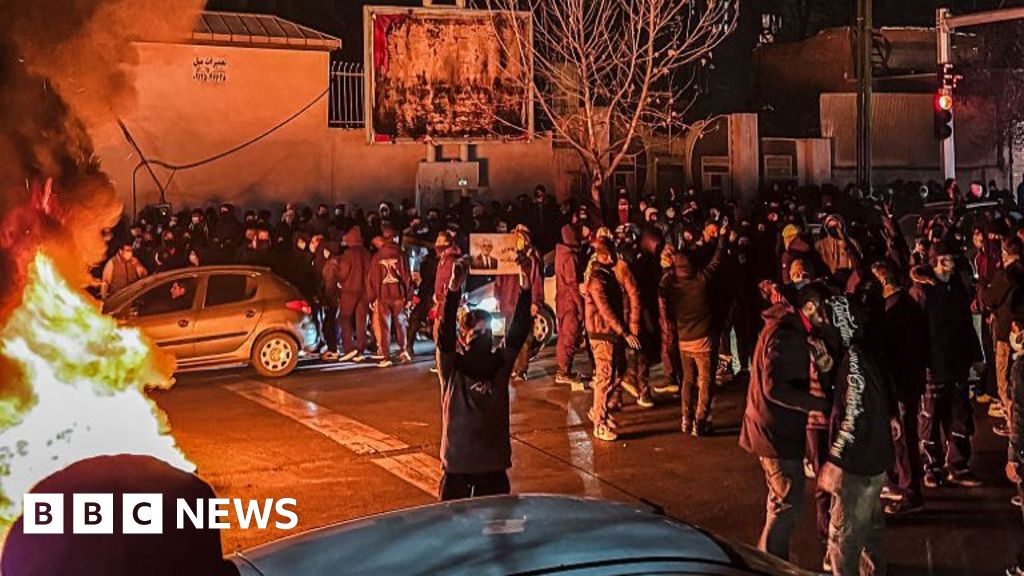
President Donald Trump says the US military is considering “very strong options” in Iran, as anti-government protests which have reportedly killed hundreds enter a third week.
The US-based Human Rights Activist News Agency (HRANA) says it has verified the deaths of nearly 500 protesters and 48 security personnel in Iran, while sources tell the BBC the death toll could be much higher.
Trump has threatened to intervene, and said on Sunday that Iranian officials had called him “to negotiate” – but added “we may have to act before a meeting”.
Iranian leaders have described the demonstrators as a “bunch of vandals”, and called on their supporters to take part in pro-government marches on Monday.
The government has also announced three days of mourning for what it called “martyrs” killed in a “national battle against the US and Israel” – two countries that Tehran says are fomenting unrest.
Anger over the plummeting value of the Iranian currency sparked protests in late December, which have grown into a crisis of legitimacy for Iran’s Supreme Leader, Ayatollah Ali Khamenei.
Trump has not yet elaborated on what the US is considering in terms of military options, nor on the proposed negotiations, despite saying that a “meeting is being set up” with Iranian officials.
He added that Iranian leaders “want to negotiate”, because “they are tired of being beat up by the United States”.
A US official told the BBC’s US news partner CBS that Trump has been briefed on options for military strikes on Iran.
Other approaches could include boosting anti-government sources online, using cyber-weapons against Iran’s military, or imposing more sanctions, officials told the Wall Street Journal.
Sources told the BBC that protests continued on Sunday night, but at a reduced level compared to previous days, as fears grow of an escalating crackdown by the Iranian government.
At least 10,600 people have been detained over the fortnight of unrest, according to HRANA.
The BBC counted 180 body bags in footage from a morgue near the Iranian capital, with one source saying on Sunday that the streets of Tehran were “full of blood”.
“They’re taking away bodies in trucks,” the source added.
In one video from the site near Tehran, about 180 shrouded or wrapped figures can be seen, the majority lying out in the open. Shouts and cries of distress can be heard from people who appear to be looking for their loved ones.
Footage has been blurred to protect the identities of the living, who could face further persecution from the authorities.
Sources said large numbers of bodies had accumulated at hospitals and forensic facilities, while some bodies were reportedly buried urgently before dawn by the authorities, limiting the chance for identification.
City workers have also removed debris, burned cars and bloodstains from the streets during the night, a source told the BBC.
Multiple sources in Iran also said that they had seen drones flying persistently over crowds and residential neighbourhoods to identify and track protesters.
The BBC and most other international news organisations are unable to report from inside Iran, and the Iranian government has imposed an internet shutdown since Thursday, making obtaining and verifying information difficult.
Some witnesses are relying on Starlink proxy connections or satellite television for information, but fear that these could be used by the authorities to trace them.
“We cannot even send text messages,” one source in southern Iran told the BBC, as a blanket internet outage continued. “Only the government is sending threatening messages to people.”
Trump said on Sunday that he would speak to Elon Musk, owner of company SpaceX which operates Starlink, about restoring internet access to Iran.
“He’s very good at that kind of thing, he’s got a very good company,” Trump said.
The protests are the largest in Iran since an uprising in 2022, triggered by the death in custody of Mahsa Amini, a young Kurdish woman who was detained by morality police for allegedly not wearing her hijab properly.
Khamenei has said demonstrators were seeking to “please” Trump, while Iran’s attorney general said anyone protesting would be considered an “enemy of God” – an offence that carries the death penalty.
Iran’s parliament speaker warned the US should not make a “miscalculation”, adding that if the US attacked Iran, both Israeli and US military and shipping centres in the region would become legitimate targets.
Meanwhile, Reza Pahlavi, the exiled son of Iran’s last shah, said in a post on X that the protests had “shaken the foundations” of the Iranian government”.
He added: “The increase in gunfire against the people is not a sign of strength, but of fear – fear of collapse and an accelerated downfall.”