
This post was originally published on this site.
Michael Sheils McNamee and Joe Inwood

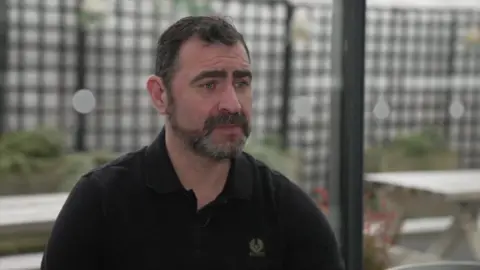
Andy Reid had been in Afghanistan for three months when the incident happened that would change his life forever.
Out on a routine patrol in the Helmand Province, he stood on a Taliban improvised explosive device, resulting in him losing both legs and an arm.
“I was there on the floor on my back, a big dust cloud all around me. I couldn’t hear anything,” he says.
“I wasn’t really in any pain at the time, but I felt some numbness throughout my body.”
“I knew something bad had happened to me. I looked down and I couldn’t see my legs at that stage.”
He was one of thousands of British troops injured in Afghanistan. A further 457 British service personnel were killed in the conflict.
For the injured and the families of the deceased, many are deeply offended at US President Donald Trump’s claim in an interview that America’s Nato allies sent “some troops” to Afghanistan, but “stayed a little back, a little off the front lines”.
“I remember working with some American soldiers in an Explosive Ordnance Disposal team,” says Reid.
“If they were on the front line, and we were stood next to them, then clearly we were on the front line as well.”
He’s called on Trump to make a formal apology for the “disrespectful, inappropriate and unexpected” remarks.
‘I’ll write to the White House’
In 2001, in the wake of the 9/11 attack, the United States became the first, and so far only country to invoke Article 5 of Nato – the clause which states that “an armed attack against one Nato member shall be considered an attack against them all”.
British troops served in the country between 2001 through to 2014, and were among a number of America’s allies to support it in the conflict. Other countries that sent troops were Denmark, Estonia and Canada.
The UK had the second largest deployment after the United States – with the number of troops it had in the country at one time peaking at about 11,000 in 2011.
Some of the heaviest fighting British troops were involved in took place in the Helmand province in the south of the country.
Initially deployed there in 2006 with the purpose of securing redevelopment projects, they quickly saw themselves caught in intense fighting against a resurgent Taliban.
Some of the worst fatalities came as a result of attacks on British foot and vehicle patrols by Improvised Explosive Devices (IEDs).
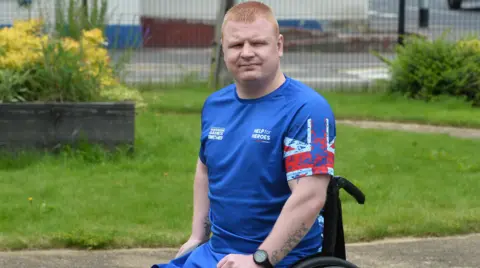
Andy Allen, a Ulster Unionist member of Northern Ireland’s assembly, was among those injured in an IED attack.
The 19-year-old had been in Afghanistan for two months when he had his right leg blown off and left leg shredded by a makeshift bomb during an early morning patrol in Helmand province in 2008.
“It was the front line in which I was injured, and it was the front line of the battle in Afghanistan in which my mates and comrades put themselves in harm’s way to extract me to safety,” he says.
 Pacemaker
Allen says he plans to write to the White House to emphasise that Nato members were on the front line “very much serving with our American comrades and counterparts”.
Despite the injuries and deaths, Trump’s comments are not the first time his administration has been critical of the support of its allies.
Speaking before a Senate committee last year, Defence Secretary Pete Hegseth – who served in Afghanistan – said the Nato ISAF badge soldiers wore in the conflict, which stands for International Security Assistance Force, really stood for “I saw Americans fighting”.
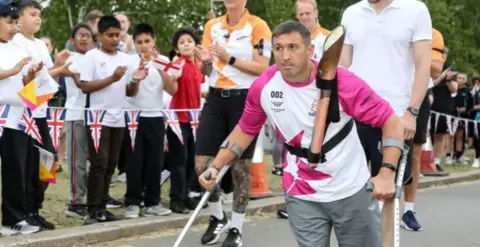
Diane Dernie, whose son Ben Parkinson is regarded as the most severely injured British soldier to survive in Afghanistan, says he was “stunned” by Trump’s comments.
“Ben wore the ISAF badge, the Nato badge, he went as part of that international security force.”
 Getty Images
The Doncaster soldier was injured when an Army Land Rover hit a mine near Musa Qala in the Helmand province in 2006.
“How on earth can this be acceptable,” says Diane.
She says her son served out of forward operating bases in Afghanistan, which are secured military positions close to the front lines.
“To have this man say that they played about behind the front lines, of course he’s angry. Of course we all are.”
Her comments echo those of survivors and relatives of British servicemen killed in the conflict.
Fourteen years ago, Monica Kershaw’s 19-year-old son Christopher was killed just three weeks into his first ever active deployment.
He was one of six British soldiers who died when their Warrior armoured vehicle drove over an improvised explosive device in Helmand Province.
“He was on the front line,” she says. “There were six lads who all got killed.
“I think they should put Donald Trump in a uniform and put him on the front line, instead of pushing a pen behind a desk, he should go out there and do it himself.”
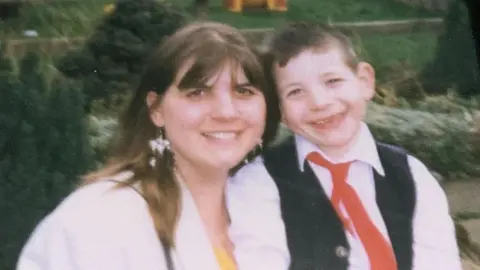
Also killed were Cpl Jake Hartley, 20, Pte Anthony Frampton, 20, Pte Daniel Wade, 20, Sgt Nigel Coupe, 33, and Pte Daniel Wilford, 21.
She says the fact they were there at the request of a US president makes Trump’s comments all the more hurtful.
“They’ve all been killed for nothing, if he says they weren’t there helping. Why were they coming back in wooden boxes?”
US Navy veteran Shawn VanDiver says his message to Nato troops is: “We see you. We know you were right there with us.”
VanDiver, who served off the coast of Iraq and now leads a group that helps Afghan wartime allies resettle, tells the BBC the president’s comments are “just not true”.
“We could not have accomplished what we did without them,” he says.
Asked how British families who lost loved ones in Afghanistan might be feeling, VanDiver says they would likely feel “betrayed”, adding: “What I would say to those families is I’m sorry.”