
UK economy sees surprise growth in August ahead of Healey’s first Budget
 Image source, Getty Images
-
Published
The UK’s economy recorded surprise growth in August despite the impact of rising energy prices and borrowing costs.
Official figures showed the economy expanded by 0.1% in the month, defying analysts’ expectations of a slight contraction.
It means the economy grew by 0.7% in the three months to August, and follows an upgrade to this year’s forecast for the UK economy from global watchdog the International Monetary Fund (IMF).
Chancellor John Healey, who will deliver his first Budget in two weeks, said the UK has shown resilience in the face of conflicts in Europe and the Middle East.
Britain’s economy was boosted in August by an increase in production, which includes manufacturing, oil and gas extraction and energy supply.
The services industry, which makes up the largest chunk of the UK’s economy, was flat during the month, while the construction sector contracted.
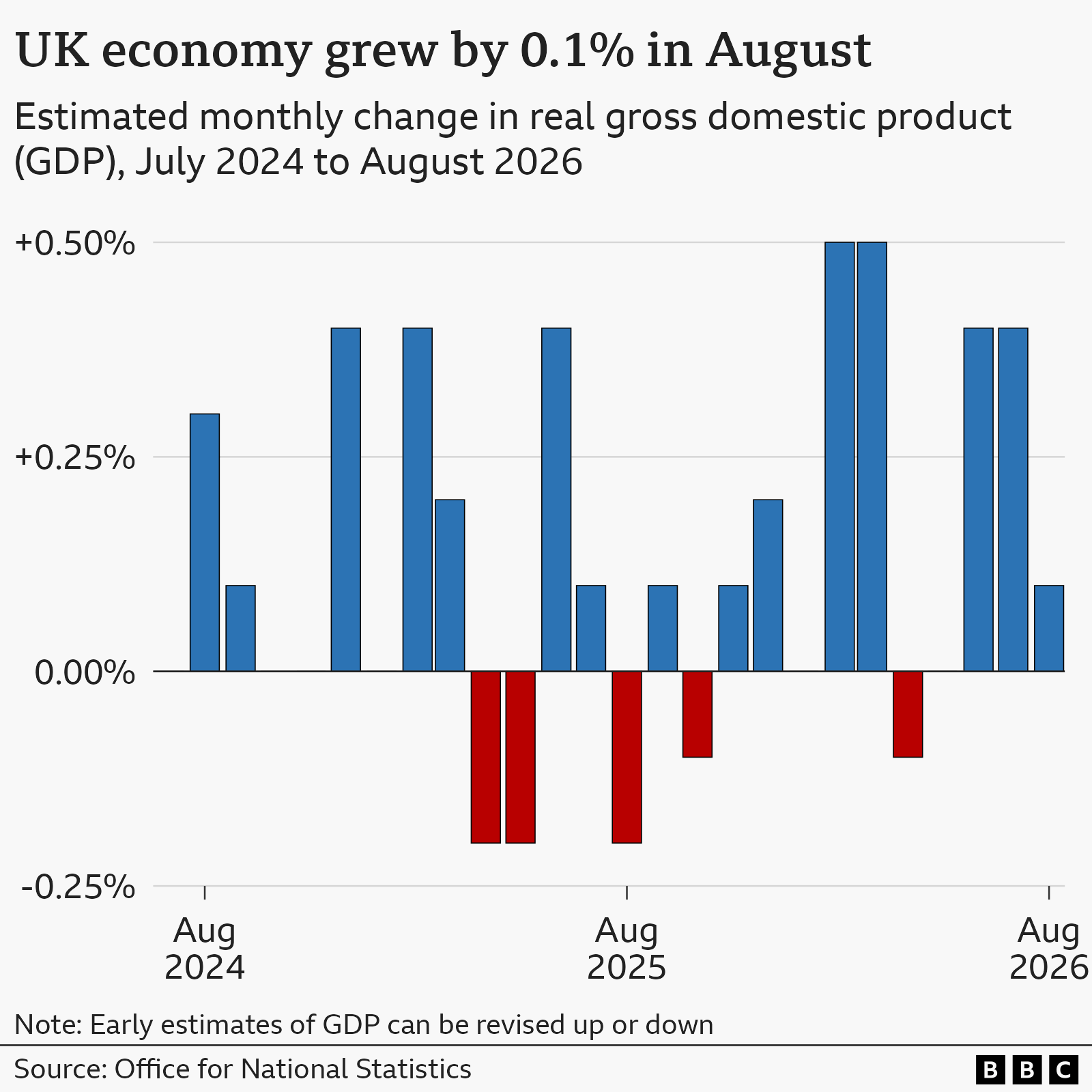
Over the three months to August, the UK’s economy grew by 0.7% overall. ONS director of economic statistics Liz McKeown said computer programming had been the biggest contributor to what she described as “robust” growth over the period.
But she said the production and construction sectors shrank over the three-month period.
August’s surprise expansion follows growth of 0.4% in July. The ONS also upgraded its estimate for June’s monthly growth to 0.4% from 0.3%.
Paul Dales, chief UK economist at Capital Economics, said Britain’s economy was “more robust than we thought”.
He warned that an expected increase in inflation would still “dampen growth”, but added that the economy was showing “remarkable resilience to higher energy prices and borrowing costs”.
PwC senior economist Jake Finney said the development of AI infrastructure was underpinning Britain’s relatively strong performance.
“The UK still lags the US in both the scale of that investment and the boost it provides to growth, but it is making progress and remains ahead of many of its European peers,” he added.
The latest growth figures were released after Healey landed in Bangkok for the annual meeting of the International Monetary Fund (IMF).
Earlier this week, the global financial watchdog praised the UK’s plans to cut debt levels, with global borrowing costs on the rise, with managing director Kristalina Georgieva adding that the country was seeing “a bit of a better growth prospect” than other G7 nations.
Healey said: “Despite conflicts in the Middle East and Europe hitting people across the world, today’s figures offer more proof of Britain’s resilience in the face of these global shocks.
“This week the IMF have upgraded UK growth for 2026 and said that our fiscal discipline stands out with the lowest deficit in the G7 forecast by 2029.”
He promised to build on the UK’s debt reduction plans, which were praised by the IMF, and use the Budget to “provide some breathing space for today, and offer fresh hope for the future”.
The Conservatives said the economic growth figures “conceal worrying trends in key sectors as we approach a crucial Budget”.
Shadow chancellor Andrew Griffith said: “Construction has now shrunk for four months in a row, with private housebuilding falling fastest. Labour promised to get Britain building, but they are failing.”
He called for Healey to cut taxes and reduce red tape.
Get in touch
What would you like to see in the Budget?

Sign up for our Politics Essential newsletter to keep up with the inner workings of Westminster and beyond.