
This post was originally published on this site.
Jamie WhiteheadBBC News

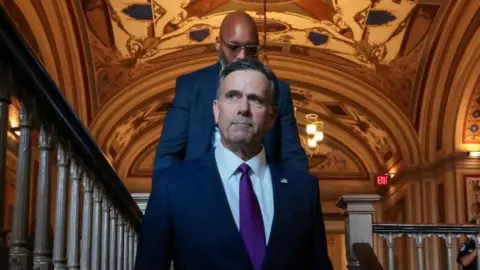
CIA director John Ratcliffe met Venezuela’s Interim President Delcy Rodríguez in Caracas on Thursday “at President Trump’s direction,” a US official has said.
The two-hour meeting was aimed at building trust and communication following the US seizure of Venezuela’s former president Nicolás Maduro almost two weeks ago.
Ratcliffe and Rodríguez discussed potential economic collaboration and that “Venezuela can no longer be a safe haven for America’s adversaries”, according to the US official.
The meeting took place on the same day Rodríguez gave her first state of the union address since taking over as interim president, where she announced oil industry reforms to allow more foreign investment – a move away from Maduro’s policies.
During her speech to the nation, Rodríguez said she was not afraid to face the US “diplomatically through political dialogue,” adding Venezuela had to defend its “dignity and honour”.
President Donald Trump has said US oil companies will move into Venezuela and make money that will go to people there and to the US, with a top official saying the US would control sales of sanctioned Venezuelan oil “indefinitely”.
Trump has asked oil companies to invest at least $100bn (£75bn) in Venezuela, but one executive said last week the country is currently “uninvestable”.
Rodríguez, the former vice-president, was sworn in on 5 January after US forces seized Maduro and his wife Cilia Flores in an operation in Caracas. They are now detained in New York, where they have pleaded not guilty to drug trafficking and other charges.
The US official described the meeting between Rodríguez and Ratcliffe as “historic”, adding that Ratcliffe was the first cabinet-level official to travel to Venezuela.
The meeting also happened on the same day that Trump met opposition leader Maria Corina Machado in Washington, who presented the US president with her Nobel Peace Prize winning medal.
In her state of the union address, Rodríguez told Venezuelans it was “very difficult” to deliver Maduro’s annual report, saying that the two were working on the speech together until six hours before his seizure on 3 January.
Noting the US is a nuclear power, the interim president said she was not afraid to engage in diplomacy, saying “we have to go together as Venezuelans to defend sovereignty, independence, territorial integrity and also defend our dignity and our honour”.
She continued that if she needed to travel to Washington DC to meet with Trump, she would do so “walking on her feet, not dragged there”.
She added that “all of Venezuela is threatened”, and called for national unity to “wage the diplomatic battle”.
In her address, Rodríguez announced the proposal to reform the country’s hydrocarbon law, saying she had asked the legislative body to approve it.
Until now, Venezuela’s hydrocarbon law has stated foreign partners must work with the country’s state-owned oil and gas company, PDVSA – which must hold a majority stake.
The reforms, Rodríguez said, would allow investment to flow to new fields.
She said she had instructed her government to create two sovereign funds – one for social protection so that “foreign currency goes directly to hospitals, schools, food, housing” and the second for infrastructure and social development to invest in water, electricity and roads.
Venezuela has been facing an economic crisis, with a sharp rise in food prices and the lack of purchasing power. Before the US operation to seize Maduro, Venezuelans told the BBC they were concerned about what they were going to eat.
“We’re more worried about food. Venezuela is in bad shape. Inflation is eating us alive,” one man said.
Rodríguez’s reforms come as Trump and American investors eye opportunity in Venezuela, which holds the world’s largest proven oil reserves.
Bosses of the biggest US oil firms who attended a meeting at the White House last week acknowledged that Venezuela represented an enticing opportunity.
But they said significant changes would be needed to make the region an attractive investment.
Trump said his administration would decide which firms would be allowed to operate.
“You’re dealing with us directly. You’re not dealing with Venezuela at all. We don’t want you to deal with Venezuela,” he said.
Trump also said that “one of the things the United States gets out of this will be even lower energy prices”.
Venezuela has had a complicated relationship with international oil firms since crude oil was discovered in its territory more than 100 years ago.
Chevron is the last remaining major American oil company still operating in the country.