
This post was originally published on this site.
Bethan LewisWales family and education correspondent

A decision to stop funding a scheme which has provided free books for newborns for a quarter of a century has been called “heartbreaking”.
BookTrust Cymru, which runs programmes aimed at helping parents to read with babies and toddlers, says a decision to stop the direct grant risked leaving the poorest families without support.
“I feel really devastated for the children of Wales,” its director Sioned Jones said, while parents told the BBC it helped build bonds with their babies.
The Welsh government said its educational resources body, Adnodd, was now responsible for early years literacy programmes and Adnodd said it was working to ensure there is no gap in provision of materials to families.
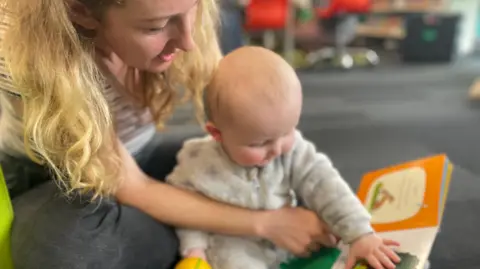
Thousands of parents each year receive the free Bookstart Baby pack, which includes a free bilingual book and advice, via their health visitor, and parents told the BBC it helps build bonds with their children.
The Bookstart programme is run by BookTrust across the UK, and in Wales it includes two free packs – one usually at the six-month health check and the other at the 27-month check. Its sister charity Scottish Book Trust supports families in Scotland.
Jones said their work supporting families with reading was about more than just the free books, with extra targeted elements to the programmes at a cost of £370,000 a year.
“We’ve been doing it for a long time,” Jones said.
“You have to build the skills, the practitioners, they have to understand the programmes they’re delivering.
“We do lots of research in BookTrust in terms of the evaluation of our programmes and the impact they make and we know they make a difference, not only in getting families reading but helping families with their Welsh as well.”
Grant funding for the programme from Adnodd stops at the end of March 2026 while it decides how to commission literacy materials for young children in future.
It said it was working with BookTrust and others “to ensure there is no gap in the provision of early years literacy materials to families” and “rather than replicating a specific delivery model, it focused on identifying the most effective approaches to improving literacy outcomes for young learners in Wales”.
“This work will be informed by evidence and research to ensure the strongest possible outcomes,” Adnodd added.
It comes amid concern about the reading standards of Welsh pupils, but BookTrust Cymru said its work was about more than literacy.
“We don’t, especially in the first 1,000 days, concentrate on literacy – that’s not the purpose of the early years shared reading,” said Jones.
“It’s about getting parents reading, attachment with their children, helping them develop their brains, helping them develop their motor skills.
“We’ve not seen any impact assessment in terms of what will this mean for the children living in poverty in Wales.
“At a time when the literacy levels are a concern why you would end a programme that you know is impactful and helps children with their reading seems a bit perplexing to us.”
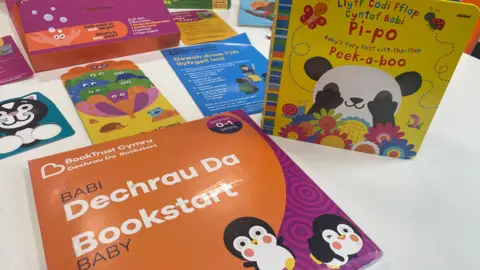
At six months old, Jess’ daughter enjoys handling and sometimes chewing books.
“She does like reading books. I mean, she obviously can’t read them,” said Jess.
“She just stares at the pictures but she’s often grabbing them and trying to put the corners in her mouth.
“She does like a flap book as well so it’s nice that these have things that have different textures that she can pull on and play with.”
She said her elder child “ended up destroying” the free book she received as a baby “because she looked at it so much”.
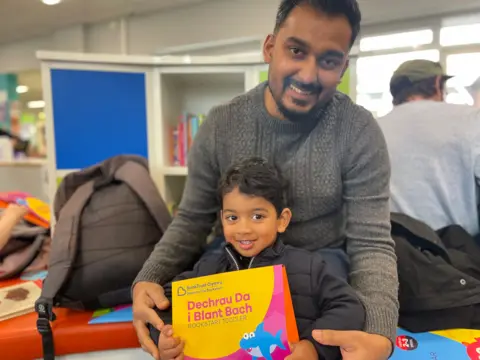
Ravi and his wife read a lot to their two-year-old at home in Cardiff.
“He loves to read the books,” said Ravi.
“It’s helped with the development and language skills.”
Introducing books at a very young age is important, he said, “rather than using mobile phones”.
 Jon Pountney/Literature Wales
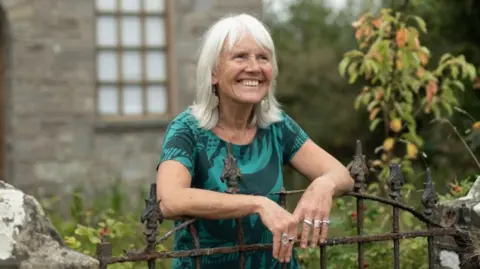
Nicola Davies, the Children’s Laureate for Wales, said reading to very young children gave them a “flying start”.
“It not only has an impact on their reading and therefore their educational attainment, it has a huge impact on relationships within the family,” she said.
“At the moment, a lot of parents who are under pressure of time and money are handing little kids a screen to look at,” she said, but reading a book together taught a “basic, fundamental human cultural skill”.
She added the Bookstart programmes were tried and tested, and the idea that they could be replicated overnight was “foolish”.
“The fact that the effects of this decision will be felt by Wales’ most vulnerable children is heartbreaking.”
The Welsh government said: “We have asked Adnodd to ensure that there is no gap in provision.”
Adnodd said no final decisions had been made about arrangements for the future.
“Any future early years literacy programme will be commissioned through an open and competitive process in line with procurement regulations, to which suppliers including BookTrust will be able to apply”, Adnodd said.
“Our priority remains to continue to work with our partners so we can collectively support and deliver strong literacy outcomes for children and families across Wales.”