
This post was originally published on this site.
Calum WatsonBBC Scotland

 BBC
BBCFor years they felt stonewalled, lied to and gaslit. Now they’re angry.
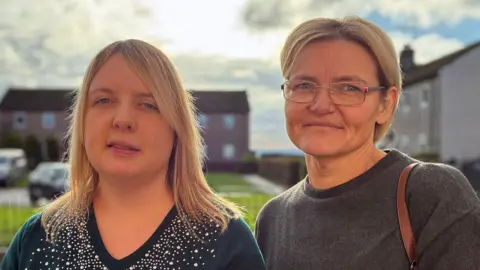
Karen Stirrat and Charmaine Lacock are mothers of children they say were exposed to infections while being treated for cancer at Glasgow’s flagship “super hospital”.
They were some of the first parents to voice fears that something in the way the buildings were constructed was inherently unsafe.
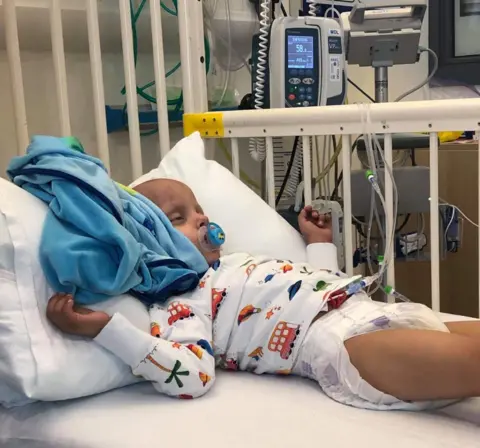
Dozens of vulnerable children like theirs with cancer or blood disorders became even more unwell while being treated at the hospital. Some of them died.
Yet for years the body that runs the Queen Elizabeth University Hospital campus refused to accept evidence that water and ventilation systems could be to blame for infections.
“From the very beginning we campaigned, with other families, and we got slated for that,” says Karen.
“We knew the truth, but we kept getting told we were just imagining things.”
A week ago, NHS Greater Glasgow and Clyde performed a jaw-dropping U-turn.
The health board, the equivalent of an NHS Trust elsewhere in the UK, now says it accepts that on the “balance of probabilities” the hospital environment, particularly the water system, caused some infections.
In its closing submission to a public inquiry it also admits that:
- the hospital opened in 2015 before it was ready
- there was “pressure” to deliver the project on time
- maintenance in the early years was insufficient
- infection control doctors who tried to raise the alarm were badly treated
The belated admissions, which contradict some positions taken by the health board during the six-year inquiry, have been welcomed.
But they have also left parents frustrated – and in some cases furious – that it’s taken so long.
“For them to now backtrack… it’s too little, too late,” Karen says.
“It’s a day of sheer and utter anger at the fact it’s got to this stage.”
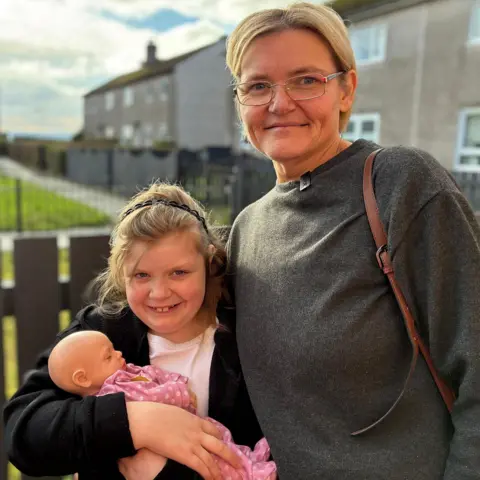
Charmaine Lacock’s daughter Paige was three when she picked up a “life threatening” infection while undergoing cancer treatment in early 2019.
When doctors gave her the news, Charmaine says she felt like her little girl had already been placed in a casket.
“A hospital is supposed to be your safe place where you go to ask for help,” she said.
Paige recovered and is now cancer free – but Charmaine still feels traumatised.
“We live in fear that our kids will relapse and have to go back and maybe the second time they won’t be as lucky.
“I think we’re broken as parents having to fight this.”
She and Karen Stirrat also live with “survivor’s guilt” that their children are alive when others, whose parents they have met through years of campaigning, have died.
Karen’s son Caleb is still receiving treatment for the side effects of a brain tumour which was diagnosed while he just three.
He had to begin his treatment in the adult hospital in 2019 because cancer wards in the children’s hospital were by then closed due to infection risks.
She says one of the early clues that something was seriously amiss came when she took him to the US for specialist proton treatment.
American doctors were surprised that he had been prescribed a strong antibiotic.
Karen believes it was a precautionary measure because doctors in Glasgow were so worried he would pick up an infection inside their hospital.
When Caleb resumed his treatment at the Queen Elizabeth University Hospital he was put back on the drugs, but no-one would tell her why.
She doesn’t blame those doctors or nurses – she says they had been forbidden by managers from telling parents about the problems with the water system and the infection risk.
“A doctor was crying at me, saying she wished she could but management wouldn’t let her. That’s unforgivable,” she said.
 PA Media
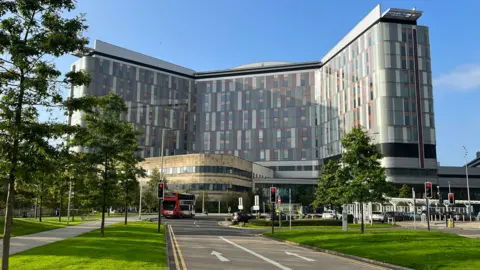
The impressive new hospital campus welcomed its first patients in April 2015 and was officially opened by Queen Elizabeth during the summer.
One of the biggest hospital complexes in Europe, it had cost more than £840m.
With typical gallows humour, Glaswegians dubbed it the “Death Star” after the Empire space station in the Star Wars film.
But the building seemed to offer new standards of care and comfort – in contrast with the drab corridors of several Victorian-era facilities it was replacing.
Beside it, the Royal Hospital for Children with its brightly coloured windows presented a reassuring space for children and their worried families.
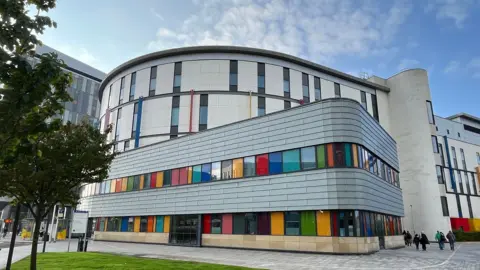
“It was a nice building from the outside, a nice building from the inside – it looked clean,” recalls Charmaine Lacock.
“We never thought anything could go wrong in a hospital. We had just had this diagnosis… we were in the best place we could be and they were going to fix it.”
In fact, there had been issues with the hospital from the start.
Within weeks of opening there were reports of difficulties during the patient transfer and long waits for admission.
We now know that 200 contractors were still on site when it opened, rushing to complete the project on time, and NHS facilities staff were overwhelmed by their workload as they tried to fix faults.
But it took years for a more disturbing story to emerge, of higher than expected infection rates and deaths of several patients with hospital-acquired infections.
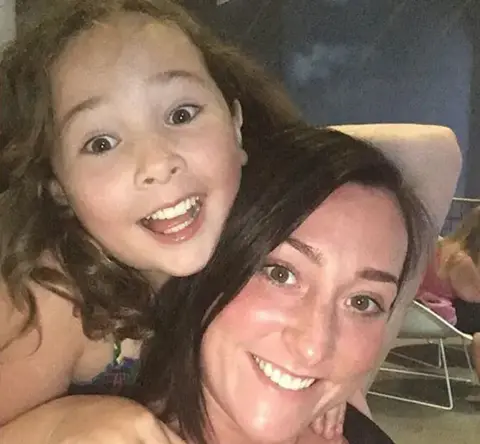 Kimberly Darroch
In 2017, 10-year-old Milly Main was recovering well from a stem cell transplant at the children’s hospital when she picked up an infection from an intravenous line used to administer drugs. She developed sepsis and died.
Her mother Kimberly Darroch told a BBC Disclosure documentary that she had hoped the stem cell treatment would give her daughter a second chance at life.
“Which it did, it worked – only for her to get a line infection which changed everything.”
Milly’s parents came to suspect the hospital water system was the source of the infection, but the health board insisted it was not possible to establish a causal link.
It still does not accept the faults were to blame for specific individual cases.
Kimberly would later become a powerful champion of parents who felt stonewalled and “lied to” by the authorities.
The year after Milly’s death, there was a cluster of infections. Higher than expected levels of bacteria that could harm patients with a weakened immune system were found in water in the children’s hospital.
“The first thing for me was seeing the notice up about the sink, saying this is a handwash sink only,” says Charmaine.
“Then they came in with bottled water and said don’t use the tap water to brush your teeth.”
Eventually most vulnerable young patients were transferred to the adult hospital while the infections were investigated and remedial work took place.
The two women were also noticing other faults – showers that flooded, blinds that wouldn’t open. Karen became so worried about the water she would pack her own cutlery and water jug.
At the start of 2019 another issue hit the headlines.
It emerged that a fungal infection often linked to pigeon droppings had been listed as a contributory factor in the death of a 10-year-old boy.
Suspicion fell on the ventilation system. Could a lack of filters or problems with air pressure have allowed dirty air to enter spaces where vulnerable patients were being treated?
A plant room on the roof near a ventilation intake that had been colonised by pigeons was initially identified as a likely source of the fungus, although a subsequent investigation contradicted that finding.
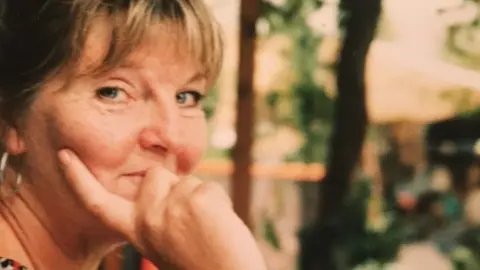 Armstrong family
Although it admits that the water system probably caused some infections, Glasgow’s health board continues to cast doubt on a link between infections and the ventilation system even though they accept it does not need required specifications in some areas.
That’s little comfort to the family of Gail Armstrong, who also died with the same Cryptococcus infection as the young boy a short time afterwards.
Although the 73-year-old was terminally ill, her family believe it hastened her decline.
Her daughter Sandie thinks the health board’s new and caveated admissions add “insult to injury”.
“It makes us feel more distressed, more confused and more angry because we feel that they are just trying to limit the damage to their reputation.
“They’re not interested in actually coming forward and speaking openly and transparently to us.”
The timeline of the hospitals controversy
By late 2019, the growing scandal was being discussed in the Scottish Parliament where Anas Sarwar, now the Scottish Labour leader, raised the case of Milly Main.
He had obtained leaked reports which showed experts were warning about the safety of the water system even as the hospital was accepting its first patients.
With public concern mounting and a ventilation problem delaying the opening of a separate hospital in Edinburgh, Scottish Health Secretary Jeane Freeman ordered a public inquiry into their design, construction commissioning and maintenance.
That inquiry, now drawing to close after six years, has heard from 186 witnesses, painting a picture of what some clinicians described as a “defensive” management culture at NHS Greater Glasgow and Clyde.
One microbiologist, Dr Teresa Inkster, said she felt discouraged from speaking up at infection control meetings.
Another microbiologist and senior doctor, Christine Peters, said she was advised by a senior colleague to “pipe down” or she would find things “hard” professionally.
She has previously told BBC News she had been flagging concerns about the buildings since 2014 and was advised not to put anything in writing.
NHS Greater Glasgow and Clyde, now under a new chief executive, accepts whistleblowing procedures fell short and has apologised to staff who didn’t feel “listened to”.
But it denies there was any cover-up. While it concedes communication was poor, it says it didn’t want to worry patients needlessly before the facts were established.
The failings, it argues, were systemic rather than the fault of individuals who were under great pressure as they dealt with a situation which was not of their making.
That makes Karen Stirrat angry. She believes that some people tried to conceal the truth – and says this lets them off the hook.
“We had looked into those buildings, we had the truth there in black and white… If that’s not saving your own skin, I don’t know what is.”
Infection levels returned to normal by late 2020 after remedial work on the water systems.
In some wards the ventilation system still falls short of national standards but the health board claims alternative infection controls measures mean the hospitals on the site are now “wholly safe”.
Lawyers for the public inquiry, whose role is to represent the public interest, have questioned that and suggested that for some vulnerable patients, in certain circumstances, there could still be a heightened risk.
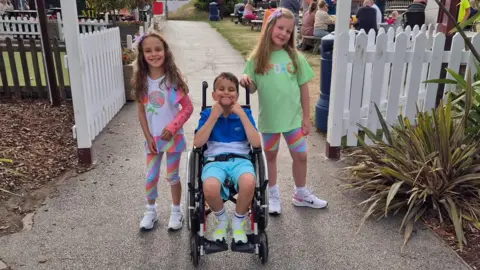 Karen Stirrat
The final report from inquiry chairman Lord Brodie is expected to be published later this year but there has already been political fallout.
In fiery exchanges in the Scottish Parliament, opposition leaders demanded to know where the “pressure” to open the hospital on time was coming from. Was it a coincidence that the opening took place just days before a general election?
First Minister John Swinney responded with an emphatic “no” when asked if political pressure was applied. And he said SNP ministers were not alerted to problems with the water system until nearly three years later, in March 2018.
For parents like Karen Stirrat and Charmaine Lacock it’s less about the politics but more about finally getting answers to questions they have been asking for years.
They still have their children. For them it’s a time of healing both physically and psychologically.
But Charmaine still finds it hard to forgive those who she believes tried to conceal the truth.
“It has taken over our lives. This will haunt us forever.”