

In business, understanding the types of processes is essential for success. You’ve got core processes that create value, like product development and customer service. Then, there are support processes, such as HR and IT, that keep everything running smoothly. Finally, management processes help you monitor performance and align your team with strategic goals. Knowing these categories helps you streamline operations, but there’s more to take into account when it comes to automation and efficiency. What’s next?
Key Takeaways
- Core Processes: Essential workflows like product development and customer service that directly create value for the organization.
- Support Processes: Functions such as HR and IT that ensure core activities run smoothly and effectively.
- Management Processes: Focus on performance monitoring and risk management to streamline decision-making and enhance strategic alignment.
- Standard Processes: Consistent, repeatable operations aimed at eliminating inefficiencies and improving operational efficiency through clear documentation.
- Long-Tail Processes: Flexible workflows that adapt to immediate needs, often requiring high manual effort and enabling quick responses to changes.
What Are Business Processes and Why Do They Matter?

Business processes are essential for any organization, as they help you turn inputs into valuable outputs. In the manufacturing industry, understanding the business process is vital. It guides the production process and assures efficiency.
Different types of manufacturing, such as batch, continuous, and job shop, require tailored processes to optimize operations.
Start by documenting your workflows clearly; this reduces compliance issues and speeds up time-to-market. Aim for visual mapping of handoffs and ownership to minimize reliance on institutional knowledge.
This approach not only enhances operational consistency but also helps allocate resources effectively.
Consider embedding checks and balances throughout your processes to mitigate risks. By focusing on these structured sequences, you can enhance overall efficiency and achieve your strategic goals.
Embrace these practices, and you’ll find smoother operations and improved productivity within your organization.
Understanding Core Processes: The Heart of Value Creation

Core processes form the backbone of value creation in any organization. These primary workflows—like product development, sales, and customer service—directly create value for customers and generate revenue.
For instance, in manufacturing, core processes might include production processes like assembly line production or batch production, which efficiently turn raw materials into finished goods.
To excel, you should guarantee each core process has a designated owner responsible for performance. This accountability promotes continuous improvement, helping you optimize these processes.
By focusing on efficiency, you can improve metrics, such as reducing time-to-market by up to 25%.
Ultimately, enhancing your core processes isn’t just about operations; it’s key to boosting customer satisfaction and guaranteeing long-term business success.
Take action: evaluate your current core processes, identify areas for improvement, and implement changes to create more value for your customers.
How Support Processes Enable Core Activities

Support processes play an essential role in ensuring that core activities run smoothly and effectively. By integrating support functions like HR and IT, you provide the necessary resources that enable your core activities to thrive.
These support processes help maintain operational consistency, which is vital for delivering value to your customers without any interruptions.
To enhance overall efficiency, align your support processes with your core objectives. This approach minimizes redundancies, boosting productivity across the board.
For instance, effective HR practices can improve employee satisfaction and retention, ensuring you have a motivated workforce to drive those core activities.
Additionally, fostering better communication and collaboration through support processes bridges gaps between departments, preventing any barriers that could hinder performance.
How Management Processes Drive Business Success

Management processes are essential for driving your business success by focusing on key responsibilities, performance monitoring, and risk management.
You need to plan effectively, track your progress with clear metrics, and identify potential risks before they become issues.
Key Management Responsibilities
Effective processes are essential for driving business success, as they confirm that every activity aligns with your strategic goals.
As a manager, your key responsibilities include designing and implementing management processes that streamline decision-making. Focus on creating a process for producing results efficiently, which can reduce your time-to-market by 25%.
Identify different types of processes within your operations and continuously measure key performance indicators (KPIs) to spot inefficiencies.
Utilize the BPM lifecycle—design, execution, and optimization—to refine these processes systematically. By empowering your team with accurate data, you can respond proactively to market changes, enhancing overall business resilience.
Prioritize clear communication and collaboration to confirm everyone is aligned with your strategic objectives.
Performance Monitoring Techniques
Monitoring performance is essential for ensuring your business stays on track to meet its goals. By using effective performance monitoring techniques, you can align your management processes with strategic objectives. Focus on key performance indicators (KPIs) like cycle time, error rates, and throughput. Regularly assess these metrics to spot inefficiencies and improve productivity. This continuous monitoring allows you to make timely adjustments, ensuring resources are used effectively.
| KPI | Definition | Application |
|---|---|---|
| Cycle Time | Time taken to complete a task | Optimize manufacturing techniques |
| Error Rate | Frequency of mistakes | Enhance quality control |
| Throughput | Output produced | Assess different kinds of manufacturing |
Implement these strategies to drive business success and optimize your processes.
Risk Management Strategies
Every business faces risks that can derail progress and threaten success. To tackle these risks effectively, start by identifying potential threats, whether they’re financial, operational, or regulatory.
Assess each risk’s likelihood and impact, then prioritize them for action. Implementing robust risk management strategies can reduce compliance issues by up to 42%, so stay proactive.
Monitor performance metrics regularly, allowing you to allocate resources wisely and align strategies with long-term goals. Engage in continuous improvement to boost project success rates by up to 70%.
This approach not only safeguards your assets but also enhances organizational resilience, helping you adapt to changing market demands.
Understanding Long-Tail vs. Standard Business Processes
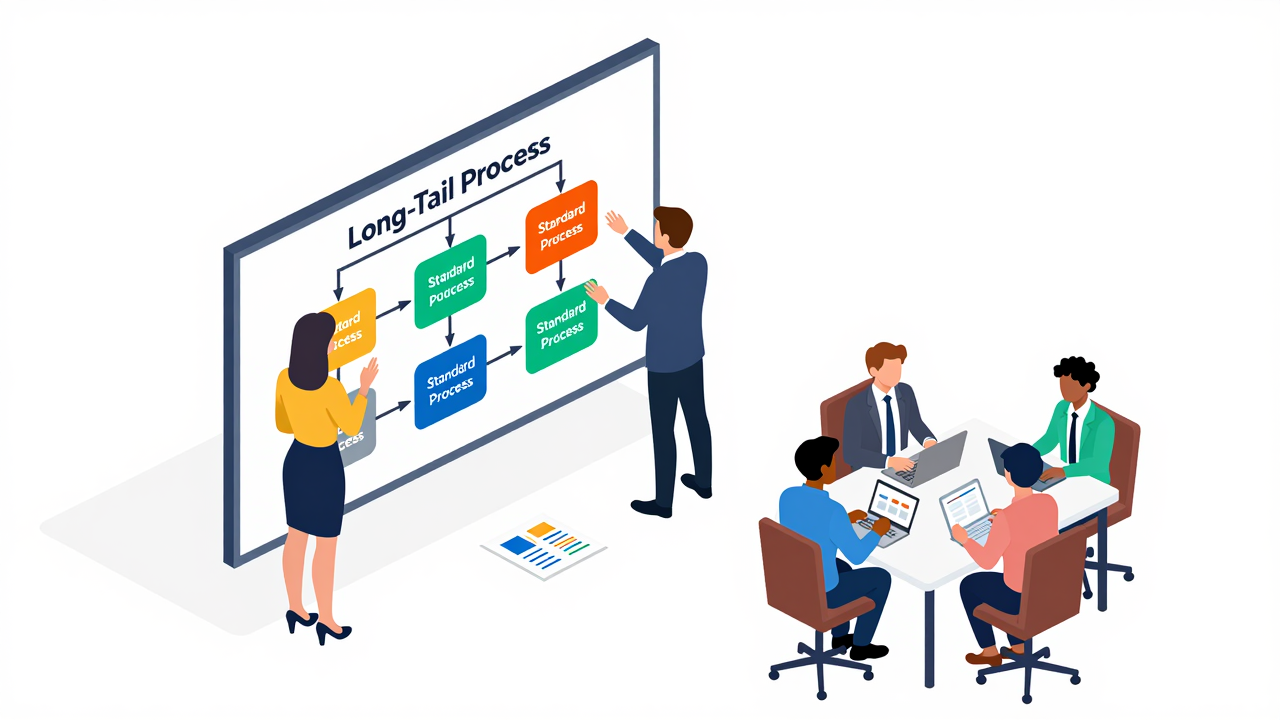
Understanding the differences between long-tail and standard business processes can help you optimize your workflow.
Long-tail processes are flexible and often evolve based on immediate needs, while standard processes provide consistency and repeatability.
Long-Tail Process Characteristics
While standard business processes offer structure and predictability, long-tail processes present unique challenges that require a different approach.
These ad hoc workflows often respond to changing business needs, involving high manual effort and inconsistent execution across departments. You’ll find that long-tail processes are typically unstructured, bridging gaps between systems and applications, which makes them dynamic and variable.
To manage them effectively, mix manual work with technology solutions. Embrace no-code automation tools; they empower you and your team to optimize workflows quickly without needing extensive technical skills.
Be prepared to adapt frequently based on feedback and shifting requirements, allowing your team to sidestep standard IT backlogs and respond more agilely to business demands.
Standard Process Characteristics
Standard business processes provide a reliable framework for operations, streamlining workflows and ensuring everyone knows their roles and responsibilities. These processes are structured and repeatable, featuring well-defined steps and outputs that focus on efficiency.
To implement standard processes effectively, document each step clearly and train your team on their specific roles. Regularly review these processes to optimize performance and eliminate inefficiencies.
In contrast, long-tail processes might arise from unique business needs and can be less structured, often requiring high manual effort.
Integrating standard processes with long-tail workflows helps bridge gaps, making your operations more agile. By managing both types effectively, you enhance operational efficiency and adapt quickly to changes in your environment.
How to Identify and Map Your Business Processes?

How can you effectively identify and map your business processes? Start by documenting each step in your workflows. Capture inputs, outputs, roles, and the interactions among stakeholders. This foundational work helps you see how everything fits together.
Next, use visual mapping techniques like flowcharts or process maps. These tools illustrate the sequence of activities and handoffs, making it easier for your team to understand the process.
Regularly review and analyze your mapped processes to spot inefficiencies and bottlenecks. This will allow you to make targeted improvements.
Consider employing business process management (BPM) software to centralize and automate your mapping efforts; it simplifies tracking and adjusting workflows in real time.
Finally, engage cross-functional teams during the mapping process. Their diverse insights will guarantee you capture all relevant perspectives, leading to a more thorough understanding of your processes.
The Importance of Process Thinking in Organizations

Understanding the significance of process thinking can transform your organization’s efficiency and effectiveness. By viewing operations holistically, you break down functional silos, enhancing communication and collaboration across departments.
Start by managing processes instead of isolated tasks; this aligns your operations with strategic goals and boosts overall performance.
To identify inefficiencies, map and analyze your business processes. This helps you spot redundancies and streamline workflows, optimizing resource allocation. For instance, if a process takes too long, consider revising steps to speed it up.
Effective process thinking can reduce compliance issues by 42% and accelerate your time-to-market by 25%.
Finally, embrace process thinking as a crucial part of your digital transformation. It prevents misclassification and misalignment, which can lead to wasted resources and ineffective automation.
Streamlining Processes: Templates for Efficiency
Streamlining your processes using templates can greatly boost efficiency across your organization. By standardizing workflows, you’ll reduce setup time and enhance consistency.
Here are three key benefits of using templates:
- Eliminate Redundancies: Templates help identify and remove unnecessary tasks, allowing your team to focus on activities that add real value.
- Visualize Workflows: Use templates to clearly map roles, responsibilities, and timelines, improving communication and reducing reliance on institutional knowledge.
- Accelerate Time-to-Market: Implement templates for client onboarding or project management, and you could speed up your processes by 25%, enhancing customer interactions.
Regularly review and update your templates to guarantee they remain relevant and effective.
This practice not only fosters continuous improvement but also contributes to operational excellence.
Tips for Managing Business Processes at Scale

To effectively manage business processes at scale, focus on establishing a solid framework that enhances efficiency and supports growth.
Start by implementing Business Process Management (BPM) software to centralize tracking and analysis, which boosts visibility and reduces setup time with reusable templates.
Next, regularly map and review your processes to identify inefficiencies and eliminate redundant tasks. This can notably streamline operations and improve productivity.
Utilize cloud-based BPM tools, as they offer built-in task allocation and monitoring features, making it easier to adjust processes as needed.
Conduct performance assessments using Key Performance Indicators (KPIs) to measure the effectiveness of your processes, allowing for guided continuous improvement.
Finally, classify your processes into core, support, and management categories. This step is essential for optimizing efforts and aligning them with your business goals, which helps prevent errors before considering automation.
Why Is Proper Classification of Processes Crucial Before Automation?

Before jumping into automation, getting your business processes classified correctly is key. Proper classification helps you identify which processes can be automated effectively, aligning them with your strategic goals. Here’s why you should focus on this:
- Avoid Misclassification: Incorrectly categorized processes can lead to wasted resources and errors during automation.
- Prioritize Impact: Understanding process types allows you to target automation efforts that will greatly enhance performance and efficiency.
- Improve Visibility: Clear classifications make it easier to monitor and optimize processes before automation.
When you classify your processes into core, support, and management categories, you lay a solid foundation for continuous improvement.
This guarantees that your automation efforts focus on processes that drive value and boost customer satisfaction.
Start by mapping out your processes, then categorize them to make informed decisions about your automation strategy.
Integrating AI Into Your Business Processes

Integrating AI into your business processes can markedly boost efficiency and streamline decision-making.
Start by identifying repetitive tasks that AI can automate, such as data entry or reporting, which can improve your project success rates.
Next, consider using no-code platforms to customize AI tools, allowing you to adapt workflows quickly without needing extensive technical skills.
Enhancing Process Efficiency
In today’s fast-paced business world, enhancing process efficiency is essential for staying competitive. Integrating AI into your operations can provide significant benefits, including:
- Automating repetitive tasks, boosting project success rates by up to 70%
- Offering real-time analytics to identify bottlenecks and optimize workflows
- Reducing manual errors, leading to a 25% faster time-to-market for new products
To get started, assess your current processes and identify repetitive tasks that AI can automate.
Use AI-driven analytics to gain insights into your workflow and make adjustments where necessary.
Encourage teams to use AI agents for better communication and collaboration.
Streamlining Decision-Making Automation
When you want to improve decision-making in your business, streamlining processes with AI can be a game changer. Start by integrating AI tools that analyze real-time data, helping you make quicker, informed choices.
Automate repetitive tasks within your decision-making workflows to boost efficiency and cut human error by nearly 70%. Use AI for predictive analytics to identify market trends, enhancing your strategic planning and resource allocation.
This can lead to a 25% reduction in time-to-decision, allowing you to adapt swiftly to changes. Finally, foster a culture of data-driven decision-making by empowering your team with actionable insights.
Key Metrics for Evaluating Business Process Effectiveness

Evaluating the effectiveness of your business processes starts with understanding key metrics that provide valuable insights. By focusing on specific indicators, you can pinpoint areas needing improvement.
Here are three essential metrics to contemplate:
- Cycle Time: This measures the total time taken to complete a process. Shorter cycle times often indicate better efficiency and speed.
- Error Rates: Tracking the frequency of mistakes helps assess quality. A high error rate signals the need for corrective actions.
- Throughput: This quantifies how much work gets done in a set timeframe. Higher throughput reflects better productivity and resource use.
Regularly analyzing these metrics allows you to make data-driven decisions, enhancing process optimization.
Start by setting benchmarks, then monitor these metrics consistently. Adjust your strategies based on the insights you gather, and watch your business processes improve over time.
Frequently Asked Questions

What Are the 4 Types of Business Processes?
The four types of business processes are operational, support, management, and long-tail.
You’ll want to focus on operational processes for tasks that create direct customer value, like production and order fulfillment.
Support processes, such as HR and IT, provide necessary resources.
Management processes involve planning and monitoring.
Finally, long-tail processes are unique, ad hoc workflows that adapt to specific needs.
Identifying and optimizing these can boost your organization’s efficiency and performance.
What Are the 5 Basic Business Processes?
The five basic business processes you should focus on are operational, support, management, core, and long-tail processes.
Start by identifying your operational processes that deliver value to customers, then guarantee your support processes provide necessary resources.
Next, implement management processes to align activities with goals.
Don’t forget to optimize core processes for revenue generation, and finally, develop long-tail processes to address unique needs.
Regularly review and adjust these processes for efficiency.
What Are the 4 Types of Processes?
The four types of processes in business are operational, support, management, and strategic.
To improve your organization, focus on operational processes that directly create customer value, like sales and fulfillment. Enhance support processes, such as HR, to back these operations.
Use management processes to plan and monitor activities, ensuring they align with your goals.
Finally, develop strategic processes that outline your business direction, including budgeting and performance assessments to guide long-term success.
What Are the 5 Core Business Processes?
The five core business processes you should focus on are marketing, sales, production, customer service, and product development.
Start by creating effective marketing strategies to attract customers. Then, streamline your sales process to close deals efficiently.
Guarantee your production delivers quality products on time. Focus on responsive customer service to build loyalty, and innovate through product development to meet changing market needs.
Regularly review these processes for continuous improvement.
Conclusion

In conclusion, understanding the types of business processes—core, support, and management—helps you streamline operations and enhance efficiency. Start by identifying your core activities and ensuring your support processes are aligned to facilitate them. Regularly assess your management processes to drive success and adapt when needed. As you consider automation or AI integration, remember to classify your processes properly. By taking these steps, you’ll create a more effective and responsive business environment.
Image via Google Gemini and Small Business Trends
This article, “What Are the Types of Processes in Business?” was first published on Small Business Trends