
This post was originally published on this site.
What could new rights for unmarried couples mean for your money?
 Image source, Getty Images
-
Published
When Amelia’s fiance died suddenly in his 20s, just months before their wedding, she never imagined the legal and financial turmoil that would follow.
“I lost him,” she says, “and then I lost everything we’d ever built together.”
The couple had been together more than seven years and shared a business. But they were not married and Simon did not have a will, so his mother and father inherited all of his assets – apart from the couple’s house – and Amelia was unable to stop them.
“I ended up in a legal battle with his parents,” says Amelia, whose real name and that of her late fiance we are not using for legal reasons.
Simon’s parents kept his car, phone and pension, as well as more personal items including his clothes, CDs and aftershave – as was their legal right. Amelia says she was also unable to get back her share of savings she’d transferred into an account in Simon’s name to pay for their upcoming wedding.
The experience left Amelia feeling like her relationship with Simon “meant nothing”, she says. “It felt like he was being ripped away from me again, every time something else was taken.
“Giving [over] the artwork from our bedroom wall and the shirt I wore to his funeral was ridiculously hard.”
Amelia says she spent nearly £10,000 on legal advice and trying to get back her share of the wedding savings. And though she was able to keep their house, as she and Simon had bought it as joint tenants, she now also has to pay his half of their mortgage.
Some of Amelia’s friends have been so spooked by her experience, they have since taken out wills and life insurance.
“Everyone just assumed that I was entitled to everything,” she says.
Currently, couples who live together but are unmarried have few legal rights if they separate or one dies without a will. But last month, the Ministry of Justice (MoJ) launched a 10-week consultation on proposals that would change this for people in England and Wales, external.
 Image source, Getty Images
Under the proposals, if one partner dies, the other would be able to inherit their assets in certain circumstances.
In the event of a break-up, one partner could be entitled to a lump-sum payment from the other.
The consultation is the first hurdle on a potentially lengthy road to the rules becoming law, and if the proposals do become a reality, they’d mark a huge change.
Countries like Sweden and Australia already have similar rules.
In England and Wales, campaign groups hope the proposals could make life easier for those who are widowed or trapped in abusive relationships.
But some have questioned the need for a new system, when marriage and civil partnerships already offer people the chance to become fully legally joined. Others want to know how the law might work, and whether they could opt out of the system.
What currently happens when a partner dies without a will?
 Image source, Getty Images
Many people wrongly believe co-habiting couples have automatic legal and inheritance rights under “common-law marriage”, says Alastair Sinclair, family lawyer at Setfords.
Instead, currently, if an unmarried person dies without a will, their partner would only be able to claim their assets under the Inheritance Act, which Hannah Mantle of law firm Forsters says is expensive, slow and “highly discretionary”.
How much money they receive is limited to what is deemed reasonable for maintenance, and would take into account their needs, their income and assets, the size of the estate, and the needs of other beneficiaries, Mantle says.
Amelia’s lawyer advised her against trying to claim her partner’s assets under the Inheritance Act because of the low value of Simon’s estate and high legal fees.
But one widow who spoke to BBC News via support group The Widowed Collective did decide to go down this route after losing her partner of seven years to cancer in 2024.
She says she spent tens of thousands of pounds on legal fees in order to get a small share of his estate under the Inheritance Act. The year-long process also took a toll on her mental health, she says, and was something she believes she “shouldn’t have had to go through” while grieving her partner.
How would the proposed law work when a partner dies without a will?
The government says the proposed changes to the inheritance system are designed to better reflect modern living habits. Many couples are now choosing to marry later or not marry at all, external.
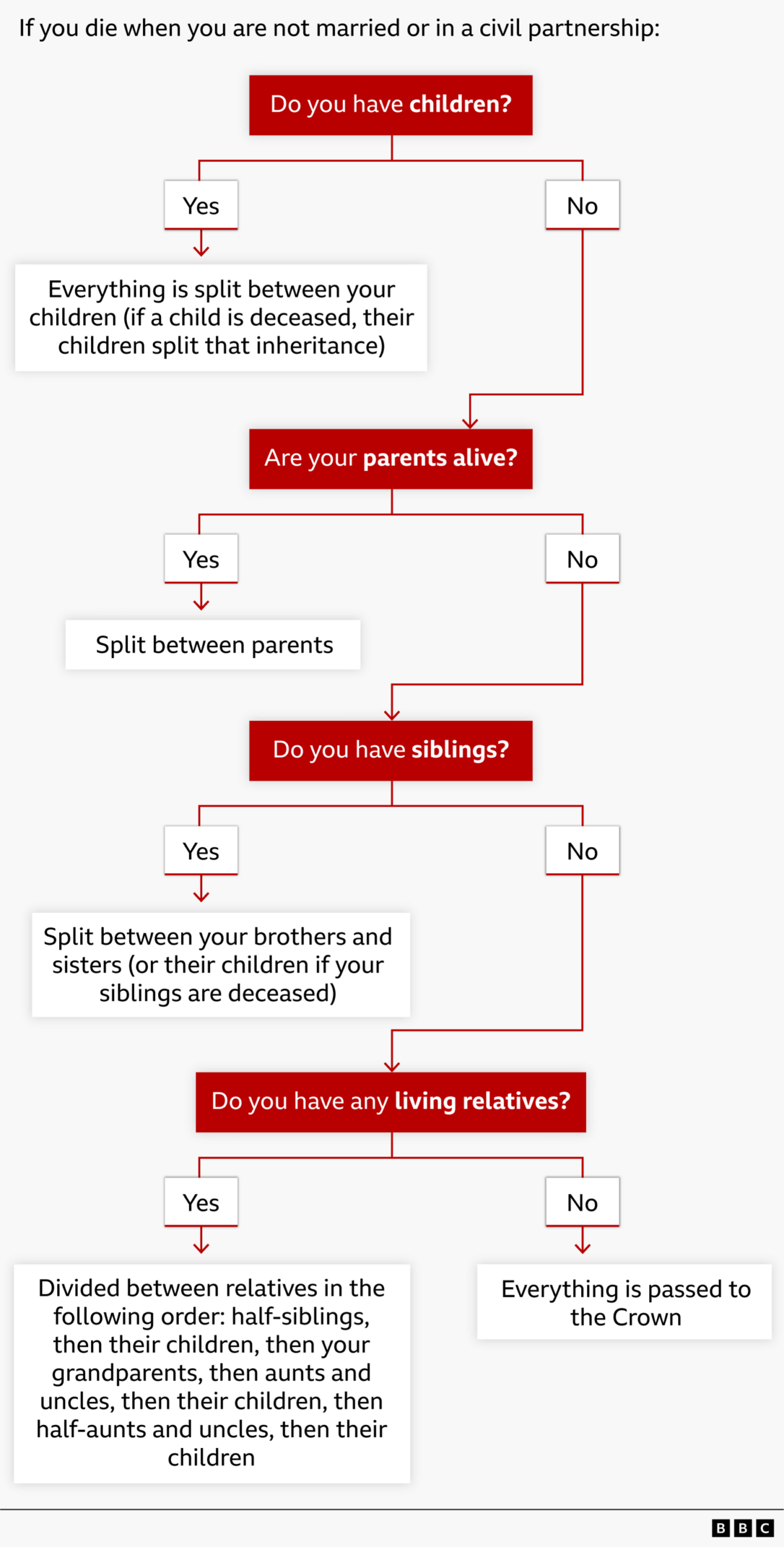
Intestacy rules provide a pecking order for who inherits a person’s assets when they die without a will, but currently do not recognise unmarried partners.
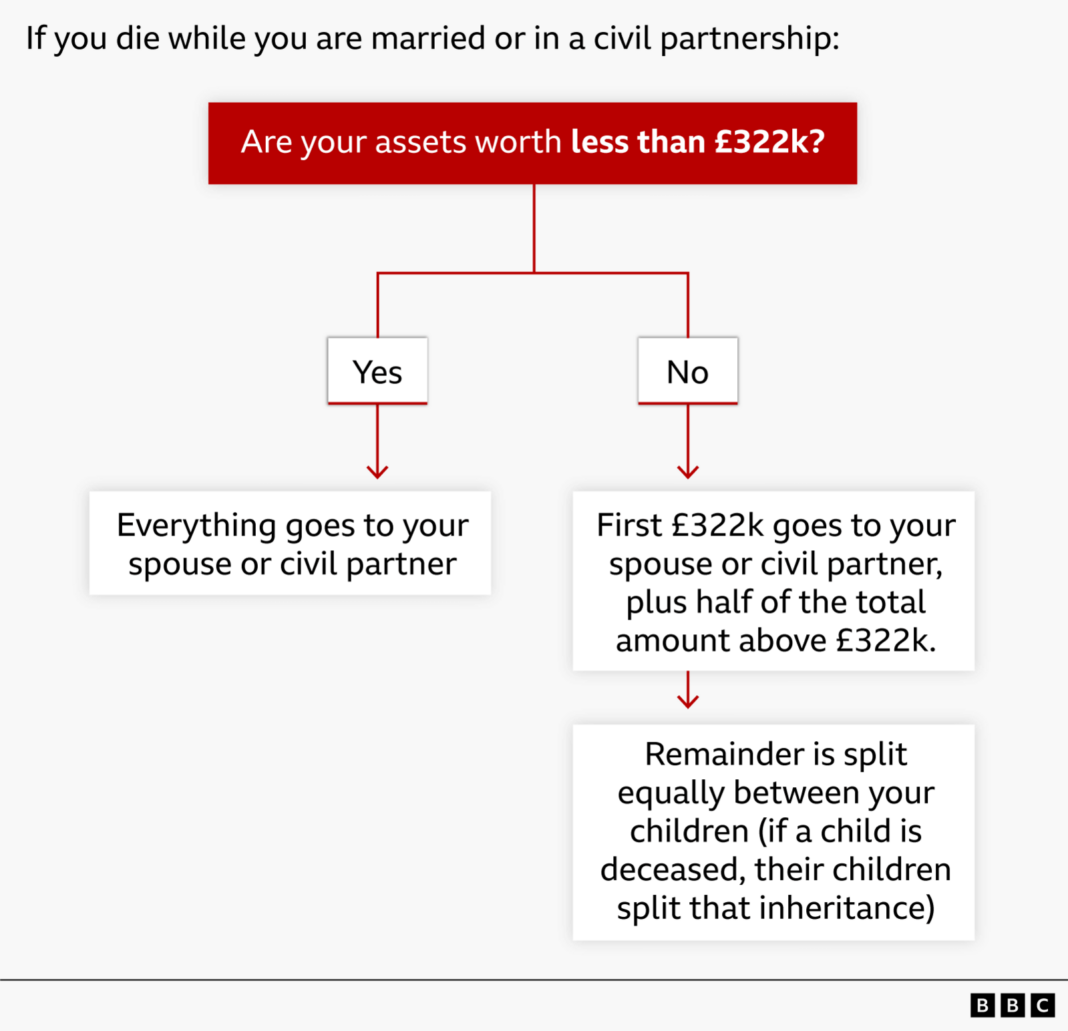
If a married person dies without a will, their estate goes to their spouse. If they were not married, their estate passes to their children if there are any, or otherwise to their parents.
Under the proposals, if someone dies without a will, the surviving partner would become the primary beneficiary of their deceased other half’s estate, provided they’d lived together for five years – or two years if the couple share a child.
But co-habiting couples would still not be in as favourable a position as if they had been married. The surviving co-habiting partner would still have to pay inheritance tax of 40% for anything above £325,000 – married partners are exempt from this.
For the new rights to apply, courts would have to rule that the couple were in a “marriage-equivalent” relationship. The consultation is looking into how this would be determined, and is considering factors such as people living together, sharing finances and others perceiving them as a couple.
How would the proposed law change work if you and your partner separated?
The MoJ consultation also proposes stronger financial rights for co-habiting couples if they separate, with couples deemed to qualify if they have been living together for at least three years or have a child together.
The rights would not be as extensive as for married couples and are not about sharing resources, says Edwards. Instead, a partner could be awarded a lump sum, transfer of property or pension share – but only if it were needed to meet basic needs, she says.
Edwards believes the proposed changes would be “transformational” for people experiencing domestic violence or coercive and controlling behaviour, who may otherwise be unable to afford to leave a relationship.
“We’re really pleased to see this consultation,” says Sam Smethers, CEO of the charity Surviving Economic Abuse, which has been campaigning for a reform to co-habiting laws.
Under the current system, people in co-habiting relationships who experience economic abuse must “walk away from their home, their savings, their financial security, just to escape the abuse”, she says. Legal routes for them to get access to their property after a separation are “very expensive and difficult to pursue” and they aren’t often successful in making their claims, she says.
Couples would be able to mutually opt out of the proposed new rights, as long as they meet certain safeguards, which could include getting independent legal advice and disclosing their financial situation to their partner.
Edwards says she thinks an opt-out system is the right way forward. “Too many people at present find out only too late that they have no rights at the end of a relationship,” she says.
Some critics of the proposals say they chose not to marry because they wanted to keep finances totally separate. “That was a conscious decision,” one person wrote on Mumsnet, external. “An opt-out scheme just reverses that default and makes us go through hoops to preserve it.”
Others say there are issues not covered by current proposals that they would like the government to address. Selina Flavius, from the charity Widowed and Young, says that after her fiance died, she would have liked the legal entitlement to have been involved in his funeral planning, as well as bereavement support payments.
 Image source, Getty Images
What rights do co-habiting couples have in other countries?
In Australia, co-habiting couples who have lived together for two years are legally considered to be in what is known as a “de facto” relationship.
If they separate, their assets are divided based on each partner’s contributions to the household and future needs, says family lawyer Byron Leong, from Australian law firm Lander & Rogers.
If one partner dies without a will, the surviving partner would typically inherit in the same way as a spouse, Leong says.
The biggest difficulty is trying to prove whether a relationship existed in the first place, for example, in cases where couples lived separately, kept their finances separate or disagreed about when the relationship started and ended, Leong says.
Many Australians now know de facto relationships have legal implications, but Leong suspects few understand these fully and may not realise, for example, that property in one person’s name could be taken into account when dividing assets.
Sweden also offers some rights for co-habiting couples on separation, including the division of some joint property.
When the Swedish law was introduced, supporters said it gave a legal safety net to the less well-off partner, while critics argued it diminished the status of marriage and ignored the wishes of those who had chosen not to marry to avoid legal ties, says Pierre Kryhl, senior lawyer at Swedish law firm Familjens Jurist.
Meanwhile, Amelia says she’s now qualified as a will writer in the hope she can encourage her friends and family to take out wills.
But for people who don’t, lawyers say the proposals would provide a safety net.
“I really hope that nobody ever has to go through what I went through,” Amelia says.
-
-
Published12 June
-
-
-
Published5 February
-