

This post was originally published on this site.
Saudi Arabia-backed LIV Golf drove a wedge through the world of golf, spending billions of pounds to entice some of the sport’s biggest names to its global series.
But as the team-based breakaway competition prepares for the start of its fifth season, uncertainty surrounds its future.
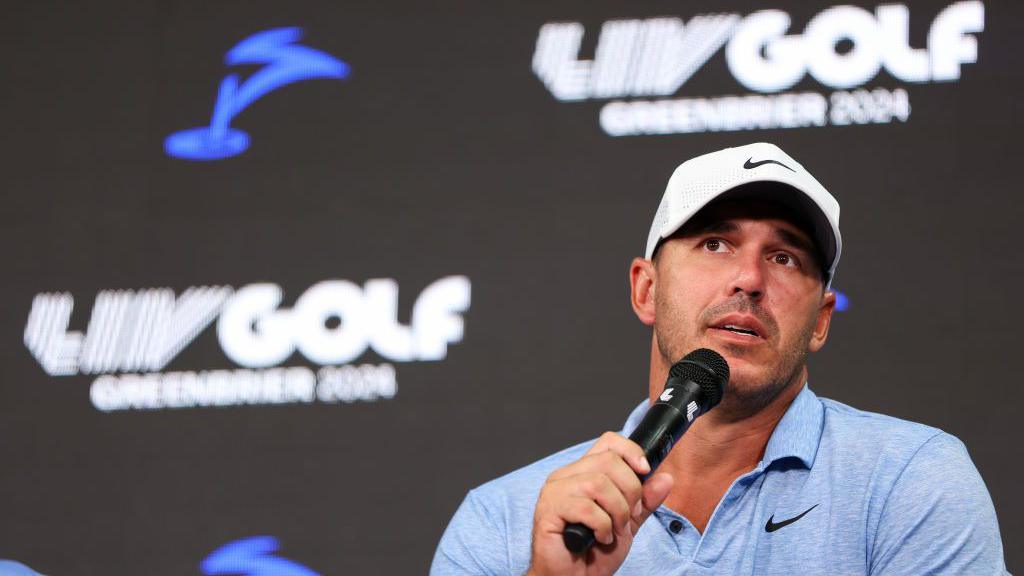
In December five-time major champion Brooks Koepka became LIV’s first star player to return to the traditional PGA Tour. Days later, fellow American Patrick Reed said he would consider following suit if he was offered the same terms.
So will other big names quit the breakaway competition? What forces are at play? And how – and will – LIV respond?
Having defected to LIV in 2022, and been banned from the PGA Tour as a result, former world number one Koepka sent shockwaves through golf when he announced he was leaving to prioritise “the needs of his family”.
He applied for reinstatement to the PGA Tour under a new ‘Returning Member Programme’, which the US-based series opened to those who had won a major – or The Players Championship – since 2022.
The PGA Tour’s new chief executive Brian Rolapp said the one-time offer – which would only last until 2 February and would require those accepting it to be subject to “severe and justified” financial penalties which could amount to tens of millions of pounds – was “part of our commitment to fans who expect the world’s best players to compete on the PGA Tour week in, week out”.
Known to want a more structured golfing calendar that is easier for sports fans to understand, Rolapp added that “we will continue to aggressively pursue anything that enhances the fan experience and makes the PGA Tour stronger”.
Amid talk of a potential exodus, fellow marquee players Jon Rahm, Bryson DeChambeau, and Cam Smith – the only other LIV players to qualify for the PGA Tour’s programme – all then indicated they would remain with breakaway circuit.
But crucially the door had been opened, with Reed (who won the Masters in 2018), telling the Daily Telegraph that he too would think about leaving LIV to return to “the best tour in the world” if the conditions for doing so were relaxed. Until Koepka was granted his exemption, the Tour had suspended players who competed in LIV events for a full year after their last event.
Meanwhile, Masters champion Rory McIlroy – who had previously criticised LIV’s “irrational spending” on huge player contracts – hinted that a lack of any major new signings over the past two years could indicate that the series was in decline. “They haven’t signed anyone who moves the needle and I don’t think they will,” he said.
‘This is a first move’
So what lies behind the PGA Tour going on the offensive, and how big a challenge is it to LIV?
Back in 2022, the PGA Tour had called LIV “an existential threat” after its offers of lucrative contracts threatened a civil war between the two organisations.
However, the following year a framework agreement was announced, ending the threat of litigation and appearing to pave the way for a shock merger.
Crucially however, the PGA Tour then agreed a private equity deal worth around £2.3bn with a group of American investors led by the Fenway Sports Group, which owns Liverpool FC, with golfers who remained loyal receiving equity in a new profit-seeking enterprise.
The PGA Tour said that its deal allowed for co-investment from Saudi Arabia’s Public Investment Fund (PIF), which bankrolls LIV. But even though US President Donald Trump – whose courses have staged LIV events – then hosted what the PGA Tour called “constructive” talks over the “reunification” of golf at the White House, the conversation stalled, and ratification of the framework agreement never materialised.
“Ever since our talks at the White House last February, there were always ways [to] make our sport unified again,” PGA Tour player director Tiger Woods said this week when asked about the American circuit’s attempt to lure back some of its former stars.
“Is it total unification, some type of integration, how do we do it, where do we do it? Different tours are involved. But this is a first move, which is a great move.”
Perhaps mindful of their investors’ desire to generate as much interest in their product as possible, and feeling emboldened since their arrival, the PGA Tour’s new approach proved crucial to the return of Koepka. “I believe in where [it] is headed with new leadership, new investors and an equity program that gives players a meaningful ownership stake”, he said.
With some of golf’s major sponsors known to want an end to the fracture running through the sport, it will be interesting to see if the Europe-based DP World Tour offers a similar olive branch to the likes of Rahm and Tyrrell Hatton, both of who are currently appealing against sanctions imposed for playing in LIV events.
It seems much now could hinge on the charismatic and big-hitting DeChambeau, the most followed golf star on social media, and who – with one more season left on his LIV contract – now finds himself in the strongest of bargaining positions.
The American is reportedly demanding $500m (£372m) to stay with LIV, and when asked if he might follow Koepka, simply said, “I’m contracted through 2026, so excited about this year”.
It did not sound like a long-term commitment. By then DeChambeau had posted a cryptic photo of him staring next to an ‘exit’ sign, along with a message asking his followers ‘What would you do?’
A ‘shift’ in Saudi investment?
 Getty Images
If LIV is troubled by Koepka’s exit a year before his contract was due to end, it seems determined not to show it.
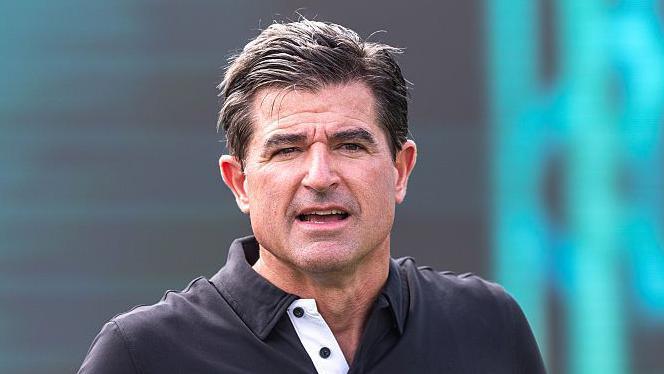
“I love where we are. We’re in really good shape as we walk into 2026,” insisted its chief executive Scott O’Neil when asked about the news, admitting that he would have done the same as the PGA Tour.
Last month, O’Neil told BBC Sport that he was optimistic LIV will secure official world golf ranking points for players in 2026, having pleased some of his players by moving from a 54-hole format to the more traditional 72 holes for the coming season, which will feature 14 events across 10 countries in five continents.
“There is no ‘holy war’, at least from our side,” he insisted, adding “there’s not a shadow of a doubt in my mind” that Rahm, DeChambeau and Smith were fully committed.
LIV also released a statement in which it said it “championed an open ecosystem and freedom for all”, and that its “vision remains unchanged – to grow the game of golf globally”.
“As the world’s golf league,” the statement continued, “LIV Golf continues to offer the best professional golfers the most competitive, challenging, and lucrative environments in which to pursue greatness on a global scale.”
Others however, are less bullish about LIV’s prospects.
Speaking on condition of anonymity, one senior source in Saudi Arabia told BBC Sport that towards the end of last year there was “a shift” in the kingdom’s attitude towards some investments, with “everything in the PIF world under serious review”.
They added: “Since then, more money has been put into AI and the tech sector. There is pressure in Saudi Arabia to make sure that we’re inviting in the right things that are sustainable and bring a return, and I don’t see how LIV Golf is going to do that.
“It has had new sponsors such as Rolex and HSBC, that’s but not enough to get anywhere close to what the players are being paid.”
Indeed, last year it was revealed that LIV’s net losses in its international markets outside of the US had spiralled to $461.8m in 2024, meaning that it had lost more than $1.1bn since it was established in 2021. PIF’s overall investment in LIV was reportedly approaching $5bn.
Broadcast rights were said to have raised just $2.7m.
Meanwhile, this all comes at a time when PIF was said to be running low on cash for new investments, partly down to low oil prices.
‘Appetite for sport undiminished’
The PIF declined to comment, but others familiar with Saudi Arabia’s sovereign wealth fund insist that nothing has changed.
“It was always expected that some players would go back”, one told BBC Sport. “It’s still early days and it can take time to get where you want to be, but LIV is moving in the right direction.
“You can’t just keep signing big names year in, year out. The appetite for sport is undiminished – it was natural that the flurry of a few years ago was not going to continue at the same pace and winning the [right to host the] 2034 World Cup means that’s a big focus for the government.”
“The point everyone at LIV tries to make is it’s not meant to be like the PGA [Tour] – it’s global and a very different proposition.”
BBC Sport has been told that PIF is close to announcing a new strategy that will run from 2026-30, but that sport is expected to remain one of its key priorities as part of the restructure.
LIV points out that its pursuit of a new audience is paying off with 50% of ticket purchasers under the age of 45, with half of those women. It says its Adelaide event last year attracted more than 100,000 spectators, a new record. And that it has generated more than $1bn in economic impact across the globe to date, with a string of new broadcast partnerships.
It also points out that it still boasts the likes of Phil Mickelson, Dustin Johnson, Sergio Garcia, Bubba Watson, Henrik Stenson, Ian Poulter, and Lee Westwood among its playing roster.
However, the sense from some in golf is that the situation is delicately poised.
“Koepka’s not been been happy since day one, so his departure is not a surprise or an indictment”, says one well-placed source in European golf.
“But if any of Rahm, Smith or DeChambeau go, that could be game over, because every other player at LIV would say ‘Is there a future here?’
“They’ve all got reasons to be at LIV. Rahm wanted to play less and get paid more. Australian Cameron Smith didn’t like the US focus of the PGA Tour.”
But the one to watch is DeChambeau. With the PGA Tour going on the offensive, how hard LIV’s paymasters fight to keep him may well go a long way to dictating the future credibility of the series, and the game it has divided.


