
Brain-health labs
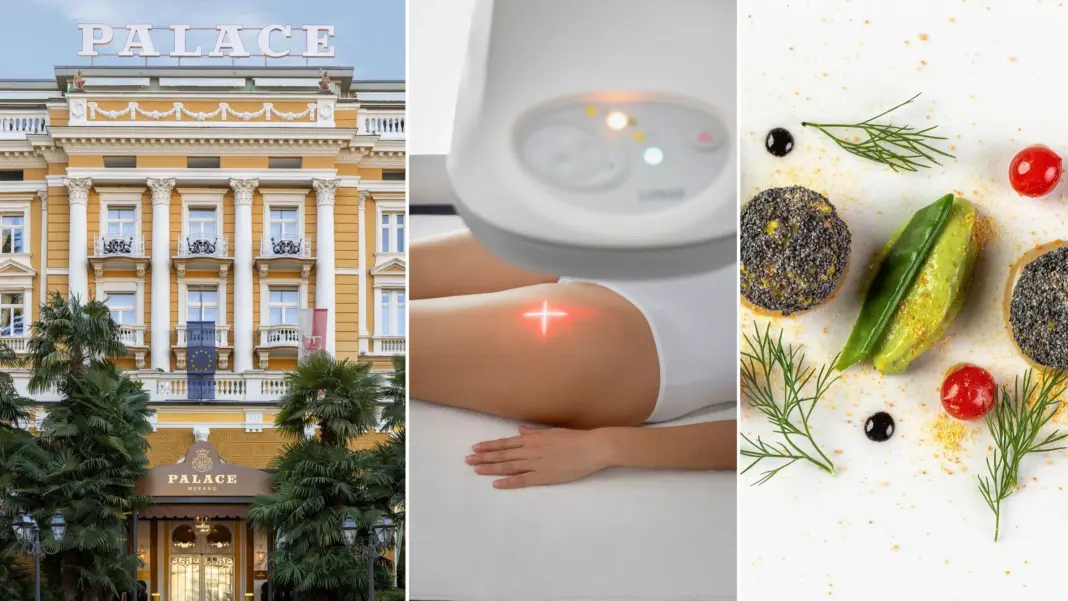
Given my special interest, Dr. Ebner adds an afternoon with Alex, a coach at the Palace’s sports and recovery lab, which includes a cognitive division. While the lab is traditionally popular among athletes for how profoundly its activities can improve mind-body connection in sports, many detox participants like me are adding cognitive testing to support focus, memory, and overall mental efficiency.
“Our cognitive tests are part of a broader approach to brain health, prevention and wellbeing,” says Schwazer. “Through exercises involving attention, concentration and memory, it can help keep certain cognitive functions active while increasing awareness of individual cognitive abilities.”
The test apparatus is a wheeled rack of six blue LED pods, mounted at staggered heights, that each flash numbers or symbols at me. In all three tests—memory, attention, and reactivity—my job is to follow them, and Schwazer encourages me every step of the way, even when I get one wrong. The better I do, the faster and more complicated it gets, as the test is designed to find my edge. My attention comes back at 251 milliseconds, a number I have no way to interpret until Schwazer tells me it’s “good.” The written report he gives me puts my attention and memory in the higher range of the average population, which I take as a win. He also gives me remote access to the Palace’s exercises, so I can keep practicing at home.
At more spiritually focused retreats I’ve experienced brain mapping—electrodes on the scalp, measuring electrical activity while you sit still. The testing Schwazer ran me through is quite different: more scientific, mathematical. He tells me brain mapping can provide interesting insights, but it’s often insufficient because it measures brain activity in a static state, whereas the tests he had his team at Palace Merano run force the brain into an active state, yielding a better read of how the brain is actually functioning.