
This post was originally published on this site.
Sofia Ferreira Santosand
Alicia Curry

 Reuters
At least 39 people have died and dozens more have been injured after two high-speed trains collided in southern Spain, the country’s Civil Guard has said.
The incident near the city of Córdoba has been described by local officials as Spain’s worst rail crash in more than a decade.
Prime Minister Pedro Sánchez visited the scene on Monday, where he announced a three-day mourning period.
Here’s what we know about the incident so far.
Where did the crash happen?
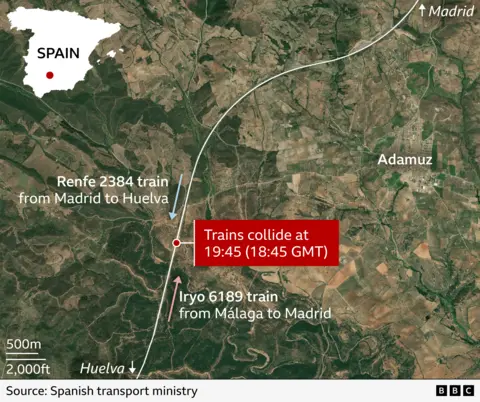
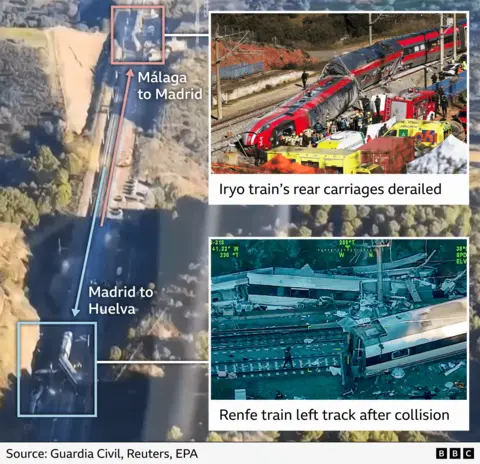
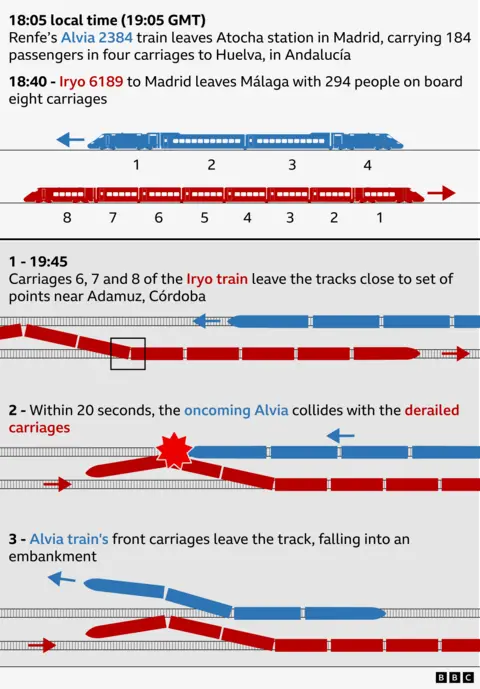
The crash occurred at around 19:45 local time (18:45 GMT) on Sunday, about an hour after one of the trains departed Málaga for Madrid.
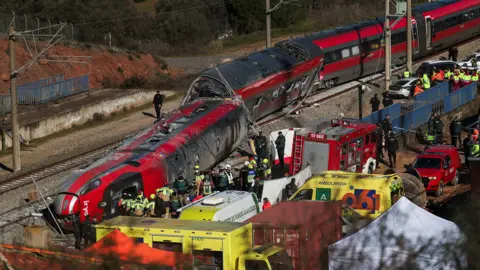
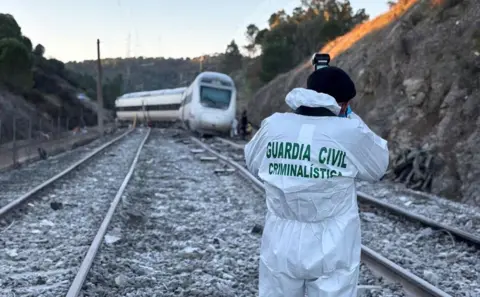
The train derailed and crossed over to the opposite track, operator Adif said.
It then collided with an oncoming train travelling from south Madrid to Huelva, which was forced into an embankment running alongside the track, Spain’s Transport Minister Óscar Puente said on Sunday.
The majority of those killed and injured were in the front carriages of the Huelva-bound train, he added.
What caused the crash?
What caused the train to derail remains unclear.
Officials say an investigation has been launched but it is not expected to determine what happened for at least a month.
Puente has described the crash as “extremely strange” and said all the railway experts consulted by the government “are extremely baffled by the accident”.
The president of Spain’s state-owned rail operator, Renfe, said he had “discarded” the possibility that the incident occured due to excessive speed or human error.
Álvaro Fernández Heredia told Spain’s national radio RNE that even if a mistake had been made, a system within the train would have fixed it.
He added that both trains were travelling under the maximum speed limit on the stretch of track where the crash happened.
Fernández Heredia suggested a mechanical fault or an infrastructure issue was a more likely cause.
Meanwhile, at a news conference during his visit to Adamuz, Prime Minister Sánchez vowed to uncover the cause of the crash and thanked emergency workers for their help “in a moment of such pain and tragedy”.
Are people still trapped in the trains?
 Spanish Guardia Civil / Handout via Reuters
There were around 400 passengers and staff on the two trains, operated by Iryo and Renfe, according to a statement from Renfe.
It is not clear if there are people still trapped inside the carriages but rescue teams are on site.
“The problem is that the carriages are twisted, so the metal is twisted with the people inside,” Francisco Carmona, head of firefighters in Córdoba, told Spanish public broadcaster RTVE.
“We have even had to remove a dead person to be able to reach someone alive. It is hard, tricky work,” he added.
The president of the Andalusian regional government, Juanma Moreno, told local outlet Canal Sur that they are waiting for “heavy machinery” to “practically lift” parts of the second train, which “has taken the worst part of this accident”.
“Until the heavy machinery can do its job and free the wagons from the track”, emergency services will not be able to start “searching and identifying” any remaining victims, he added.
Who are the victims?
The 39 victims of the crash have not yet been identified, with Puente saying the death toll “is not yet final” as investigations into the crash commence.
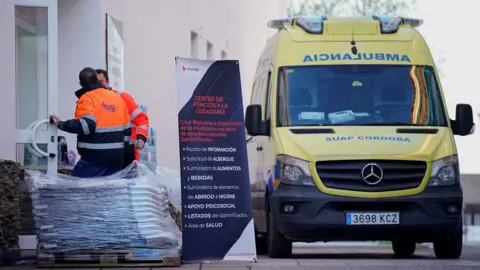
As of Monday afternoon, 122 people had received medical assistance, 48 of whom remained hospitalised, local emergency services said.
Among the 48 victims still in hospital, five are under the age of 18.
Moreno said teams are working to identify those who have died.
What have the survivors said?
 Reuters
Passengers on board the Madrid-bound train described the moment of impact feeling like an “earthquake” and said it shattered the train’s windows, displaced luggage and threw people to the floor.
“I was in the first carriage. There was a moment when it felt like an earthquake and the train had indeed derailed,” journalist Salvador Jimenez told Canal Sur.
“There were people screaming, calling for doctors,” he added.
Another passenger, Lucas Meriako, told Spanish broadcaster La Sexta Noticias he was in the fifth carriage of the same train when he started to “feel some banging” that got louder and louder.
“Another train passed us and everything started vibrating. There was a jolt behind us and the feeling that the whole train was going to fall apart,” he described.