
This post was originally published on this site.
What we should make of CIA boss’s secret trip to Moscow
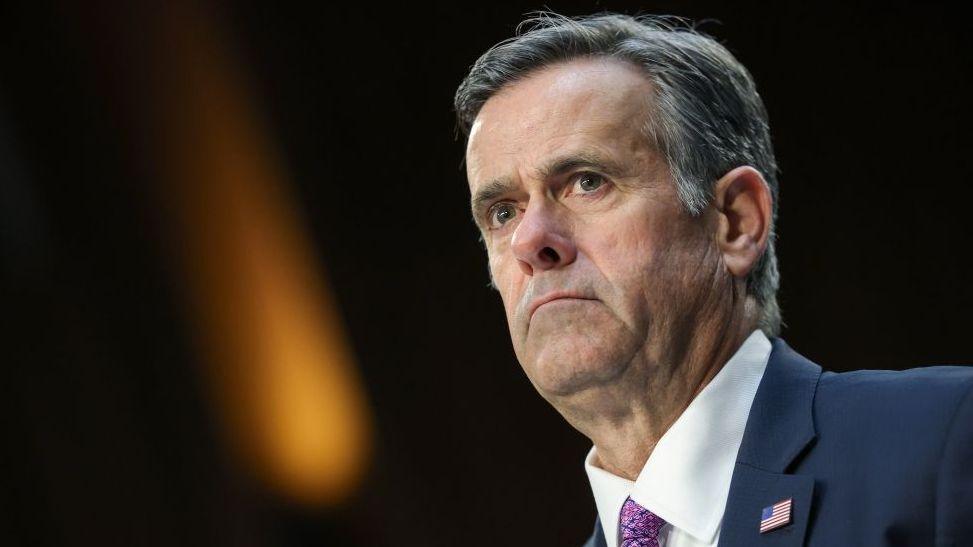 Image source, Getty Images
-
Published
President Donald Trump said John Ratcliffe’s trip to Russia was a “semi-routine” visit but there is nothing routine about the CIA chief making a secret, 10,000-mile return dash to Moscow.
Ratcliffe met Russian intelligence officials on Tuesday – notably his opposite number in Russia’s overseas spy agency, Sergei Naryshkin – after arriving unannounced on a US military plane, the Kremlin confirmed.
It’s been nearly five years since his predecessor William Burns made this trip and that was at a similarly tense time, just as Russia was drawing up plans to invade Ukraine. So, this is probably serious.
In the absence of any official US comment on the reason for the mission, it is being widely reported Ratcliffe’s trip was to warn Moscow not to escalate in relation to the stalemate in Ukraine – possibly by taking action against Nato members.
One US official told Politico that the “meeting was primarily to warn Russia against any escalatory action against the Baltic states”.
The UK is also in Russian crosshairs. On Thursday, a foreign ministry spokeswoman said Russia could strike British military targets as retaliation for Ukrainian strikes on Russia using British missiles.
And a drone carrying an explosive which was discovered at an airport in the German city of Leipzig was probably Russian, security experts have said.
News of Ratcliffe’s visit follows reports of US intelligence assessments that President Vladimir Putin was planning a limited assault on a Nato ally.
But you don’t need the world’s most powerful electronic eavesdropping organisation – the US National Security Agency – to know that Putin is under mounting domestic pressure to “do something” to break the deadlock.
Ukraine’s deep strikes with long-range drones have not only hammered Russia’s energy industry, they have brought the war home to ordinary Russians.
Nothing says things are not going to plan more than long queues for petrol and billowing smoke coming from stricken oil refineries. The Kremlin sees these attacks as Nato fighting an indirect war on Russia by using Ukraine as a proxy.
So how will Russia respond? There is a broad spectrum of possibilities here.
These include stepping up the ballistic missile attacks on Ukraine that Moscow is already launching, including targeting the centre of Kyiv, knowing that Ukraine is running dangerously low on Patriot interceptors to stop them.
It could entail expanding the undeclared “hybrid war” that Russia is already suspected of waging against Nato countries, using sophisticated cyber-attacks, drone incursions and using not-so-sophisticated criminals to carry out arson attacks on munitions factories.
But at the even more alarming end of the scale there are other potential scenarios which the Kremlin may be considering, urged on by hardliners.
One is to distract attention from its obvious failure to win the war in Ukraine by testing Nato’s resolve through a limited attack on a Baltic state. Estonia, Latvia and Lithuania were all once part of the Soviet Union, effectively ruled from Moscow until 1991.
Today they are all members of Nato, while still being home to substantial Russian-speaking communities.
To play this video you need to enable JavaScript in your browser.
This video can not be played
Putin will be well aware of Donald Trump’s periodic disdain for Nato and he may have calculated that a low-key attack on say, Lithuania, is not going to trigger Nato’s mutual self-defence clause – Article 5 – and that the US will not respond.
In which case it would make sense for part of the CIA chief’s unexplained mission to Moscow was to remind Russia that the US is still fully committed to Article 5.
Lithuania is of special interest to the Kremlin as it has a common border with Poland known as the “Suwalki Gap”. Just 60 miles long, this strip of land is all that separates Russia’s client state Belarus from its nuclear-armed exclave of Kaliningrad, which is separated from mainland Russia.
If Russia were to seize that it would effectively cut off those three Baltic states by land from their Nato neighbours.
Then there is the question of tactical nuclear warheads. It has long been said that Russian military doctrine views these small but highly destructive weapons as an integral part of its order of battle.
Moscow has been warned off, by friend and foe alike, not to break the 81-year long taboo on using nuclear weapons in anger.
Yet this could still be a tempting option for Vladimir Putin to “escalate to de-escalate” by demonstrating to Ukraine that it has such catastrophic weapons at its disposal it would be better for Kyiv to capitulate to Moscow’s terms now or face annihilation.
Of course, in the absence of any clear, attributable, official confirmation from the US as to what this sudden CIA dash to Moscow was all about then it is always possible it was about something else.
That could be trying to persuade Russia to end its military cooperation with Iran, for example, or maybe about more prisoner swaps or the prospect of a mass mobilisation of Russian troops.
But make no mistake, this trip was highly unusual and it came at a time of rising tension between Moscow and the West. Something is almost certainly up.