
This post was originally published on this site.
 Getty Images
McLaren team principal Andrea Stella says the world champions have faced an “unprecedented” amount of work to prepare for the new rules in Formula 1 this season.
Teams are facing what is widely regarded as the biggest regulation change in history, with new cars, engines, fuel and tyres.
Stella said: “There’s been so much work behind the design, the realisation, the build of the 2026 cars that, for what I can remember is almost unprecedented, because never before has there been such a huge and simultaneous change of chassis, power unit and tyres.
“But even the sheer volume of redesigning that went through the last 20 months at McLaren has been probably the biggest design, or in general, dealing with a new car project that I was a part of.
“This all makes it extremely interesting to see how the cars will perform, how the competitiveness order will be somehow mixed up.
“We are champions, but we don’t carry being champions into 2026. Everyone will start from the starting blocks – everyone will start from zero.”
Stella said McLaren would not be ready to run their new car on the first day of the first pre-season test in Spain next week because they wanted to give themselves as much time as possible to design their car, to maximise performance.
The test runs behind closed doors, with no access for independent media, from 26-30 January at Barcelona’s Circuit de Barcelona-Catalunya, where teams are permitted to run on three of the five days.
The new Cadillac and Audi teams and Racing Bulls have already given their cars ‘shakedown’ tests, while Mercedes are due to run at Silverstone on Thursday. Others, including Aston Martin, are known to be following McLaren’s route of not running until well into the Barcelona test.
“We plan to start testing either in day two or day three, so we will not be testing in day one,” Stella said.
“We wanted to give ourselves as much time as possible for development, because every day of development, every day of design was adding a little bit of performance.
“If you are early on track you will have the reassurance of knowing what you need to know as soon as possible. But at the same time it means that you might have committed to the design and the realisation of the car relatively early, so you will have a compromise against development time and ultimate performance.”
Racing may be ‘weird’
Stella said the extent of the rule changes was such that F1 racing in 2026 “may look a little weird”.
On-track running will be defined by energy management, because the electrical part of the hybrid engines now supplies about 50% of the total power output, but the amount of energy that can be recovered is limited.
So drivers will have to make choices about when to expend energy at various points on a lap for optimum racing.
“It may look a little weird that one car can overtake so easily another car,” Stella said.
“It’s important the spectators understand why that was so easily [done], or even that in one car the battery is now quite full, while the car ahead has the battery quite empty. Therefore, something [new] is coming from a racing point of view.
“The power-unit exploitation as a racing and overtaking variable will be particularly important in being able to communicate effectively to our spectators.”
McLaren technical director for performance, Mark Temple, said: “Now we have a similar capacity battery but you have a higher level of power. So you can use that more on a single straight, get a bigger boost in that one straight from that extra battery capacity.
“But then maybe your [battery] pack is empty. If you press your boost mode and you choose to use all of the energy, you’ll then go into the next corner and come out of it with only what you were able to recover in that corner. And that could then leave you exposed in a following straight, which maybe traditionally wouldn’t be such an opportunity.
“The most interesting aspect, and in a way the thing that’s the hardest to simulate, is going to be those kind of overtaking, attacking, and defending scenarios. In 2026 the amount of energy that you have will be much more of a factor in the strategy.”
Drivers will still be free to compete
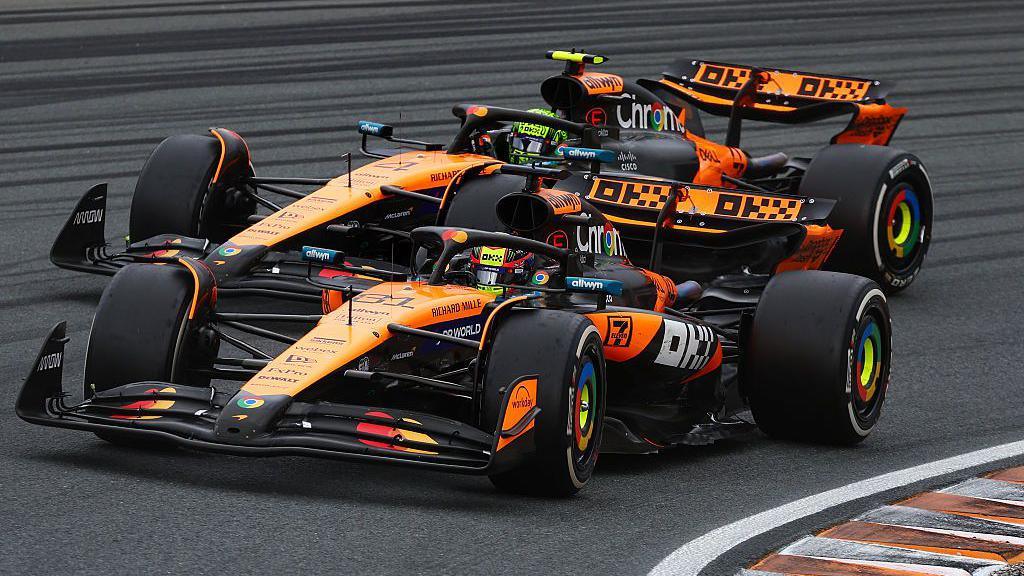
Stella said McLaren had reviewed they way they operated last season as drivers Lando Norris and Oscar Piastri battled for the championship and agreed that allowing them to race each other would continue into 2026.
The team faced a number of difficult situations as they tried to operate in what they considered a fair manner.
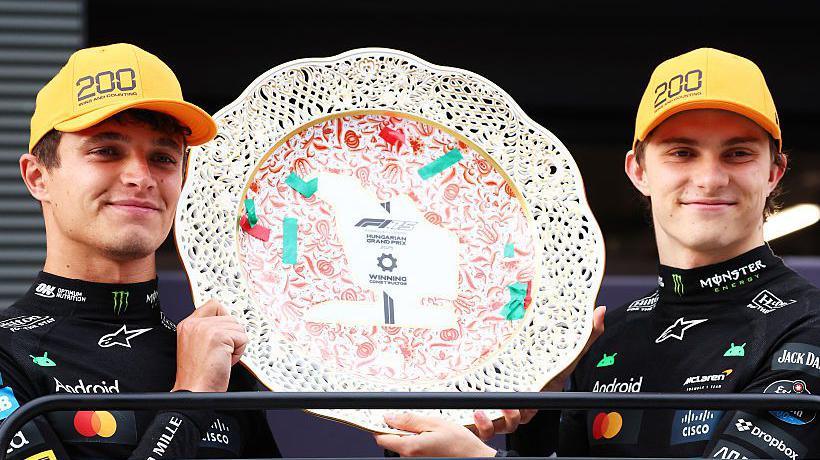
These included Norris being allowed to run a different strategy at the Hungarian Grand Prix, which ended up with him beating Paistri to the win even though the Australian was ahead in the early part of the race.
In Italy, Piastri was ordered to give second place back to Norris after the Briton lost it following a team intervention on strategy and a slow pit stop.
And there were incidents in Singapore and Austin where their cars touched – with varying seriousness – which also required managing.
Throughout, both drivers insisted the team’s approach was the one they favoured as they each wanted the best chance to win the championship. Norris ended up beating Red Bull’s Max Verstappen to the title by two points, with Paistri finishing third.
“We talked last year quite a bit about internal racing at McLaren. From that point of view, we will enter 2026 with continuity – we will keep racing the McLaren way,” said Stella.
“If we have been able to achieve success in 2024 and then in 2025, what has added extra value is the way in which we have achieved in such a collaborative, supportive, cohesive way together with our drivers.
“All this has led us to reaffirm fundamentally that the concepts of fairness, integrity, equal opportunities, sportsmanship – they are all fundamental for the team, for Lando and for Oscar. They are confirmed and consolidated, if anything.”
But Stella acknowledged there were ways in which the team could “streamline” operations.
“At the same time, we all acknowledge that the volume of work required, for instance, for the team and to some extent even for the drivers related to internal competition was important,” he said.
“Therefore, any attempt we can make to make this going racing together just simpler to some extent will be welcome. It will be in reality a matter of fine-tuning because once we reviewed what we have done, in most of the cases we said that’s exactly what we would still do again.
“But we have found a few opportunities in which we can streamline the way in which we operate collectively.”