
This post was originally published on this site.
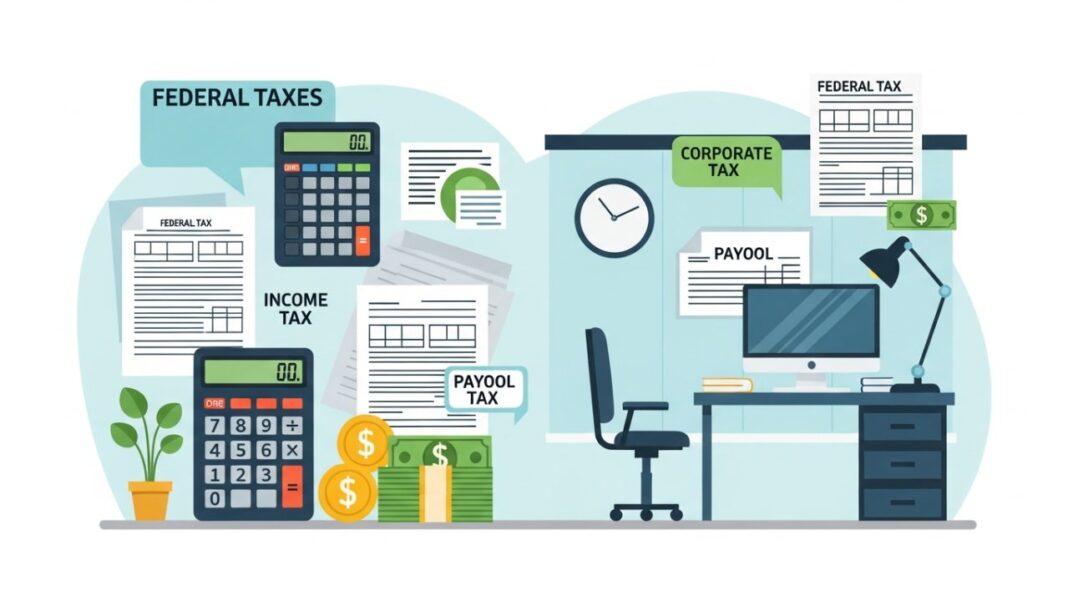
Regarding federal taxes, comprehending the different types can help you grasp how government funding works. Individual income tax, corporate income tax, payroll tax, and capital gains tax are just a few key components. Each tax serves a specific purpose, contributing to overall revenue. As you explore these categories, you’ll uncover how each one impacts your financial responsibilities and the nation’s economy. What other tax categories might influence your situation?
Key Takeaways
- The federal tax system primarily includes individual income tax, corporate income tax, payroll taxes, capital gains tax, and excise taxes.
- Individual income tax is progressive, with rates from 10% to 37%, and includes a standard deduction for filers.
- Corporate income tax is levied at a flat rate of 21% on C corporations’ profits, with large corporations facing a minimum tax of 15%.
- Payroll taxes fund Social Security and Medicare, with a combined rate of 15.3% on wages, subject to specific limits.
- Excise taxes are applied to specific goods like gasoline and tobacco, while customs duties tax imported products.
Overview of Tax Types

The federal tax system in the United States is a complex framework designed to generate revenue for government operations and services. In FY2023, about 49% of federal revenue comes from individual income tax, which is the largest source. There are approximately 150 million taxpayers in the U.S., all contributing to this vital funding.
Federal taxes types include corporate income taxes, payroll taxes, capital gains taxes, and excise taxes. Corporate income taxes contribute around 9% of total revenue, taxed at a flat rate of 21%.
Payroll taxes, significant for Social Security and Medicare, account for 36% of revenue, levied at rates of 12.4% for Social Security and 2.9% for Medicare.
Capital gains taxes apply to profits from investments, with rates varying based on income brackets. Finally, excise taxes target specific goods, providing a smaller but variable share of federal collections.
Individual Income Tax

Individual income tax plays a pivotal role in the federal tax system, representing nearly half of the government’s revenue. This progressive tax system in the U.S. has federal marginal tax rates ranging from 10% to 37%, determined by your taxable income.
In FY2023, it’s projected to generate about $2.2 trillion, making it one of the largest revenue sources for the federal government. Taxable income is calculated as Adjusted Gross Income (AGI) minus deductions, with the bulk of income, around 65%, coming from wages and salaries in 2024.
As taxpayers, you can choose between a standard deduction or itemizing deductions, with the 2024 standard deduction set at $14,600 for single filers and $29,200 for married couples filing jointly.
Furthermore, the Alternative Minimum Tax (AMT) may apply to you if you have high deductions and credits, ensuring you pay a minimum level of tax regardless of your claimed deductions.
Corporate Income Tax

When you think about corporate income tax, it’s crucial to understand that it targets the profits of C corporations at a flat rate of 21%.
This tax structure doesn’t vary based on profit levels, meaning all taxable income faces the same rate.
Furthermore, corporations can deduct certain business expenses, which can help reduce their overall tax burden considerably.
Tax Rate Structure
Grasping the tax rate structure for corporate income tax is essential for comprehending how businesses contribute to federal revenues.
In the U.S., corporations face a flat tax rate of 21% on taxable income, established by the Tax Cuts and Jobs Act in 2017. Unlike individuals, corporate tax rates don’t change with income brackets; all corporate earnings are taxed uniformly.
You should also be aware that corporations can deduct business expenses, which can lower their taxable income considerably.
Certain large corporations, earning over $1 billion, are subject to a minimum tax of 15% under the Inflation Reduction Act.
Comprehending this structure helps clarify what taxation means and what taxes are used for in funding government services.
Impact on Businesses
Grasping the impact of corporate income tax on businesses is crucial for comprehending how these taxes affect operations and financial strategies.
[embedded content]
The corporate income tax (CIT) imposes a flat rate of 21% on taxable income for C corporations, established by the Tax Cuts and Jobs Act of 2017. This tax can greatly influence how many taxpayers are in the U.S., as corporations can deduct business expenses, lowering their tax liability.
Furthermore, the Inflation Reduction Act set a minimum 15% tax for large corporations, ensuring they pay a fair share. Corporate income tax revenue contributed about 9% of total federal revenue in FY2023.
Comprehending taxation meaning helps clarify that the IRS is federal, not state, impacting businesses nationwide.
Payroll Tax

Payroll taxes play a vital role in funding Social Security and Medicare, which provide fundamental benefits to many Americans.
You’ll notice that both employers and employees share this tax burden, each contributing a flat rate of 7.65% of wages, up to a certain limit.
Comprehending the structure and impact of payroll taxes can help you better grasp how they affect your income and overall financial situation.
Purpose of Payroll Tax
Even though you mightn’t think much about it during payday, payroll taxes play an essential role in funding fundamental government programs like Social Security and Medicare. They account for a combined rate of 15.3%, with 12.4% for Social Security and 2.9% for Medicare, impacting many of the 157 million taxpayers in the United States of America.
Here are some key purposes of payroll taxes:
- Funding Social Security: Provides retirement benefits for workers.
- Supporting Medicare: Guarantees healthcare for seniors and certain disabled individuals.
- Regressive Nature: Disproportionately affects low to moderate-income earners.
- Unemployment Insurance: Employers likewise contribute for unemployment benefits, helping those in need.
Many individuals may pay payroll taxes without a federal income tax liability, making them essential for government revenue.
Tax Rate Structure
Comprehending the tax rate structure for payroll taxes is important for grasping how these contributions impact your earnings.
[embedded content]
In the U.S., the combined payroll tax rate stands at 15.3%, which includes 12.4% for Social Security and 2.9% for Medicare.
Social Security taxes apply only to wages up to $168,600 for 2024, whereas Medicare taxes have no wage limit. If you earn over $200,000, an additional 0.9% Medicare tax kicks in, further increasing your payroll tax burden.
Many low and moderate-income earners end up paying a higher percentage of their income in payroll taxes than wealthier individuals.
Comprehending how many taxpayers are there in the U.S. helps contextualize the impact of these payroll taxes on the overall workforce.
Impact on Income
Grasping the impact of payroll taxes on your income is crucial for managing your finances effectively. Payroll taxes, primarily for Social Security and Medicare, total 15.3% of your earnings.
Here are some key points to reflect on:
- The Social Security tax applies to income up to $168,600 for 2024.
- Payroll taxes are regressive, affecting low and moderate-income earners more heavily.
- These taxes are automatically deducted from your paycheck, with employers matching contributions.
- Many individuals may pay payroll taxes without owing income tax, highlighting their importance.
With approximately 164 million taxpayers in the U.S., comprehending payroll taxes helps you realize who taxpayers in the USA are and how these contributions support critical social programs.
Capital Gains Tax

Have you ever wondered how the capital gains tax affects your investments? This tax is imposed on profits made from selling capital assets, like stocks and real estate.
The rate you pay depends on how long you held the asset. If you hold an asset for longer than a year, it qualifies for long-term capital gains tax, which is taxed at preferential rates of 0%, 15%, or 20%, based on your income bracket.
Conversely, if you sell an asset held for one year or less, it’s taxed as ordinary income, subject to your regular tax rates.
Moreover, you can offset capital gains with any capital losses incurred during the same tax year, potentially lowering your taxable income.
In 2024, individuals with taxable income up to $44,625 (single) or $89,250 (married filing jointly) may even qualify for the 0% capital gains tax rate, making it advantageous to plan your sales strategically.
Property Taxes

Property taxes play a vital role in funding local governments, as they provide significant revenue for fundamental services like education and public safety.
You’ll find that property tax rates and assessment methods vary widely, affecting how much you pay based on your property’s market value.
Furthermore, it’s important to take into account the regressive nature of property taxes, which can impact lower-income households disproportionately.
Property Tax Calculation Methods
Comprehension of how property taxes are calculated is crucial for homeowners and potential buyers alike. Here’s a breakdown of the calculation methods:
- Fair Market Value: Local governments assess the fair market value of real estate, usually on an annual basis.
- Assessment Rate: The assessed value is then multiplied by the local property tax rate, which can vary from 0.2% to 1.9%.
- Additional Taxes: Local governments may impose extra taxes for specific needs, like funding schools, impacting overall tax rates.
- Exemptions: Homeowners may qualify for exemptions, such as homestead exemptions, which lower the taxable property value and eventually reduce tax liabilities.
Understanding these components can help you better plan for property ownership costs.
Local Government Funding Sources
Local governments rely heavily on various funding sources to support their operations, and property taxes play a significant role in this framework. These taxes are levied based on the fair market value of real estate, calculated by multiplying the local property tax rate by the property’s assessed value.
In the U.S., property taxes account for over 30% of state and local tax collections, making them a fundamental revenue source. Rates can vary widely, from 0.2% to 1.9% of assessed value, depending on the jurisdiction.
Local governments utilize this revenue to fund indispensable public services like education, transportation, and public safety, ensuring community needs are met. Comprehending property taxes is imperative for recognizing how local funding operates.
Regressive Tax Implications
Even though many people may not realize it, the structure of property taxes can create significant regressive tax implications.
These taxes often burden lower-income households disproportionately, as they pay a higher percentage of their income compared to wealthier individuals.
Here are some key points to take into account:
- Property taxes are based on real estate value, not income, making them blind to a taxpayer’s financial situation.
- Rates vary widely, ranging from 0.2% to 1.9%, affecting low and moderate-income families’ affordability.
- Reliance on property taxes can lead to unequal public service funding, with wealthier areas generating more revenue.
- Fixed incomes make it harder for some individuals to bear the tax burden, exacerbating financial strain.
Understanding these implications is vital for evaluating tax fairness.
Estate and Inheritance Taxes

When someone passes away, their estate may be subject to federal estate taxes, which are levied on the fair market value of the estate before any distribution to beneficiaries occurs. In 2023, only estates valued over $12.92 million are taxed. In addition, inheritance taxes, which vary by state, are paid by beneficiaries on the amount they inherit and can range from 0% to over 16%.
| Type of Tax | Key Detail |
|---|---|
| Estate Tax | Imposed on estates exceeding $12.92 million |
| Inheritance Tax | Varies by state, paying rates from 0% to 16% |
| Exemptions | Transfers to spouse or charity are exempt |
Seventeen states and the District of Columbia enforce these taxes, bringing complexity into estate planning as valuations must be submitted within nine months of death, often needing professional help.
Sales Taxes

As you consider the various forms of taxation, sales taxes represent a significant aspect of the tax terrain in the United States. These consumption taxes are imposed on the retail sales of goods and services, with rates that can vary from 0% to 16%, depending on where you are.
Here are some key points to understand about sales taxes:
- They account for about 30% of state tax collections, providing crucial revenue for state and local governments.
- Many states offer exemptions for specific items, like groceries and prescription medications, which can differ widely.
- Sales tax is applied only at the point of sale to the final consumer, avoiding the tax pyramiding seen in value-added taxes.
- Businesses can deduct previously paid sales taxes on their purchases when calculating their own tax liabilities.
Understanding these factors can help you navigate sales taxes effectively.
Excise Taxes

Excise taxes are targeted levies applied to specific goods and activities, such as gasoline, alcohol, and tobacco, making them a distinct category of taxation.
Often labeled as “sin taxes,” these are imposed on products that can have negative health or social impacts. You mightn’t notice these taxes separately on your receipts, as they’re typically included in the product price.
The federal government sets varying rates, such as 18.4 cents per gallon for gasoline and $1.01 per pack for cigarettes.
Excise taxes can likewise function as user fees, with revenue often directed to specific programs like the Highway Trust Fund to support transportation infrastructure.
Unlike sales taxes, which are based on retail prices, excise taxes apply to quantity or specific criteria, which can lead to tax pyramiding when products are taxed at multiple production and sale stages.
Customs Duties

Customs duties, often referred to as tariffs, play a crucial role in the U.S. tax system by imposing taxes on imported goods. These duties vary based on the product type and country of origin, impacting both consumers and businesses. Here are some key points to understand:
- Rate Range: Customs duties can range from 0% to over 20%, depending on specific trade agreements and classifications under the Harmonized Tariff Schedule.
- Revenue Contribution: In FY2023, customs duties accounted for approximately $100 billion of federal revenue, making them a significant source of income for the government.
- Trade Negotiations: The U.S. Trade Representative (USTR) negotiates agreements that can influence customs duty rates, affecting international trade dynamics.
- Domestic Protection: Customs duties likewise serve to protect domestic industries by raising the cost of imported goods, encouraging consumers to choose local products.
Understanding customs duties helps you grasp their impact on the economy and international trade.
Wealth Taxes

As customs duties focus on taxing imports to shape trade and protect domestic industries, wealth taxes target individuals with substantial assets, aiming to address disparities in wealth distribution.
Unlike income taxes that tax earnings, wealth taxes are assessed on an individual’s total asset value, including real estate, stocks, and personal property.
In the U.S., wealth taxes are less common compared to other countries, with only a few states implementing them, each with different rates and exemptions.
Recently, the idea of wealth taxes has gained traction as a way to combat income inequality and fund public services.
Nonetheless, critics argue they can drive capital flight, discourage investment, and create administrative challenges, making them politically divisive.
Tax Administration

Tax administration in the United States is primarily managed by the Internal Revenue Service (IRS), which is responsible for collecting taxes and enforcing tax laws across the country.
Here are some key aspects of how it operates:
- Filing Deadline: Taxpayers must file their federal income tax returns by April 15 each year, with extensions available until October 15, though taxes owed must still be paid by the original deadline.
- Progressive Tax System: The IRS employs a progressive tax system, with individual income taxes calculated based on brackets ranging from 10% to 37%, depending on income level.
- Audit Methods: The IRS uses various methods to audit taxpayers, including computer-generated programs that analyze returns for discrepancies.
- Penalties: Taxpayers face penalties for late filing or payment, which can amount to 5% of the unpaid tax for each month it remains unpaid, capping at 25%.
Special Tax Provisions

Special tax provisions play a crucial role in shaping the overall tax terrain in the United States, influencing how individuals and businesses manage their financial obligations.
For instance, if you’re a non-resident citizen, you’re taxed on your worldwide income, but you can exclude the first $120,000 of foreign earned income from taxation.
Nevertheless, the SALT deduction limit, capped at $10,000, disproportionately affects you if you’re a medium or high earner in states with high tax rates.
[embedded content]
Moreover, the G7 agreement exempts the U.S. from the new 15% minimum corporate tax rate, which affects multinational tax strategies.
The proposed retaliatory tax could impose extra taxes on entities from countries with unfair tax practices.
Finally, provisions like the Alternative Minimum Tax (AMT) can increase your tax liability if you claim significant deductions and credits, complicating your overall tax situation.
Frequently Asked Questions

What Are the Three Major Types of Federal Taxes?
The three major types of federal taxes are individual income taxes, corporate income taxes, and payroll taxes.
Individual income taxes are based on earnings, with rates ranging from 10% to 37%.
Corporate income taxes apply a flat 21% rate on businesses’ profits.
Payroll taxes, which fund Social Security and Medicare, total 15.3% of employee wages.
Together, these taxes generate significant federal revenue and reflect a system designed to fund government services effectively.
What Are the 6 Current Federal Taxes?
The six current federal taxes in the United States include individual income tax, which is a progressive tax on personal earnings; corporate income tax, imposed on business profits; payroll taxes, funding Social Security and Medicare; capital gains tax, applied to investment profits; estate tax, levied on inherited wealth; and excise taxes, targeting specific goods and services.
Each of these taxes plays a crucial role in generating federal revenue and funding government operations.
What Are the 7 Types of Taxes With Examples?
There are seven types of taxes you might encounter.
Individual income tax taxes your earnings, whereas corporate income tax applies to business profits.
Payroll taxes fund Social Security and Medicare.
Capital gains tax affects profits from investments.
Estate taxes apply to your assets when you pass away.
Sales tax is added to the purchase price of goods and services, and property tax is based on real estate value.
Each plays an essential role in funding government services.
What Are the 7 Federal Income Tax Rates?
The seven federal income tax rates in the U.S. for 2024 range from 10% to 37%.
You’ll pay 10% on income up to $11,000, 12% on income from $11,001 to $44,725, and 22% on earnings between $44,726 and $95,375.
Higher rates apply as your income increases: 24%, 32%, 35%, and 37% for various income thresholds.
Conclusion
Comprehending the different types of federal taxes is crucial for grasping how the government finances its operations. Individual income taxes, corporate taxes, payroll taxes, and capital gains taxes each play a significant role in generating revenue. Furthermore, customs duties and wealth taxes contribute to federal income, whereas tax administration guarantees compliance. By recognizing these tax components, you can better appreciate their impact on the economy and your financial responsibilities as a taxpayer.
Image via Google Gemini