
This post was originally published on this site.
What’s behind having to release some prisoners early?
-
Published
The government has changed its plan to release thousands of offenders in England and Wales well before the end of their sentences in an attempt to make space in prisons.
People sentenced for rape, serious child sex and grooming offences will now not be eligible for early release from October.
But some prisoners who are not excluded could be freed after serving a third of their total custodial sentence rather than after 40% or 50% of their term.
This is not the first time a government – Conservative or Labour – has had to release prisoners early to make space in England and Wales’ overcrowded prisons.
BBC Verify has looked at the reasons why ministers feel the need to resort to these measures.
More prisoners than prison space
The prison population in England and Wales on 3 August was 86,495, external, which was 97% of useable capacity.
The Ministry of Justice (MoJ) has warned the prison population will overtake capacity as soon as this November.
In the long-term the MoJ has projected that the capacity of all prisons will rise to around 99,000 by 2032 as a result of more prisons being built by this government.
But it also projected that the prisoner population would rise to about 104,000 by 2032 if the Sentencing Act 2026 – which provides for earlier release – did not come into force.
That is why new Justice Secretary Alex Norris says there is a “prison capacity crisis” which means the government has to implement the latest early release scheme.
Norris has said that 5,000 prisoners are now due to be released from October – down from 6,000 due to the new exclusions.
The MoJ has projected that the Sentencing Act will mean the prisoner population remains below the capacity of the prison system, rising only to around 96,000 by 2032.
More people are being sent to prison for longer
The England and Wales prison population has risen significantly in recent decades with a significant uptick starting in the 1990s before reaching a record high in 2024.
The Institute for Government (IFG) think tank says this is partly the result of longer sentences.
In 2023, the average prison sentence at Crown Courts in England and Wales – which deal with more serious offences – was more than 25% longer than those handed down in 2012.
For some crimes, the increase was greater. Sentences for robbery in 2023 were 13 months longer on average than in 2012 – an increase of 36%.
Longer sentences mean more people being held in prison at any one time.
Former Conservative Justice Secretary David Gauke, who led an independent sentencing review for Sir Keir Starmer’s government, argues this is the result of a “bidding war” by political parties since the 1990s over who can imprison people for longer.
Gauke also points out that the prison population has been rising at a time when overall crime in England and Wales has been falling, according to the official Crime Survey.
So despite the fall in crime more people are being sent to prison – and for longer.
Another reason for upward pressure on the prison population is that more people than before are being returned to prison for breaching the conditions of their release.
There were 51,419 licence recalls in England and Wales in the year ending March 2026, up from 40,259 in the previous year – a 28% increase.
Cassia Rowland from the IFG said most recalls are for breaches of licence conditions, such as missed appointments, rather than offenders committing further offences or posing a serious risk to the public.
“The probation service is overwhelmed, with high caseloads and lots of vacancies putting often inexperienced staff under huge pressure,” she said.
Slow pace of prison building
Successive governments have pledged to increase the number of prison places – but delivery has often fallen short of those promises.
Between 2010 and 2024, when the Conservatives were in power, around 13,000 new prison places were created.
But around 12,500 places – notably those built during the Victorian era – were closed after falling into disrepair.
That means an estimated net total of only around 500 new prison places were added over 14 years.
In a 2024 report, the National Audit Office (NAO) cited the MOJ’s “unrealistic timelines”, and government bodies not working together to prioritise delivery, as reasons for the slow pace of prison building.
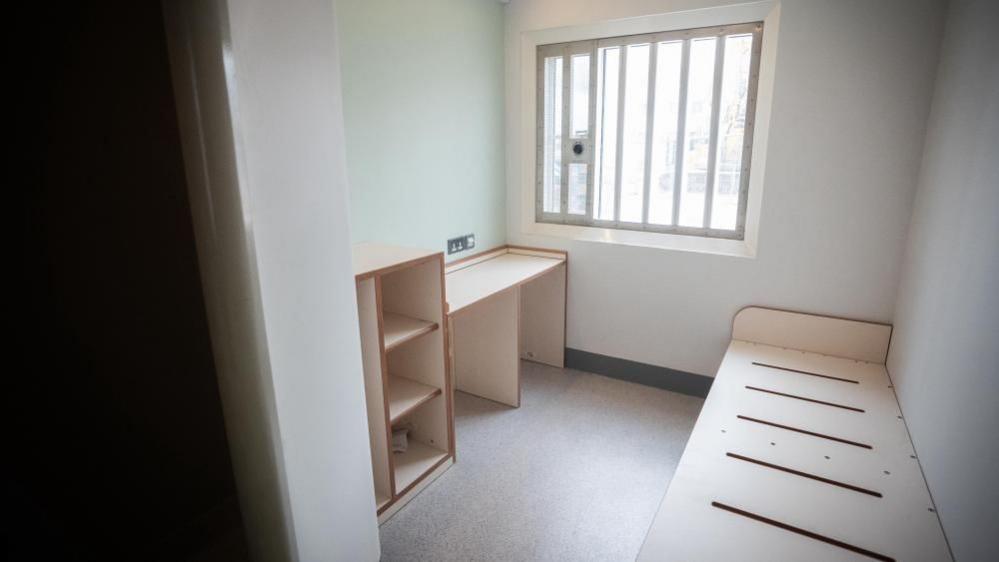 Image source, PA Media
Although three new prisons have opened in the past four years – adding approximately 5,000 more places – further expansion to existing prisons has been delayed by a major supplier going into administration, according to the Prison Reform Trust.
Pia Sinha of the Prison Reform Trust told BBC Verify: “Successive governments have found it difficult to increase prison capacity because new prisons take years to plan and build, often facing planning hurdles and local opposition.”
The Labour government has pledged to build 14,000 new prison places by 2031. The MoJ told BBC Verify that it had delivered about 3,200 places as of July.
However, it has not said how many prison cells have been taken out of use so we cannot say whether there has been a net gain or loss of spaces.
Analysts argue that without a major change in thinking about the appropriateness of prison as punishment, or a significant long-term increase in prison building, the system in England and Wales will remain close to capacity.
And that means governments will continue to be under pressure to implement early release schemes to avert a capacity crisis.