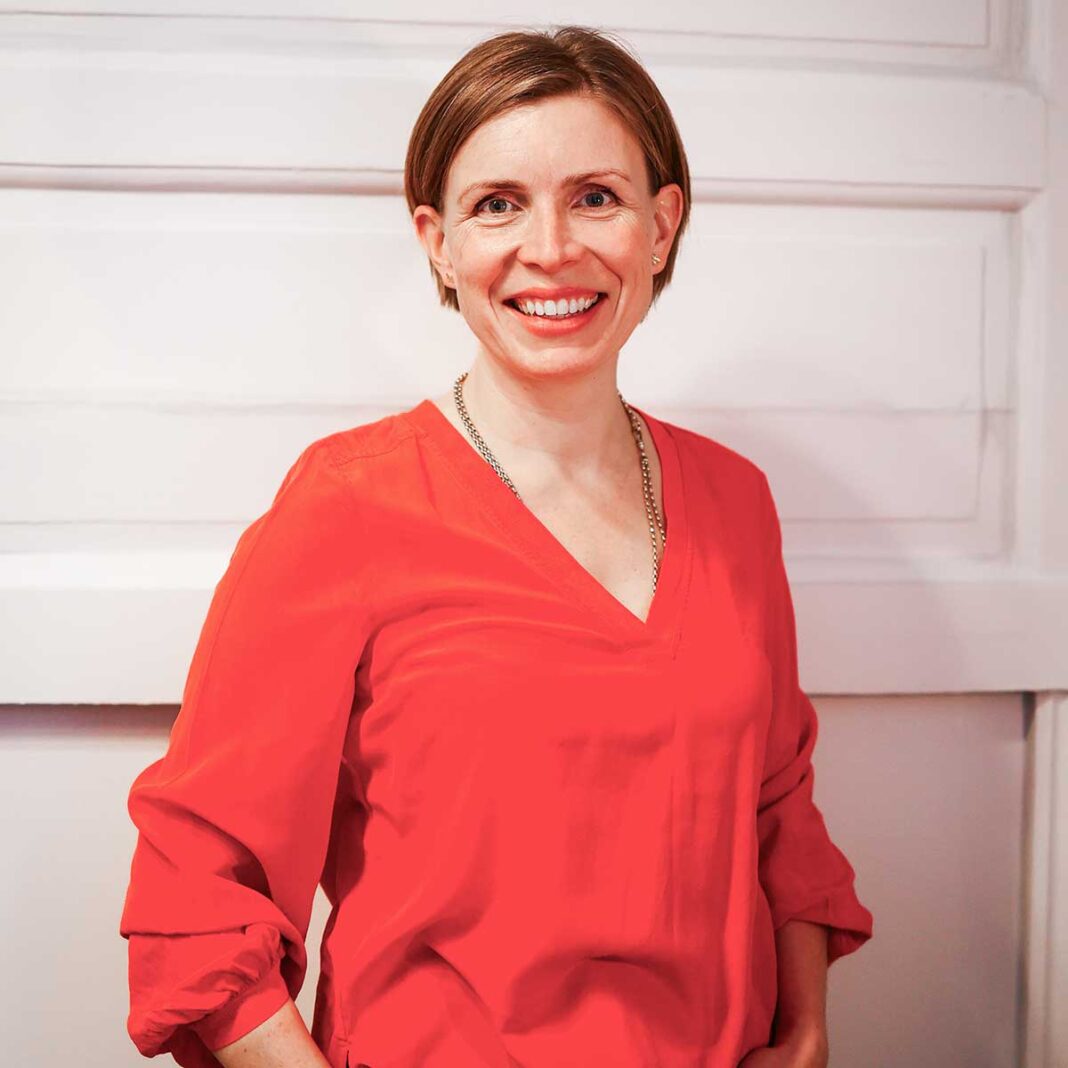

Alice Rackley is co-founder and CEO of Polytag, the Welsh technology company that tags and traces packaging so brands can see what happens to it after it is sold.
Its Ecotrace programme reads invisible UV tags at recycling centres, and Kraft Heinz became the first branded food manufacturer to join it, starting with Heinz Beanz and Heinz Tomato Ketchup.
In July 2026 Polytag appointed Alex Webster, founder of GENIE Drinks and an investor in Monzo and Revolut, as chief strategy officer to shape its growth ahead of the GS1 Sunrise 2027 programme.
Speaking from the company’s base on the Deeside Industrial Estate, she tells Business Matters why packaging traceability is becoming infrastructure rather than innovation.
What do you currently do at Polytag?
I am co-founder and CEO of Polytag. We build the technology, partnerships and infrastructure that help brands get value from every item of packaging they put on the market. Packaging has traditionally been a cost to minimise and then forget. We help brands treat it as a commercial asset that delivers measurable returns across sustainability, consumer engagement and loyalty.
Our award-winning Ecotrace Programme uses invisible UV tags and detection technology in recycling centres to trace millions of items at barcode level. For the first time, brands get barcode-specific recycling data at scale. We are now working on the next phase, where packaging is detected and sorted by its individual attributes, producing higher-quality recycled material.
Polytag’s Smart QR platform transforms packaging into a dynamic digital communication channel. Brands can deliver personalised sustainability information, recycling guidance and marketing content directly to consumers. Each experience can be tailored in real time based on the product being scanned, the consumer’s location and their device language.
This hyper-relevant engagement keeps consumers connected to brands for longer, strengthens loyalty and provides measurable return on investment, while enabling organisations to tell richer and more impactful sustainability stories.
Our customers include Kraft Heinz, Ocado, Waitrose and Suntory Beverage & Food. My days mix strategy, raising investment, building partner relationships and speaking to the wider industry at events. I also still put on a hard hat and steel-toe-capped boots to climb onto a conveyor belt in a recycling centre and calibrate our machines.
What was the inspiration behind your business?
I often say that I did not become an entrepreneur, I was raised by entrepreneurs. My parents were antique dealers who went on to build a successful contract furniture manufacturing business. I watched them spot opportunities, take calculated risks and build something from nothing.
Antique dealing is also one of the oldest circular economies there is, restoring and repurposing what already exists. Long before the term “circular economy” entered mainstream business vocabulary, those principles were being lived and demonstrated around me every day.
My own route was less direct. I started on the Waitrose graduate scheme, drawn by its environmental commitments. I then did an MBA at Imperial College London, worked as a retail consultant at Deloitte on digital transformation, and moved to Marks & Spencer, where I saw that commercial success and environmental responsibility could align.
At GS1, the global standards organisation, I learned that circular economies only work when whole industries share a language and collaborate through common standards. Those moves seemed slightly disconnected at the time. In hindsight, they were an apprenticeship for Polytag.
I have always been motivated by the same question: not “what is the problem?” but “how do we build the solution?” So at Polytag we set out to build it and prove what was possible.
Who do you admire?
I have long admired Helena Morrissey for her work on women’s representation in business, including the 30 Per Cent Club (which I was part of back in 2012), and for always being truthful about the realities of family and business life. I also admire Baroness Martha Lane Fox, for Lastminute.com and her later work on digital inclusion. She has shown that business can be a force for wider good while still delivering commercially.
Closer to home, Jenny Burns, founder of Magnetic, recently led the buyback of her company from corporate ownership, which took huge courage and real conviction. Her energy is infectious, and I love grabbing a coffee with her. Amanda Fairbrass, CEO of Seymourpowell, pairs creative leadership with sharp commercial acumen in a constantly changing market. I am proud to call her a friend.
My earliest and most influential role models were my parents. They showed me how to create value, take risks and work hard, and they taught me resourcefulness long before sustainability became a boardroom priority. Cheesy, but totally true.
Looking back, is there anything you would have done differently?
The lesson I keep learning is what I call being “homeless on a P&L”. Our early revenue comes from brand innovation and R&D budgets, which exist for pilots and experimentation. Once a customer sees the value, the conversation moves to operational deployment, and the R&D budget stops being the right home.
Packaging traceability and recycling data are new categories, so there is often no cost centre ready to pick them up. Our growth is limited less by demand than by annual budgeting cycles, and sometimes we wait more than 12 months for the next one.
We are still working through this obstacle, and this transition marks a pivotal moment in our evolution. It demonstrates that we are moving beyond being an interesting innovation towards being an indispensable part of the infrastructure required to deliver packaging circularity at scale. Hurrah. (But also, hurry up.)
What defines your way of doing business?
Building rather than talking. We challenge one of the most entrenched assumptions in global supply chains, that packaging has value only until it is sold. Because we are creating a category, we build the infrastructure ourselves, together with customers, partners and investors.
Regulation such as EPR, Digital Waste Tracking and the PPWR is making accountability irreversible, and we give organisations the data and transparency to comply while unlocking new value.
Our culture is simple: work hard, build stuff, get things done and have fun. In the words of my favourite dinner lady, Mrs Wheeler, we are “less chat, more chew”. In a world that loves talking about problems, we would rather be building the solutions.
I care about shared standards and collaboration, about integrity and transparency, and about protecting our customers’ data. We also keep our own environmental footprint low, including minimal use of AI. I believe sustainability and commercial value can, and must, be achieved together.
I lead with authenticity. Thanks to my network, my family and my career, I know myself and how I want to lead. I would describe the business as gritty, determined, practical and optimistic.
What advice would you give to someone starting out?
There is no single route and no perfect time to start. I am an “accidental” CEO who built experience in retail, consulting, sustainability, standards and digital transformation first, and every role taught me something I later needed. Corporate experience and entrepreneurial ambition go together, and the resilience you gain on a traditional path is a strong foundation.
Build your network and look after it. Mine, my life’s work, has been critical.
Do not feel you have to fit the expected mould. Packaging and recycling have historically been male-dominated, and I built a business there anyway. Ask how to build the solution instead of only naming the problem.
Be honest about balance. My children are the joy of my life, and the tension between being an ambitious founder and the mum you want to be is real. Mum guilt is not a business concept, but many mum founders feel it, and it applies to anyone raising a family.
You keep finding ways to combine ambition and family, and the answer changes as life and business change. Celebrate the growth, but be truthful about the sacrifices. The aim is a great life alongside a great company.