
PLEASANTON, Calif. — Team Dos Ojos won Zoho Corporation’s first AI hackathon on Sept. 22, taking the $15,000 prize with a crop-stress tool built for small farmers in the Rio Grande Valley.
The team is Edgar and Eduardo Bello Gonzalez, brothers and engineering and computer science students at the University of Texas Rio Grande Valley. Their system pairs free Sentinel-2 satellite imagery with targeted drone flights, then sends farmers bilingual SMS guidance on where to direct scarce irrigation water during a drought. No dashboard. No subscription. A text message.
The brothers grew up in Mexico through stretches when their city had no water and local harvests failed. They moved to the Valley and started watching the same pattern repeat.
Four other teams presented that day, and the margin was thin. The panel landed on Dos Ojos unanimously, but not quickly.
I know because I was one of the judges. Zoho flew me out to sit on the panel and give a short talk at the finals. Worth knowing before you read the rest of this, and also why I can tell you what the scoring actually looked like from the table. I had no hand in picking the five finalists and no business relationship with the company.
The contest was built to make proximity an advantage
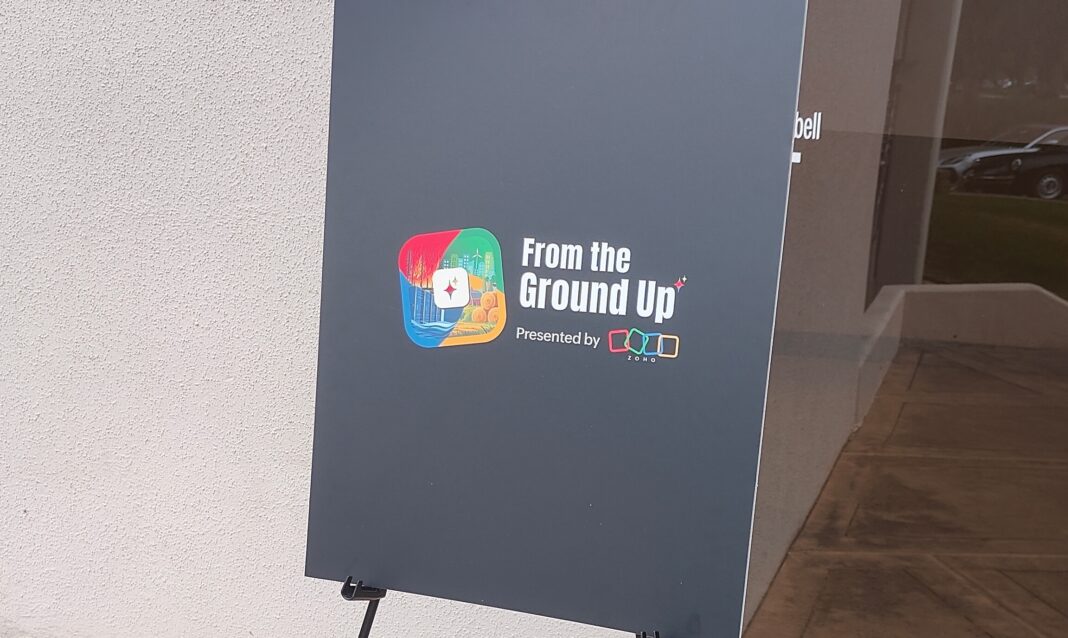
Zoho called it From The Ground Up. Entry was limited to students at a preselected list of rural and rural-serving universities in California and Texas, the kind of schools where AI funding and hardware rarely arrive. Teams of up to three submitted written proposals on wildfire risk, water scarcity, or agricultural instability. Five made the finals and traveled to Zoho’s Pleasanton office to present a prototype and a pitch deck. Small Business Trends covered the finalist announcement earlier this month.
Every finalist team was from Texas.
Those rules are worth reading closely, because they cut against most of what the market has been selling for three years. Small, purpose-trained models running locally, not big general-purpose systems. Edge deployment on modest hardware. Cheap to adopt, works with spotty connectivity, runs fine for somebody with no data science staff. Teams also had to account for the computing and water footprint of the AI itself, and treat the communities involved as partners instead of a data source.
Raju Vegesna, Zoho’s chief evangelist, tied the competition to something the company has believed for decades, that world-class software gets built anywhere, rural communities included. He pointed to the office Zoho has kept in the village of Tenkasi, India for more than ten years, and to the talent the company keeps finding in Texas’s Rio Grande Valley. On the rest of the industry he was blunter, saying Silicon Valley has spent years making vague claims about AI solving global problems, and this was an attempt to put real money and tools behind that instead. Zoho is privately held and profitable, with more than 19,000 employees across 28 countries and U.S. headquarters in Austin.
What the other four teams built
NoNiMo, three computer science students at Texas A&M University-Corpus Christi, built BASIN. It generates and ranks drought scenarios from public precipitation data so regional planners can decide which situations justify paying for formal hydrologic modeling. Their city is on track to become the first in the country to run out of water, and the regional supply models still rest on hydrology data from 2015. Updating those models for every new emergency costs more than the community has.
CoderOP, also at TAMUCC, went after water the utility already paid to treat and then lost. The tool reads nighttime flow logs and free satellite imagery to flag likely leak zones, then outputs a plain-language worklist with estimated gallons per day, cost, and location, so non-technical staff can act on it without an analyst.
Irriga, at East Texas A&M University, built a dual-model irrigation advisor for Panhandle farmers that works online or offline, using soil, well, and weather sensor data that already exists but rarely reaches the people farming above the Ogallala Aquifer.
Land Memory AI, at Austin Community College-Round Rock, went the other direction. Their tool helps landowners combine their own records, photos, and observations with environmental data, on the premise that the farmer knows things the satellite does not.
Why a small business owner should care
None of these students had a lab. None had a grant. They built on borrowed hardware, under constraints most enterprise AI vendors would call impossible, and they produced working prototypes aimed at problems they live next to.
That is roughly the position every small business owner is in. And the lesson runs the same direction.
The model is not the advantage. Every business on your street can rent the same frontier model you can, and it will hand all of you about the same average answer. What changes the output is the person aiming it, someone who knows which customers actually pay late, which job in the pipeline is about to go sideways, which supplier quietly stopped answering the phone.
AI is the labor. The direction is still yours.
The second lesson is cheaper than the first. Every one of these teams chose the smallest tool that would do the job and delivered the answer where the user already was. A text message beat a dashboard. A plain-language worklist beat a model output. Owners shopping for AI right now tend to buy the biggest platform they can justify and then never touch most of it. These students spent their whole build deciding what to leave out.
There is a competitive read here too. Zoho ran this competition the way it runs its business, on a deliberate bet that useful software comes out of proximity rather than out of headquarters. Whether the bet pays off will not show up in the prize money. It will show up in whether a water district in South Texas is still opening one of these tools next March, long after the check clears.
That is the only scoreboard that ever mattered.
One more thing from the judging table. What separated these five had almost nothing to do with technical horsepower. Every team had built something that worked. What made the difference was how specifically each one understood the person on the other end, and every single project was aimed at a problem the students lived next to. Nobody went shopping for something that would look good in a portfolio. They picked up what was already on the kitchen table.
That is not a student lesson. That is the whole lesson.
Zoho has not said yet whether this runs again in 2027. It should.