
B2C isn’t far behind: NielsenIQ puts it at 42% of consumers researching products with AI.
That’s why bigger budgets are being allocated to AI search.
It’s also why we’re all scrabbling to work out how valuable our AI visibility strategies are.
Searches for AI attribution and ROI keywords have grown 212% over the last 18 months, according to our Keywords Explorer data:
AI search ROI, in its simplest terms, is the value you get back from your AI visibility work, divided by what you put in.
I’ll say upfront: I don’t think you can ever neatly prove AI search ROI.
At Ahrefs, we’ve always taken the view that trying to meticulously trace a sale back to every touchpoint is a losing game.
And AI search is one of the least trackable digital channels yet, so perfect attribution is even further out of reach.
Someone can get a complete answer inside ChatGPT and never visit your site at all.
When they do click through, referrer data can be stripped, so it just looks like direct traffic.
And even if someone acts on an AI recommendation, they don’t always tell you that’s what happened.
That said, leadership doesn’t need a perfect number.
They need a sensible estimate they can compare over time, and between what you can track and what your customers tell you, there’s enough data to build one.
If my manager asked me to report on our AI search ROI, this is the process I’d follow.
It’s not bulletproof, but it’s a method you can repeat every quarter, and it mostly uses data you already have.
How to estimate your AI search ROI
AI search ROI is the value you get from appearing in AI answers.
Formalized into an equation, it would be value minus the cost spent getting there, divided by that cost.
- Value equates to sales, traffic, awareness among people who never click, conversions, and better-informed buyers
- Cost covers content, technical work, tools and team time
Revenue is the obvious thing to measure when you’re calculating ROI, so that’s what the steps below focus on.
AI search ROI = (AI revenue − AI cost) ÷ AI cost × 100
But the other types of “value” matter hugely, and should be reported on alongside your ROI (we cover these in our follow-up article).
Step 1: Work out your AI costs
You have two types of costs to think about when you’re calculating AI search ROI:
Pure AI cost: The costs that only exist because of AI search, such as AI visibility tracking tools or agency retainers for AI work.
Shared cost: The costs that go towards both AI search work and your wider SEO or content work. This covers tools and outside help, as well as people:
- General AI platforms like ChatGPT or Claude subscriptions
- Your SEO suite
- Freelancers
- Agencies
The simplest way I’ve found to split them up is to ask one question of every cost: would you still pay for it if you stopped doing AI search work tomorrow?
If the answer’s no, count all of it.
If the answer’s yes, count a share of it.
Calculating that share is a bit hand-wavy, but in my opinion there are diminishing returns in spending tons of time accounting for every cent spent.
A ballpark figure should prove good enough. Here’s how you can work it out.
Share of team resources dedicated to AI
Start with people, since they’re usually your biggest shared cost. The question is how much of their time went on AI search work that quarter.
You don’t need to start creating and analyzing timesheets if that’s not something you already do.
Instead, talk to your team or suppliers about where their time went that quarter—e.g. did they spend a third of it on AI content/optimization?
For example, say your content team of three costs $54k a quarter in salaries.
If they spent about a third of their time on AI search work, count $18k.
Share of tool usage dedicated to AI
Most of your tools will be shared too—whether that’s your SEO platform or a ChatGPT subscription.
Tool usage is harder to pin down than time, though.
The simplest option is to count the same share as the team that uses them.
So if your content team spends about a third of its time on AI search work, assume a third of their tool spend goes on AI too.
If a tool has a separately priced AI feature or add-on, you can count the price of that add-on and ignore the rest.
If the amount of AI work goes up or down each quarter, make sure to adjust the share to match.
Put together, a quarter’s AI search costs may look something like this:
|
Quarterly cost |
Share counted |
|||
|---|---|---|---|---|
|
AI visibility tracking tool |
||||
|
AI-only agency retainer |
||||
|
Content team (3 people) |
||||
|
Freelance writer |
||||
|
SEO suite and AI subscriptions |
||||
That $27k is your AI cost. Keep it in your back pocket for step 3.
Step 2: Estimate your AI revenue
AI search is hard to put a single revenue figure on, because a lot of its influence never shows up in your analytics.
There are two ways I’d estimate it.
Go with whichever one suits your data, or calculate both (if possible).
FYI: Each one will likely undersell the real value of AI. It’s worth making that clear in your reports.
Tracked revenue
Tracked revenue is based on the conversions you can link directly to visits from AI tools.
You can find those in analytics tools like GA4 or Ahrefs Web Analytics, then turn them into a revenue figure using your average customer value.
How to calculate tracked revenue:
- Count conversions associated with AI referral traffic
- Multiply them by your average customer value for that product/service (or use real deal values if your CRM hooks up to your analytics)
For example, if 40 AI-referred visitors converted last quarter and your average customer is worth $900, that’s $36k of tracked revenue.
Bear in mind, tracked revenue only shows you part of the picture.
AI is usually just one touchpoint in a much longer customer journey, and plenty of people read an AI answer and come to your site later by searching your brand name or typing in your URL.
Those visits don’t get credited to AI.
The inverse is also true: traditional content marketing can have a big influence on somebody, even if their final touch point is coming to a pricing page via ChatGPT, for example.
Most analytics also can’t follow an individual visitor all the way to a closed deal, because of things like cookieless tracking, declined cookie banners, people switching devices, and sales cycles that outlast cookies.
That’s why I think average customer value is the better option for most teams; it turns the conversions you can see into a revenue estimate without everything needing to link up.
That said, depending on how your tracking is configured, some of that link may already exist.
When someone arrives from an AI tool and signs up or books a demo in the same visit, some forms may pass that source into a CRM, showing you the actual pipeline and deals attached to it.
For example, if those same 40 conversions came through with deal values attached and added up to $42k, you’d use that figure instead of the $36k your average gave you.
Use those real figures where you have them, but bear in mind they’ll only cover people who convert on their first visit.
Self-reported revenue
Self-reported revenue is simply a matter of asking new customers how they found you, usually with a “How did you hear about us?” question during signup, checkout, or onboarding.
Because it doesn’t rely on tracking anyone, it can pick up a lot of the people your analytics misses—including those who saw your brand in an AI answer and came back later another way.
We do exactly this when tracking our Ahrefs Free signups, and that data gets plugged straight into our analytics and Slack channels.
How to calculate self-reported revenue:
- Include AI tools as an option in your survey, and allow more than one answer.
- Use actual deal values, because each answer is tied to a real customer.
- Work out what percentage of respondents’ revenue came from AI, then apply it to all your new-customer revenue for the quarter.
Let me break down that last point in a bit more detail.
It’s very unlikely you’ll get a 100% response rate to your “How did you hear about us?” survey.
For that reason, start with the customers who did answer that quarter.
Add up the revenue from those who chose an AI tool, and divide it by the total revenue from everyone who answered.
That gives you the percentage of respondents’ revenue that came from AI.
Then apply that same percentage to the revenue from all your new customers that quarter, including those who didn’t answer.
Example: If respondents brought in $100k and $10k of it came from people who chose an AI tool, that’s 10%.
So, if all your new customers brought in $400k that quarter, you can reasonably estimate your AI revenue at $40k.
That leaves you with the “Value” part of the equation.
Step 3: Turn those figures into an ROI percentage
Now that you have your costs and your revenue estimate (or estimates), you can work out your return.
Remember the equation from earlier? Take away your cost from your revenue figure, divide the result by your cost, then multiply by 100.
AI search ROI = (AI revenue − AI cost) ÷ AI cost × 100
For example, if you spent $27k in a quarter, a:
- Tracked revenue of $36k gives you (36 − 27) ÷ 27 × 100 = 33% ROI
- Self-reported revenue of $54k gives you (54 − 27) ÷ 27 × 100 = 100% ROI
It’s worth pointing out that a 33% ROI is a very good thing. It means that for every $1 you put in, you get that dollar back plus an extra 33 cents in profit.
If you’ve only used one method, that’s your ROI.
If you’ve used both, I’d lead with the higher figure and report the other alongside it so leadership can see the full picture.
Then repeat the process every quarter to see whether your return is growing.
AI search ROI calculations will never be 100% precise, but working them out the same way each quarter keeps your numbers comparable, so you can see whether your return is heading in the right direction.
Step 4: Put an ad-equivalent value on AI visibility (optional)
Out of curiosity, I wanted to see what our AI visibility would be worth if we’d paid for it.
So I used our AI marketing platform, Letaido, together with Ahrefs Brand Radar data, to work this out across ~110 custom prompts I track.
They’re bottom-of-the-funnel queries from people in the market for an AI visibility tracking tool, so they’re some of the most valuable prompts for us to show up in.
Here’s the sum I used.
AI ad equivalent value = (mention-adjusted impressions ÷ 1,000) × CPM
For impressions, I used Brand Radar’s AI adjusted volume, which represents how often each prompt is asked on each AI platform.
I then accounted for how often Ahrefs actually appeared in those answers.
Over the last 30 days, Ahrefs showed up in nearly half (46%) of ChatGPT responses to those prompts.
Together, these datapoints helped me calculate the mention-adjusted impressions metric.
Which is how I discovered that our visibility came out at roughly $77–$139 in equivalent ad spend.
It’s a small number, but that’s expected.
Bottom-of-the-funnel prompts are niche, so they typically don’t get huge impressions—whether they’re paid or organic.
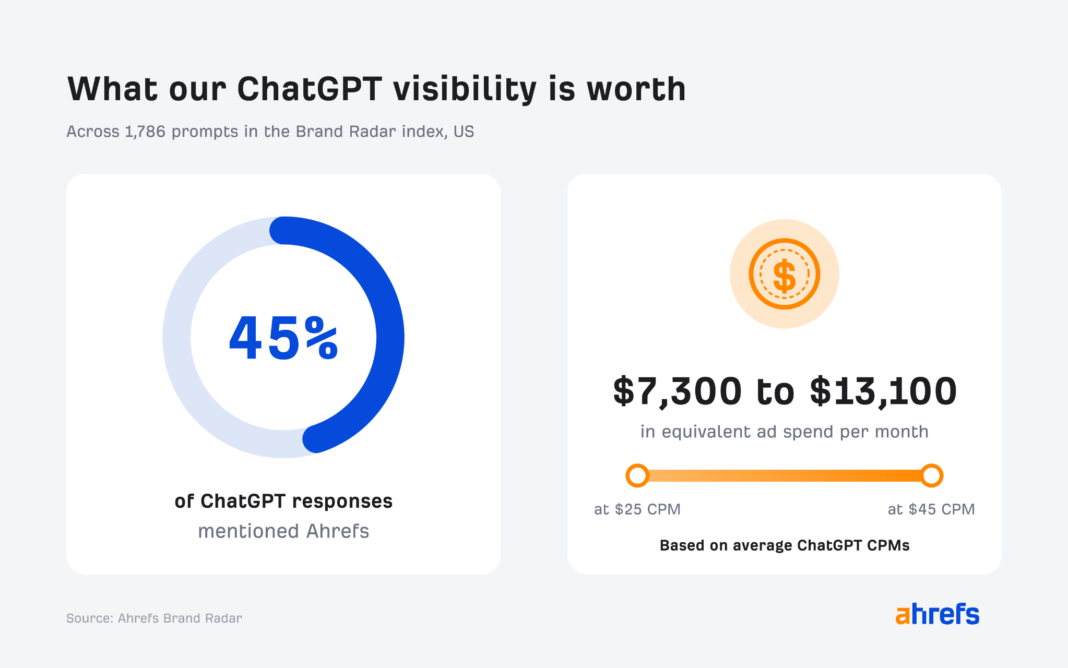
To get a better idea of our overall visibility, I ran that same sum across ~1,800 prompts from the wider Brand Radar index.
These are tracked less often than custom prompts, so the figures are a little less reliable, but they give a better picture of our presence in top and mid-funnel queries.
Ahrefs appeared in 45% of these queries, and our visibility came out at roughly $7,300–$13,100 in equivalent ad spend.
This is what our visibility might have cost us if we’d invested in ChatGPT ads and paid our way into AI conversations.
This is a hypothetical saving, but it’s one execs would love to see reported alongside ROI.
Final thoughts
You won’t be able to prove AI search ROI to the cent, but you can build an estimate leadership will trust and compare quarter to quarter.
Start by adding up what you spend on AI search, then estimate the revenue it brings in using tracked conversions, survey answers, or both.
Use the same method every quarter, so that when the number moves, you know your performance moved with it.
And if you have the data, report the ad-equivalent value alongside your ROI.
This article is all about how to attempt the impossible job of attributing value to AI visibility, but as we all know, revenue is the smallest part of what AI search returns.
AI answers also shape which brands people remember and shortlist, long before they ever click through to a site.
In our next article, we cover six ways to measure that value and report it alongside your ROI.
Keep your eyes peeled for that!