
Enterprise brand teams face a complex version of AEO that most tools weren’t built for. A single brand might span a dozen product lines, operate in multiple languages, and compete in markets where local answer engines have their own citation patterns.

When content teams, regional marketers, and product groups handle AEO separately, visibility becomes fragmented. The challenge becomes coordinating AEO across the organization. While individual teams may be able to see how individual product lines or markets are performing, they don’t have a clear picture of how the brand is showing up overall.
Scaling AEO at the enterprise level requires centralized monitoring, cross-team workflows, and the ability to tie visibility investments to revenue outcomes. Let’s get into each.
Monitor brand visibility across products, markets, and answer engines from one place.
At the enterprise level, brand visibility across answer engines is a matrix, not a single number. Marketing teams need to understand how different product lines are cited, how visibility varies by region, and how the brand is positioned relative to competitors in each market. They also need to track those changes across answer engines.
When that data lives in disconnected tools or requires manual assembly, enterprise AEO monitoring quickly becomes difficult to scale. Teams end up with snapshots of individual products or markets but no way to see the full picture.

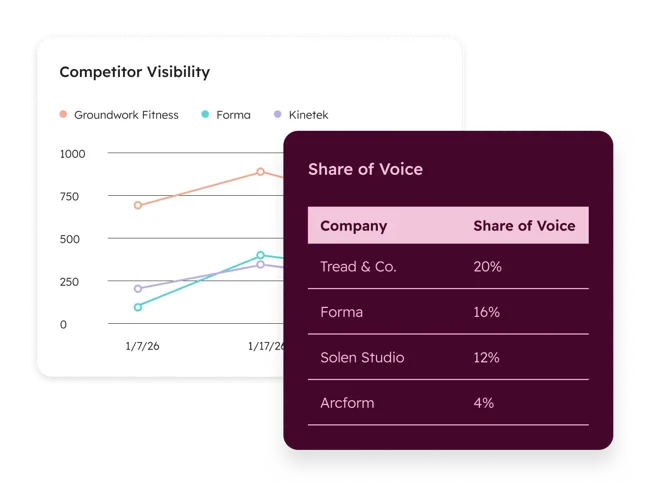
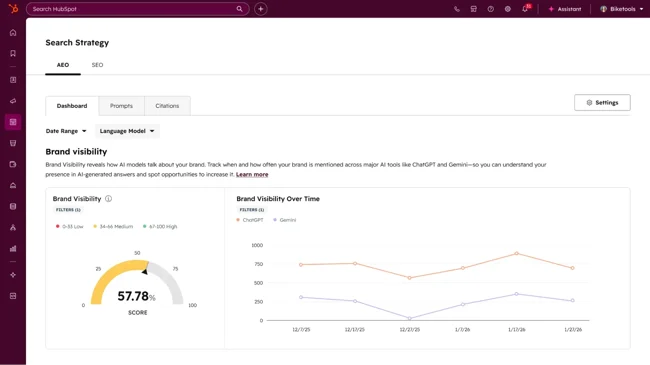
HubSpot AEO’s Brand Visibility Dashboard consolidates brand visibility score, share of voice, and citations data across a brand’s entire footprint. Enterprise teams can segment visibility by product line or market and track trends across AI engines from one view.
The results speak for themselves: HubSpot AEO users generate 2.7x more MQLs, according to HubSpot internal data. This gives teams a way to connect AEO visibility with the broader marketing outcomes they already measure.
But monitoring visibility is only the first step. Enterprise teams also need a way to coordinate those insights and turn them into action.
Coordinate AEO recommendations across content and regional teams.
Generating AEO recommendations is the easy part. The challenge is getting those recommendations acted on by content teams in multiple regions, working across different languages and editorial calendars.
Recommendations are ineffective when they sit in a dashboard that content teams don’t have access to, or arrive as ad hoc requests without priority or context. This creates a gap between identifying a visibility opportunity and actually acting on it.

Enterprise AEO requires coordinated action, not just data. HubSpot AEO surfaces recommendations based on a company’s current visibility gaps and citation opportunities. Content teams can act on those recommendations within HubSpot, deploying content agent to help them quickly generate optimized content. This keeps AEO execution connected to the workflows they already use.
Once teams are aligned on acting on AEO insights, one challenge remains: Proving that the investment is driving business results.
Attribute AEO investment to revenue outcomes at the enterprise level.
Enterprise stakeholders don’t want to know how many citations a campaign earned. They want to know how AEO investment is affecting pipeline, MQLs, and market share.
Most enterprise AEO programs fall short when tying AEO to revenue outcomes. Without a clear connection from brand visibility to business outcomes, AEO can be difficult to evaluate as it competes for budget against channels that have established attribution models. The work gets done, but the case for sustained investment is hard to make.
With HubSpot AEO connected to CRM data in Marketing Hub Pro and Enterprise, marketing teams can build custom reporting to see whether increases in share of voice or citations line up with changes in inbound volume, MQL rates, or pipeline.
Scale enterprise AEO with the right infrastructure.
Enterprise AEO requires infrastructure that helps teams monitor AI visibility across products and markets, coordinate content efforts, and connect visibility trends to business outcomes. As AI becomes a larger part of buyer research, centralized processes make it easier to identify gaps and act on opportunities at scale.
HubSpot AEO can support that process by bringing brand visibility, citation insights, and content recommendations into existing marketing workflows. The goal isn’t just to increase visibility, but to build a repeatable approach for managing AEO and understanding its impact on the business.