
Will anyone stop re-election of Infantino as Fifa president?
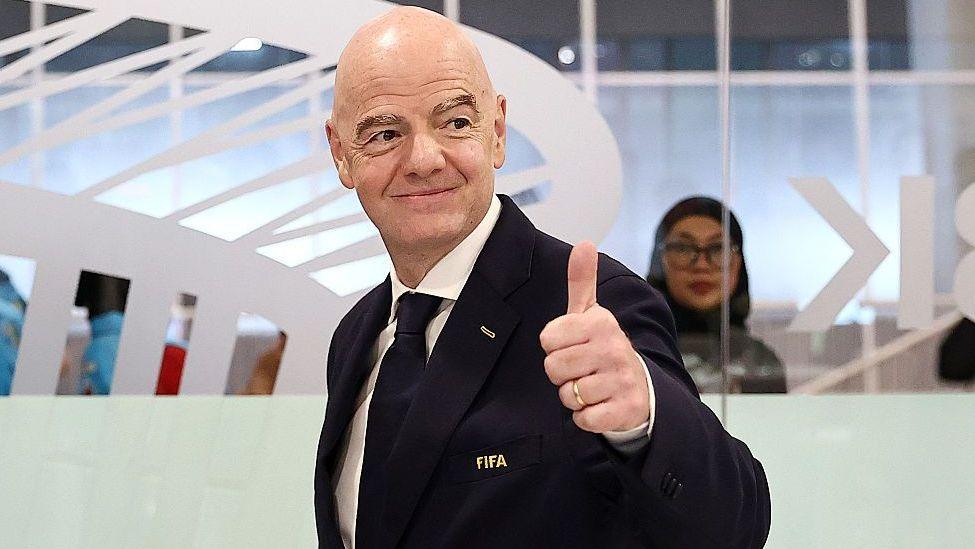 Image source, Getty Images
-
Published
Remember when pretty much everyone thought Gianni Infantino’s days were numbered as Fifa president?
It is little more than two months since news broke of Infantino’s Fifa Forward Enterprise (FFE) proposal, the plan to sell off commercial rights in the World Cup to a private equity firm.
Infantino, who had seemed impregnable as the head of world football’s governing body, suddenly appeared not only to be vulnerable, but in fact in an untenable position.
Yet, with 40 days to go until the 18 November deadline for nominations for the presidential election, senior figures in world football now firmly believe the 56-year-old may well be unopposed.
Uefa thought that FFE had given it the chance to cut the head off the snake.
Except Uefa did not quite have the necessary weapons to pull it off, to overthrow a figure who has built up considerable levels of support in the rest of the world.
No election, no challenge, just another coronation at the Fifa Congress in Rabat on 18 March.
Right now, you cannot shake the feeling that Infantino has won.
Uefa fails to find anyone to stand against Infantino
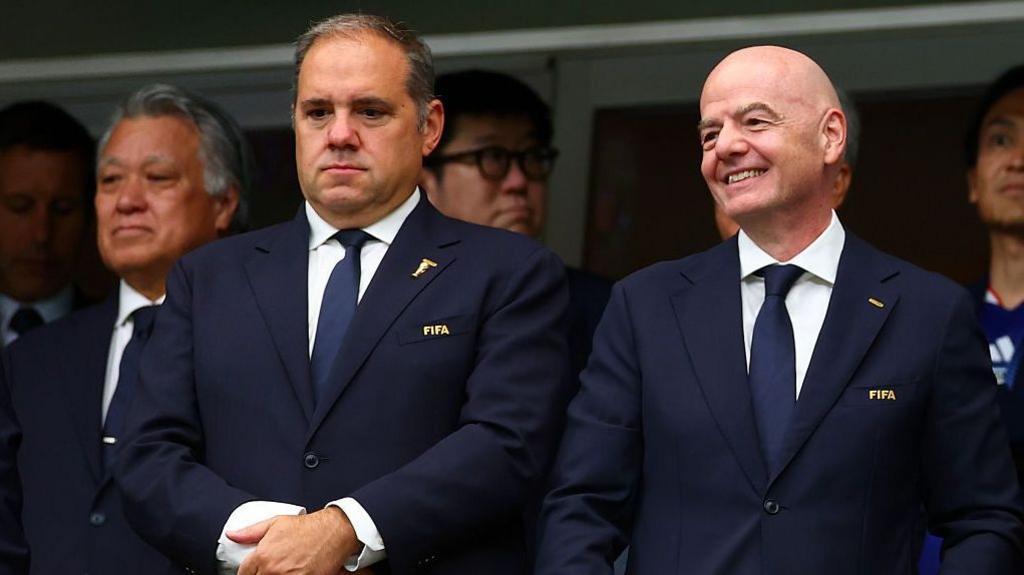 Image source, Getty Images
Since summoning the Fifa management board to Rabat on 5 August to discuss FFE, Infantino has been on a tour of the world to cement his position.
To Colombia for the inauguration of the country’s new president, Abelardo de la Espriella. Then visiting a Fifa-funded youth football tournament in the Dominican Republic.
At the weekend, he was at the Fifa Asean Cup final in Jakarta, Indonesia. And this week, an African football conference in Cape Verde.
It has been business as usual for the Swiss-Italian.
But there remains a rudimentary split in world football. Uefa, Concacaf and Asia against Infantino; Africa, South America and Oceania in support.
It raises the prospect that Infantino will be returned despite only carrying the backing of roughly half of Fifa’s 211 members.
It is the funding model which has made Infantino’s position so impenetrable, even in the face of accusations that he had worked against the wider interests of the game.
“We have invested $1bn in 10 years in Africa,” Infantino told the assembled delegates in Cape Verde.
At the same event, and for the third time this year, the 54 African nations – carrying more than a quarter of the votes – pledged their unconditional support.
Not only does that buy votes, it buys loyalty too.
And, away from Europe – which has 55 votes – Infantino has that in bucketloads.
Uefa wants a president who is “a respected and unifying figure, deeply rooted in football” with “an unequivocal commitment to development, reform, integrity and independence”.
But it has not been able to identify that person itself.
Victor Montagliani, the president of the Confederation of North, Central America and Caribbean Association Football (Concacaf), had been put forward as the most credible opponent. A non-European who could unify opposition to Infantino, and perhaps get others to swap sides.
Yet the Canadian never publicly said he even wanted the job, or to be the face of the campaign against Infantino.
Montagliani has told staff that he intends to stand for re-election with Concacaf, ending any suggestion that he could enter the race at the last moment.
While Infantino’s opponents try to find a candidate, Infantino has effectively been out on the campaign trail, clasping hands, taking up photo opportunities.
Only Ramon Vega, the former Tottenham and Switzerland defender, has put himself forward to stand.
But, as was the case four years ago, it seems unlikely Vega will even get the required five letters from the 211 member associations to back his candidacy.
To those on the outside looking in, it might seem preposterous that Infantino will be free to continue, considering the scandal and the reputational damage Fifa has faced.
Such is the power of the position, replacing the president is incredibly difficult.
Fifa has only had five presidents in the past 65 years. And only once, England’s Sir Stanley Rous in 1974, has an incumbent lost an election.
When Sepp Blatter resigned in 2015, he did so just eight days after winning re-election.
Uefa still hopes to find a smoking gun through the courts
Next Thursday, Infantino will come face-to-face with his fiercest critics for the first time at a meeting of the Fifa Council in Zurich.
Not just over FFE. But the Fifa Peace Prize, awarded to Donald Trump, and the US President’s subsequent intervention in Folarin Balogun’s red card at the World Cup.
Uefa president Aleksander Ceferin is expected to attend in person, along with the other eight European representatives – including Football Association chair Debbie Hewitt.
Ceferin, who on Wednesday confirmed he will stand for a fourth term in the role, has been unrelenting in his campaign to replace Infantino.
Even so, BBC Sport understands that internally Uefa accepted some time ago that there was little chance of removing Infantino democratically.
Uefa always had one key hand to play, one tool to deliver a fatal blow – a threat to boycott Fifa’s competitions. And it had to be used to get FFE scrapped.
Can it now find a way to get Infantino to stand down, and bow out gracefully?
That would require clear evidence that Infantino had acted against the interests of Fifa and football.
So far, not so good.
Hours after peace appeared to break out, after Uefa rescinded its boycott threat, it lodged claims in three US courts in an attempt to procure documents related to FFE.
If those papers include anything incriminating, Uefa intends to pursue “criminal mismanagement” through the Swiss courts with the hope of forcing Infantino out.
Up until now there has only been a tit-for-tat legal exchanges.
Even if Infantino does not have an opponent at the ballot box, the battle looks set to continue among the lawyers well into next year.
-
Politicians, private jets and power – the life of a Fifa president
-
Published7 August
-
-
The map showing world’s division over Infantino
-
Published11 August
-
-
Uefa preparing criminal legal action against Infantino
-
Published27 August
-
Infantino’s initial statements after the fall of FFE included some criticism of those who opposed it.
More recently, he has appeared to be more conciliatory, perhaps aware that this approach may be more effective in winning the war.
“When you go through a journey, sometimes concerns are raised,” he told the conference in Cape Verde.
“When they are raised, we have to address them. As far as we are concerned at Fifa, we address them always with the spirit of dialogue and with open arms, an open heart and an open mind. We can always be better and do better.”
If, as expected, Infantino does stay then Uefa wants reform of Fifa governance.
But Uefa may come across issues here, too.
Sheikh Salman bin Ibrahim Al Khalifa, the president of the Asian confederation and a Fifa vice-president who sits on the Council, had been a fierce critic of Infantino.
But this week, in a letter sent to Ceferin, Montagliani and Infantino, Al Khalifa distanced himself from a “wholesale redesign of Fifa’s governance system”.
Al Khalifa said change should be “driven by the football institutions themselves, rather than being outsourced to an external party”.
It makes it less likely that, once again, Uefa will get what it wants.
Uefa also wants each country to be paid an additional $10m (£7.6m) from Fifa’s vast reserves of around $6bn (£4.5bn).
In a perverse kind of way, Infantino bowing to that demand would probably cement his position even further.
After all, money is a vote-winner for the Fifa president.
-
-
Published8 June
-
-
-
Published28 August

-