
Nathan Maxwell Cann, our guide, spectacled, moustachioed, and clad in a well-worn chore jacket and waterproof boots, talks the group through the principles and practice of sea urchin gathering. He tosses out the explanation of what we’re looking for with the easy, self-deprecating banter of a former bartender. For a long time he worked in restaurants in North California, but a few years ago he caught the tidal foraging bug and became a self-professed ‘kelp guy’ with a sideline in urchins.
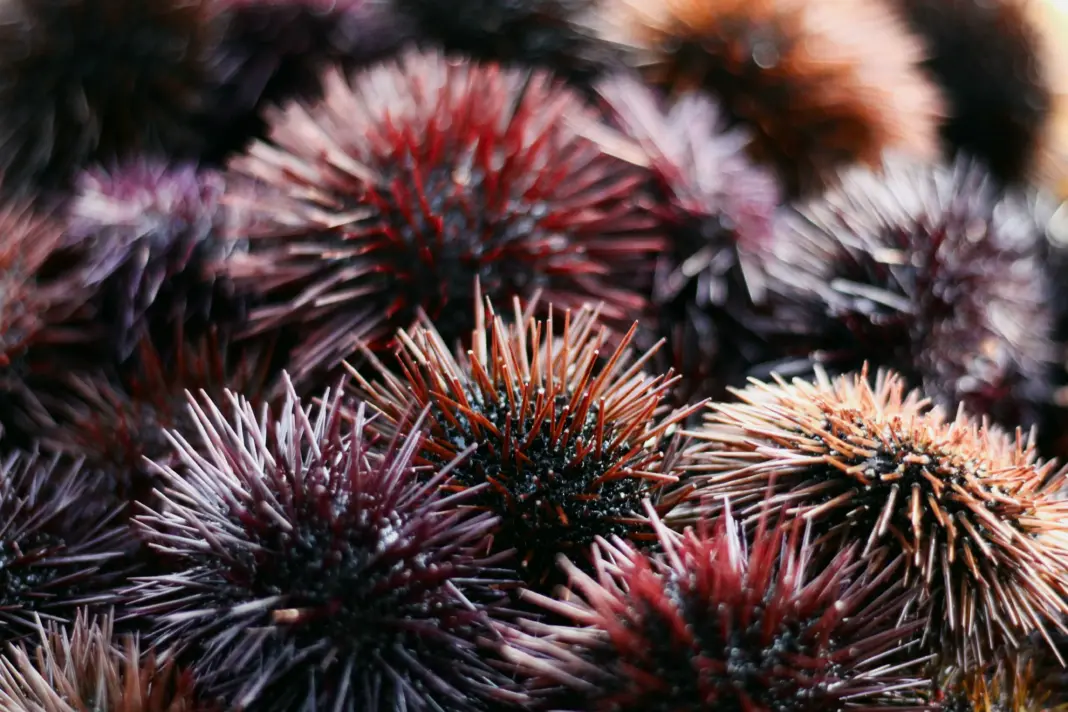
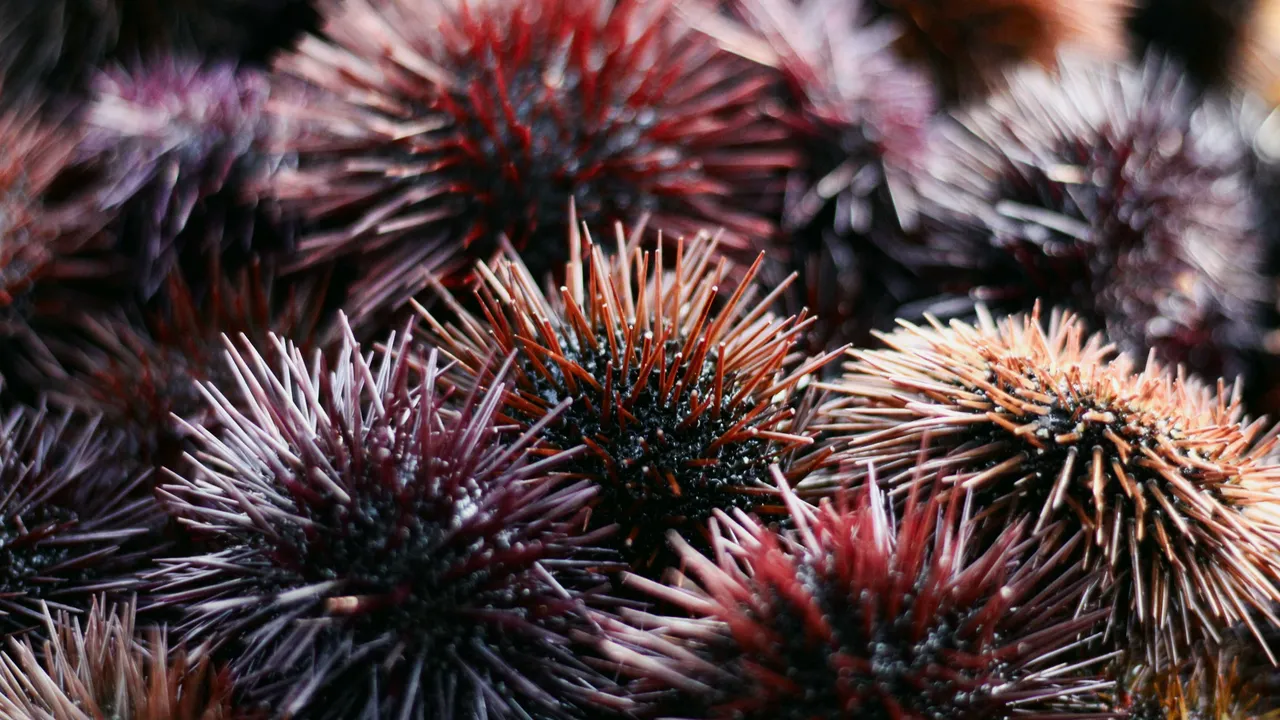
He shows us our prey. Out of the water, urchins look like curled-up hedgehogs, which is the root of their name in Spanish, Italian, and even English (many years ago our word urchin was used for the hedgehog). Their purple spikes project outward from a roughly hemispherical shell, known as a test. Most are somewhere between the size of a golf ball and a fist, and their only real feature is a malevolent-looking mouth armed with five overlapping teeth for grinding and shearing kelp.
In the water, their flare of spines look like dark starbursts against the rock. At first you only see the big ones, but the longer you stare into the pools, the more urchins you will make out; what seemed shadows resolve themselves into potential pickings, far more than could possibly be taken by hand.
There are huge number of purple sea urchins in this cove, and there are even larger numbers of purple sea urchins throughout California’s coast. Whole swathes of seafloor where kelp forests used to stand are now home to nothing but thousands of the prickly echinoderms, so-called urchin barrens. Similar barrens can be found in Alaska, Tasmania, New Zealand, South Africa, and beyond. Sea urchins have become one of the few seafoods that exist in abundance—or rather, overabundance.