
BLUF stands for “bottom line up front”. You put your main point (or conclusion or key finding) in the first sentence, then the detail the reader needs to act on it, then background only if they need it.
It comes from the US Army, whose writing regulation tells soldiers to put “the main point at the beginning of the correspondence”. Orders had to be read and acted on fast, so the conclusion went first.
The same habit now helps with AI search, because AI tools also pay the most attention to the start of a page.
Here are some examples of BLUF in action:
Before: “Hi Mark, as you know we’ve been looking at options for our webinar platform… Would you be able to approve the annual plan?”
After: “Hi Mark, can you approve the Livestorm annual plan ($2,400) by Friday? It was the cheapest of the three tools I tested and the only one that connects to HubSpot. Comparison attached if you want the detail.”
Blog post intro
Before: “Email marketing has been around for decades, and in that time it’s changed a lot… So, what’s the best time to send an email?”
After: “The best time to send a marketing email is Tuesday morning, around 10am in your subscriber’s time zone. That said, your own list may behave differently, so here’s how to test it.”
LinkedIn post
Before: “I’ve been thinking a lot about SEO reporting lately. Over the past year, I’ve sat in a lot of meetings with stakeholders and noticed something interesting…”
After: “Most SEO reports answer the wrong question. Stakeholders don’t care about rankings. They want to know what changed and what you’re doing about it.”
BLUF rewriter
Use this tool to turn your draft into BLUF.
Why BLUF works
BLUF works because people and AI tools both give the most attention to the start of a text.
Whatever you put first is what gets read, understood and passed on.
People decide in the first line or two whether to keep reading
People skim, and the first line or two decides whether they read on.
Nielsen Norman Group’s eye-tracking research found people read web pages in an F-shaped pattern: they read the first lines properly, then their eyes slide down the left edge. Whatever you put first gets read. Whatever you put fourth probably doesn’t.
And the busier the reader, the worse it gets. Your manager reading on their phone between meetings isn’t going to wade through three paragraphs to find out what you need.
AI also reads the top of a page first
SEO researcher and founder of Dejan, Dan Petrovic, argues that writing for people is also writing for AI, since both give the most attention to beginnings, and that this makes human-friendly content AI-friendly content.
Kevin Indig’s analysis of 1.2 million ChatGPT responses backs this up, with 44.2% of citations coming from the first 30% of a page.
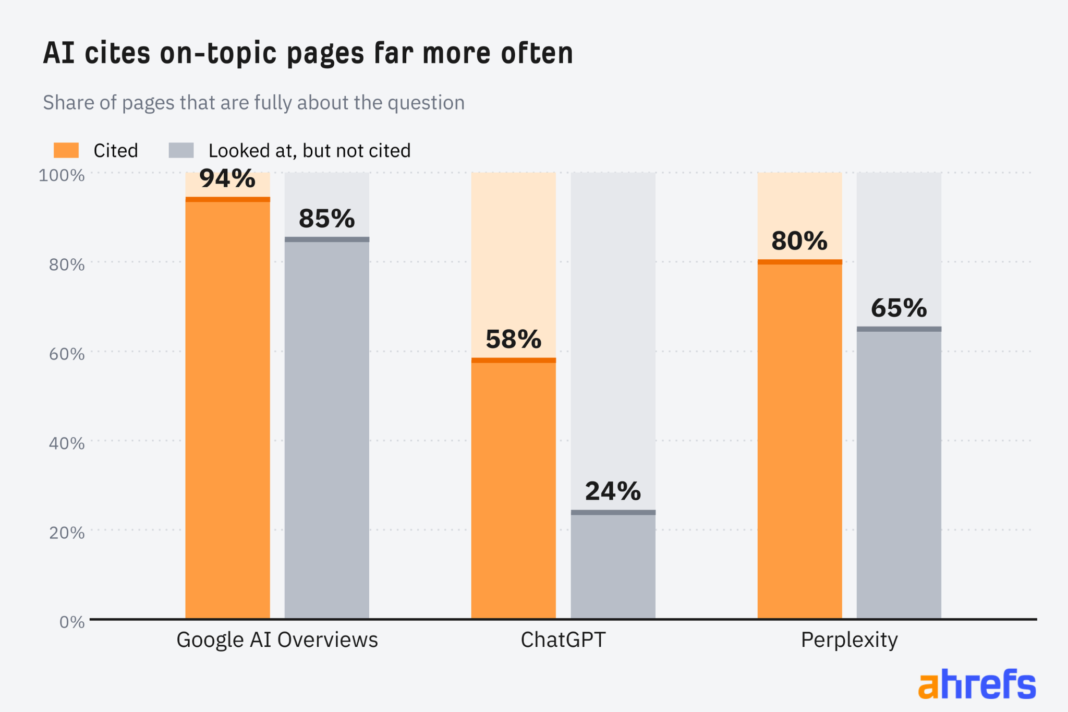
I also ran a quick study of 1,900 questions in Google’s AI Overviews, ChatGPT and Perplexity (via Letaido), comparing the pages AI tools cited with the pages they found and skipped.
What we found is that the biggest difference was whether a page was fully about the question.
In ChatGPT, 58% of cited pages were fully on topic, compared with 24% of the pages it looked at and left out. Perplexity (80% vs. 65%) and Google’s AI Overviews (94% vs. 85%) showed the same pattern.
But if you’re already on-topic, answering first may tip it towards your page, especially for AI Overviews.
Of the on-topic pages Google cited, 42% answered straight away, against 34% of the on-topic pages it left out. ChatGPT (42% vs. 42%) and Perplexity (37% vs. 35%) showed no real difference.
This is where BLUF can help, because opening with the answer is the fastest way to show a reader, or an AI, that your page is about their question.
So make sure your page fully covers the question, then open the page, and every section, with the answer.
A title that matches the question helps too, since our query fan-out study found ChatGPT prefers citing pages whose titles closely match the searches it runs behind the scenes.
How to write bottom line up front
To write BLUF, work out the one thing you want the reader to know or do, and put it in your first sentence.
1. Decide what you want the reader to know or do
Your bottom line is the one sentence you’d want them to read if they read nothing else.
Usually it’s a request (“Can you approve this by Friday?”), a decision (“We’re pausing the campaign”), or a finding (“Traffic dropped because of the site migration”). If you find yourself answering “well, it’s complicated”, write down the complicated version, then keep cutting until one sentence survives.
For example, let’s say you’ve been asked why signups fell last month. Your first attempt might look like this:
Now ask what the reader actually needs to know. They need the main cause, and what you want to do about it.
Seasonality explains a few percent at most, so it can go in as details. The onboarding emails are a guess, so they can go too. That leaves the pricing page, which is where most of the drop started.
That’s your first sentence. The seasonality and the ad budget can sit underneath it as context.
2. Put it in the first sentence
Skip the “Hope you’re well” and the background paragraph, and start with the point.
For emails, put it in the subject line too. “Approval needed: Q4 budget by Friday” tells the reader everything before they even open it. “Quick question” tells them nothing.
3. Add only the context they need to act
Add only the detail the reader needs to act on your point, and cut the rest.
The history of how you got here usually doesn’t make the cut. If they want it, they’ll ask.
Going back to the signups example: Your manager has to approve rolling back the pricing page, so ask what they’d need to say yes:
-
Proof the pricing page caused it: the drop started the day the new page went live.
-
What the rollback costs: an hour of dev time, and you’d lose the new annual-plan banner.
-
How you’ll know it worked: you’ll check signups again in two weeks.
Everything else stays out. That leaves you with this:
4. End with the next step
Finish with who does what, by when, if you need something. “Can you send me the login by Thursday?” beats “Let me know your thoughts”.
Read only the first sentences to check your BLUF
Did you notice this whole article was written BLUF?
Scroll back up and read just the first sentence under each heading. You’ll get the whole argument without reading anything else.
Now try it on your own draft. If the first sentences don’t tell the story, paste it into the BLUF tool above and see where your point is hiding.