
More of your audience now gets answers from AI instead of a list of links. So when someone asks an assistant about your category, the response draws on sources you may never even see, and your brand either shows up in it — or doesn’t.
That shift changes what AI in content marketing asks of you. Writing a strong page used to be the finish line. Now you also need to know how AI systems find, select, and cite pages, and that starts with a question many marketers haven’t had a reason to ask yet: what is RAG in AI?
Pew Research Center looked at this behavior in a 2025 analysis of 900 U.S. adults’ browsing data. Users clicked a traditional search result on 8% of visits when Google showed an AI summary, compared with 15% of visits without one. Fewer clicks means the answer itself carries more weight, and so do the sources behind it — the pages a system pulls from can shape what it says about you.
This guide explains RAG in plain language, starting with what it means for your marketing and then covering how it works. You’ll leave with a checklist for making your content easier for retrieval systems to use.
One caveat up front: retrieval-friendly content can improve machine accessibility, but it doesn’t guarantee retrieval or citation.
Table of Contents
What is RAG in AI?
RAG in AI is a method that retrieves relevant information from an external knowledge base before a model generates an answer. The name stands for retrieval-augmented generation, and it also shows up in conversations about GenAI RAG setups. In each case, RAG augments the model’s prompt with retrieved source material, which improves answer grounding.
Without RAG, a language model answers from what it absorbed during training. With RAG, it checks a source first. That source can be a help center, a product database, or a set of company documents, and the answer reflects what the model finds there.
Why does RAG in AI matter to marketers?
RAG matters because it connects AI answers to source material, and your content can be that source material.
A standard large language model (LLM) generates answers from patterns it learned during training. That knowledge has a cutoff date and doesn’t include your latest pricing page, product launch, or help article. RAG fills that gap. The system retrieves relevant context from an external knowledge base, then uses it to write the answer.
For marketers, three things follow from that:
- Your content can be retrieved and cited. When an answer engine uses retrieval, the pages it pulls from can influence what it says about your brand.
- Clarity and freshness become competitive factors. Pages with explicit facts, consistent terminology, and current information give a retrieval system better material to work with.
- Ownership matters. Someone needs to maintain the source of truth, because a retrieval system can only surface what exists and what it can access.
Answer engines retrieve and cite sources differently, so you can’t predict outcomes for any single platform. What you can do is make your content easier for machines to read, which is the focus of the sections below.
How does RAG in AI work?
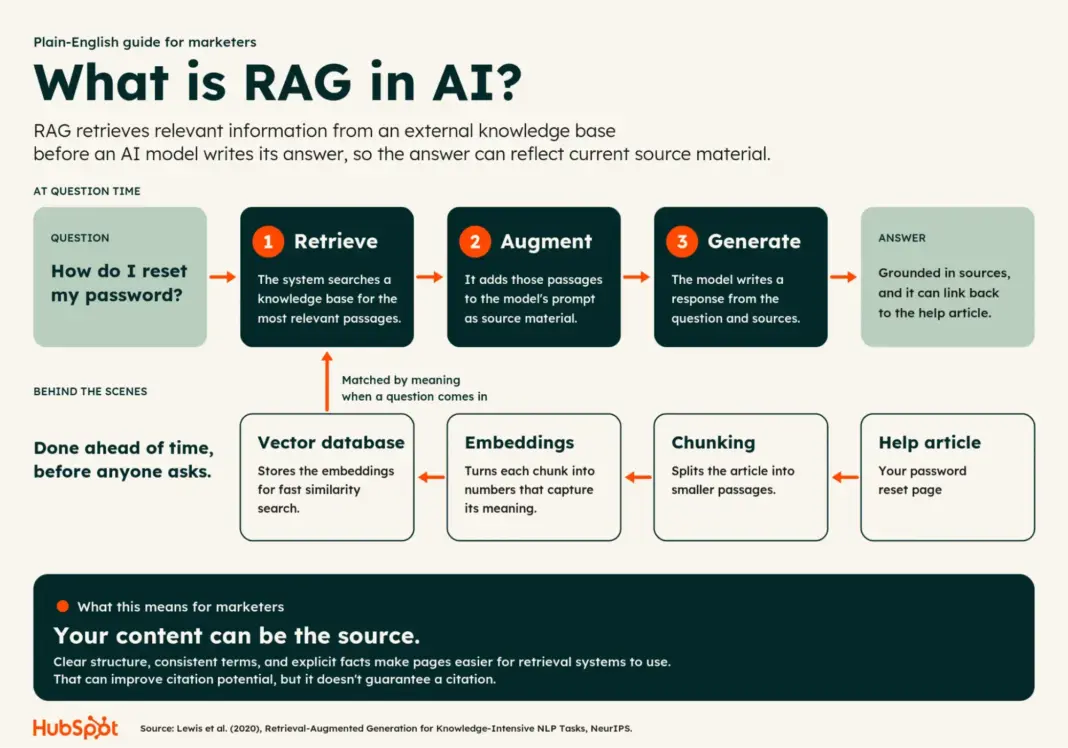
RAG works in three steps: retrieve, augment, generate. If you want the broader picture of what’s happening inside these systems first, our guide on how AI works covers the fundamentals.
- Retrieve. The system takes a question and searches a knowledge base for the most relevant passages.
- Augment. It adds those passages to the model’s prompt, giving the model source material to work from.
- Generate. The model writes an answer using both the question and the retrieved material.
Here’s a marketer-friendly example. Say your company has a help article about resetting a password. Behind the scenes, a RAG system prepares that article in advance:
- Chunking: It splits the article into smaller passages, such as one section per step or topic.
- Embeddings: It converts each chunk into a numerical representation of its meaning, so the system can match by meaning rather than exact keywords.
- Vector database: It stores those embeddings in a database built for fast similarity search.
When someone asks, “How do I reset my password?”, the system finds the closest-matching chunks, adds them to the prompt, and generates an answer. If the system is built to show sources, it can cite the help article.
Text version of the workflow: question comes in, the system retrieves matching chunks from the knowledge base, adds them to the prompt, the model generates an answer, and the answer can link back to the source.
What is retrieval-augmented generation?
Retrieval-augmented generation is a method that combines a language model with an external source of information. The term comes from a 2020 research paper by Lewis et al., “Retrieval-Augmented Generation for Knowledge-Intensive NLP Tasks”, which paired a pre-trained language model with a searchable index of Wikipedia. The retrieval step gives the model access to information stored outside its own parameters, which is why the approach supports fresher, domain-specific answers when the retrieval source is maintained and accessible.
Three distinctions help here:
- RAG vs. web search: Web search returns a list of links for you to read. RAG retrieves passages and uses them to write a response.
- RAG vs. training: Training changes what the model knows permanently. RAG supplies information at the moment of the question and leaves the model’s weights unchanged.
- RAG vs. fine-tuning: Fine-tuning adjusts a model’s behavior or style with extra training data. RAG adds knowledge at answer time. We compare the two in more detail below.
How can you explain RAG to your team?
Try this analogy: a standard LLM is a smart colleague answering from memory, and a RAG system is the same colleague with your company wiki open in another tab. The colleague is just as smart, but the answer is only as good as the wiki. If the wiki is outdated, disorganized, or missing pages, the answer reflects that.
That framing also tells your team where to focus. You can’t control the model, but you can improve the wiki. For marketers, the “wiki” includes your site, help center, documentation, and product pages.
Why can RAG affect AEO and brand visibility?
RAG can affect answer engine optimization (AEO) because retrieval systems choose which passages to hand to the model, and clear, trustworthy passages are easier to use. Retrieval-friendly content uses clear structure, consistent terminology, and explicit facts, which improves machine accessibility and citation potential without guaranteeing citation.
Think about what a retrieval system does with a page. It splits the page into chunks and judges each chunk on its own. A chunk that opens with a direct answer, names the product or topic explicitly, and states facts in full sentences can stand alone. A chunk that says “as mentioned above, this is the best option” has lost its context.
This is also where AEO differs from traditional search. If you’re used to optimizing for rankings, our guide to AI SEO explains how the two approaches overlap and where they diverge. In short, ranking gets your page into a results list, while retrieval and citation determine whether an AI system uses your page inside an answer.
Keep in mind that answer engines differ. Some retrieve from the live web, some from curated indexes, and some from a company’s private documents. Citation behavior varies by platform and can change as products update. Treat any tactic as something that may improve your odds — then measure what happens.
When should you use RAG versus fine-tuning?
Use RAG when your information changes often or when answers need to be traced back to sources. Use fine-tuning when you need to change how a model behaves, writes, or handles a specialized task. Turbine Kreuzberg’s RAG explainer is a useful outside reference for the retrieve, augment, generate flow and for this same comparison.
Here’s a simple decision aid:
- Your content updates weekly or daily (pricing, policies, product details): RAG. Update the knowledge base and the answers can reflect the change.
- You need answers tied to specific documents: RAG, because retrieved passages can be shown as sources.
- You need a consistent brand voice or output format: Fine-tuning, since it shapes style and behavior.
- You need the model to perform a narrow task better, such as classifying support tickets: Fine-tuning.
- You need both fresh facts and a specialized style: Combine them.
Limitations apply to both. RAG depends on retrieval quality, so a poorly organized knowledge base produces poor answers. Fine-tuning bakes knowledge in at a point in time, so it goes stale and needs retraining to update. Neither removes the need for human review, so the most effective approach is usually hybrid: the tool proposes, a person decides.
How can you make content retrieval-friendly?
Start with this checklist. Each item makes your content easier for a retrieval system to find, interpret, and trust.
- Structure: Use descriptive headings, short paragraphs, and one main idea per section.
- Explicit facts: State key facts in plain sentences. Put names, numbers, and definitions in text, not only in images.
- Terminology: Use the same names for products, features, and concepts everywhere.
- Metadata: Keep titles, descriptions, dates, and authorship accurate.
- Canonical sources: Pick one authoritative page per topic and point other pages to it.
- Freshness: Review and update time-sensitive pages on a schedule.
- Ownership: Assign a named owner to every important page.
- Access controls: Decide which content is public and which is restricted, and confirm permissions work as intended.
- Human review: Have a person check anything that goes into a knowledge base or gets published from AI-assisted drafts.
How can you structure pages for retrieval and citation?
AI tools may never reach it. Lead each section with the answer, then add detail. A heading that asks a question, followed by a one- or two-sentence answer, gives a retrieval system a self-contained chunk to pull.
Write sentences that name their subject.
- “HubSpot AEO shows marketers how their brand appears in AI-generated answers” carries its full meaning on its own.
- “It shows you how you appear” doesn’t, once the chunk is separated from the sentence before it.
Use lists and short tables for comparisons and steps. Add a date and an author to pages where recency and expertise matter.
What is the best way to package knowledge for RAG?
If you’re building an internal assistant, such as a chatbot trained on your help center, the packaging of your knowledge base decides how well retrieval works. Here are the practices that help most:
- Keep one topic per document or section.
- Remove duplicates and contradictory versions.
- Put the current version in the knowledge base and archive the old one.
- Convert PDFs, slide decks, and screenshots into searchable text.
- Tag content with product, audience, and date.
Customer-facing bots are one of the most common uses of this approach. For real-world context, see these examples of AI in customer service. Retrieval is also a core capability for more autonomous systems, and types of AI agents often rely on it to look up information before taking action.
What common RAG pitfalls should marketers avoid?
Most RAG failures trace back to the content, not the model. Watch for these:
- Unstructured content: Long pages with no headings give retrieval systems poor chunk boundaries.
- Inconsistent terminology: If you call the same feature three different names, the system may treat them as three different things.
- Buried facts: Key details hidden in the fifth paragraph can get separated from the context that gives them meaning.
- Image-only assets: Text inside images and charts may never reach the knowledge base.
- Stale information: Old pricing or retired features can resurface in answers.
- Weak permissions: Internal or confidential documents can leak into answers if access controls fail.
- Unclear ownership: When no one owns a page, no one updates it.
Hallucinations deserve special attention. A hallucination is when an AI generates false information with confidence. RAG reduces the risk by grounding answers in sources, but it doesn’t remove it.
A Stanford-led study published in the Journal of Empirical Legal Studies in 2025 tested RAG-based legal research tools whose vendors had promoted them as avoiding hallucinations. The researchers found that the tools from LexisNexis and Thomson Reuters each hallucinated more than 17% of the time, although that rate was lower than that of a general-purpose chatbot. Retrieval helps, and human review is still required.
That review applies to AI-assisted content too. AI detection tools can flag text that looks machine-written, but they can’t tell you whether the facts in it are correct. Fact-checking stays a human job.
To keep your knowledge base reliable, set a few governance habits:
- Review cadence: Audit high-value pages quarterly, and pricing, policy, and product pages more often.
- Versioning: Keep a record of what changed (and when) in key datasets.
- Deprecation: Retire or redirect outdated pages, and remove them from any knowledge base.
- Change logs: Note updates on the page or in your content system so owners and reviewers can see what’s current.
RAG Glossary for Marketers
Here are the terms you’ll run into most, with what each means for your work. For more AI vocabulary, see our artificial intelligence glossary for marketers.
Retrieval-augmented generation (RAG): A technique that retrieves relevant information from an external source and gives it to a language model before it generates an answer. Marketing implication: your content can be the source.
Chunking: Splitting documents into smaller passages for storage and retrieval. Marketing implication: each section of your page may be judged on its own, so make sections self-contained.
Embeddings: Numerical representations of text that capture meaning, letting systems match related ideas even when the wording differs. Marketing implication: consistent terminology helps matching.
Vector database: A database that stores embeddings and finds the most similar ones quickly. Marketing implication: this is where prepared content often lives in a RAG system.
Augmentation: Adding retrieved material to the model’s prompt so it has context for its answer.
Citations: References that point to the sources behind an answer. Marketing implication: citations are how brands get credit and traffic from AI answers, though not every system provides them.
Hallucinations: False or fabricated information generated by an AI model. Marketing implication: accurate source content lowers the risk, and review catches what’s left.
Knowledge base: The collection of documents a RAG system retrieves from. Marketing implication: maintaining it is a content job as much as a technical one.
Context window: The amount of text a model can consider at once. Marketing implication: only a limited amount of retrieved material fits, so the most relevant chunks get priority.
What does RAG mean for your AEO strategy?
Understanding what RAG in AI does turns into four practical actions:
- State facts clearly. Put definitions, specs, and claims in direct, complete sentences near the top of each section.
- Maintain a source of truth. Choose a canonical page for each topic and keep related pages consistent with it.
- Keep information fresh and citable. Update on a schedule, show dates, and cite credible sources for your own claims.
- Align content and governance owners. Marketing, product, support, and legal each hold part of the picture, and someone needs to coordinate who updates what.
None of this guarantees that an answer engine will retrieve or cite your content. It makes your content easier to work with and keeps your brand’s facts accurate wherever they’re used.
How HubSpot AEO can Help Without the Jargon
Once your content is in good shape, the next question is how your brand appears in AI answers today. HubSpot AEO shows marketers how their brand appears in AI-generated answers and which sources influence visibility. It also provides citation analysis and prioritized recommendations, which help marketers decide what to improve next.
Think of it as a way to monitor AI visibility, review the sources behind answers, and choose where to act first. It doesn’t make content RAG-ready on its own, and it can’t guarantee retrieval or citation. The content work described above still comes first.
Want to see where your brand stands in AI answers? Explore the State of AEO.
Frequently Asked Questions About RAG in AI
Do I need to change my CMS to support RAG?
Usually no. RAG systems retrieve from content you’ve already published or stored, so most teams don’t need a new CMS. What helps is clean structure, accurate metadata, and text that machines can read. If your CMS makes those hard to manage, such as locking content inside images or PDFs, that’s the part to fix.
How Is RAG Different From Traditional SEO?
Traditional SEO focuses on earning rankings in a list of search results. RAG is a method AI systems use to retrieve passages and build answers from them. The practices overlap, since clear structure and credible content help both, but the goal differs: SEO aims to earn clicks from rankings, while AEO aims to earn a place in the answer.
How Can I Tell If AI Assistants Are Citing My Content?
You can test by asking AI assistants questions, checking their answers, and checking which sources they cite. Because answers vary by platform and over time, a one-off check gives limited information. A dedicated tool such as HubSpot AEO can monitor how your brand appears and which sources shape the answers. Verify current plan availability and feature scope before relying on it.
When Should We Consider Fine-Tuning Instead of RAG?
Consider fine-tuning when you need a model to change its behavior, tone, or performance on a specialized task, and your information doesn’t change often. If your priority is fresh facts and answers tied to sources, RAG is usually the better fit. Many teams use both.
What’s the First Step to Get Started?
Audit your most important pages. Pick the ten topics that matter most to your business, find the page that should answer each one, and check whether it states the answer clearly, uses consistent terminology, and shows a current date. Fix those first, then assign an owner and review schedule to each page.