
If you’re weighing Scrunch vs Ahrefs, you’re probably asking a bigger question underneath it: do I buy a specialist tool for AI search, or let the SEO platform I already use handle it?
People are asking AI tools for recommendations before they ever hit a website, and when Google shows an AI summary, searchers end their browsing session more often, according to Pew Research Center. So it makes sense that you want to see how your brand shows up in those answers.
 Here’s the quick version. Scrunch is built for AEO. It tracks your AI visibility and also changes what AI bots see when they crawl your site. Ahrefs Brand Radar adds AI brand monitoring and citation tracking to the keyword, backlink, and site audit tools you may already use. If you’re starting a dedicated AEO program, Scrunch is worth a close look. If your team lives in Ahrefs, Brand Radar will feel like home. Either way, AEO works alongside AI SEO and traditional SEO, so you don’t have to pick one world over the other.
We’ll compare the two on engine and surface coverage, prompt methodology, citation and reporting detail, actionability, integrations, pricing, and best-fit team.
One more thing: HubSpot sells its own AEO products, and will show up after the neutral comparison, judged on the same criteria.
Table of Contents
Scrunch vs. Ahrefs at a Glance
Choose Scrunch if you want active website optimization for AI crawlers, product-level shopping visibility, or agency pitch workspaces. Choose Ahrefs Brand Radar if you want AI tracking inside an all-in-one SEO platform, backed by a large database of real user search prompts and multi-channel tracking across YouTube, Reddit, and TikTok.
Scrunch is an Agent Experience Platform (AXP) from Sitecore. It detects AI agents such as ChatGPT, Claude, and Perplexity at the edge and serves them a token-light, structured version of your pages, while human visitors see the normal site. Ahrefs Brand Radar tracks AI visibility from inside the Ahrefs ecosystem, so the AI data sits next to Site Explorer, Keywords Explorer, and Rank Tracker.
Quick Scrunch vs. Ahrefs Comparison Table
Scrunch vs. Ahrefs Engine Coverage and Surfaces
An engine is the AI product that generates the answer, such as ChatGPT or Perplexity. A surface is a place where answers or brand mentions appear, such as a Google AI Overview, Google AI Mode, a YouTube video, or a Reddit thread. Comparing the two tools gets easier once you keep those terms separate.
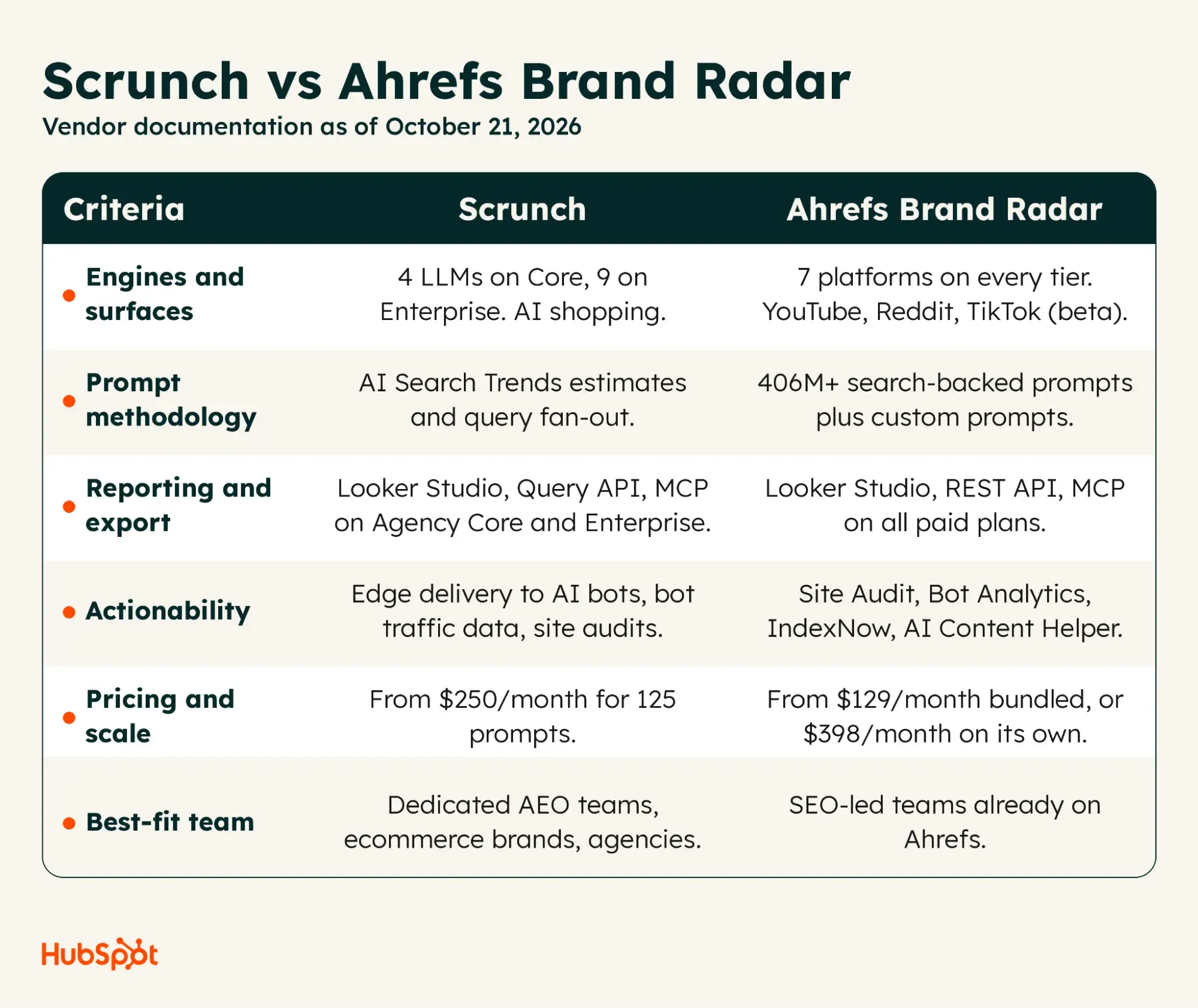
Ahrefs Brand Radar covers 7 platforms on every tier. Scrunch covers 4 LLMs on Core and 9 on Enterprise, with Claude, Gemini, Meta AI, Google AI Mode, and Grok added at the higher tier. If you need broad engine coverage without an enterprise contract, Brand Radar has the edge. Scrunch’s depth shows up elsewhere, in its Shopping module and its bot-side tools. Ahrefs goes wider on surfaces that aren’t LLMs, tracking YouTube transcripts and titles, Reddit, TikTok in beta, and a GBP Monitor for Google Business Profiles.
Which engines matter most for my category?
Start with the engines your buyers use, then work outward. Your analytics referrals, sales call notes, and customer surveys will show where buyers say they research. Google deserves early attention because of its reach.
Research found that 18% of Google searches in March 2025 produced an AI summary, and the rate climbed with longer, question-style searches. If your buyers research with long, conversational queries, Google AI Overviews and AI Mode belong in your first tracking set. Our guide to the top search engines can help you map where your audience searches, and the evolution of search gives context on why that mix keeps shifting.
Ecommerce teams should weigh Scrunch’s product-level shopping visibility. Brands with strong video or community footprints should weigh Ahrefs’ YouTube and Reddit tracking.
How should I validate coverage during a trial?
Scrunch offers a 7-day free trial on entry tiers. Ahrefs doesn’t offer free trials or discounts on Brand Radar, so ask your rep what a pilot looks like. Either way, validate the same way:
- Pick 15 to 25 prompts that mirror real buyer questions, across awareness, comparison, and purchase stages.
- Run the same prompts manually in each engine you care about and save the answers.
- Compare the tool’s output to your manual results. Check that it reports the same brand mentions and cited sources.
- Note any engine you need that the plan doesn’t include.
Look at how each engine appears in the SERP features you already track, too. AI Overviews are a SERP feature, so your existing SERP data is a useful cross-check.
Scrunch vs. Ahrefs Reporting Depth and Methodology
Prompt methodology affects how representative an AI visibility measurement is. The two tools build their prompt sets differently, and that difference shapes what you can trust in a report.
Ahrefs Brand Radar is built on a proprietary database of 406M+ monthly search-backed prompts, derived from real keyword searches by real users rather than artificially generated prompts. You can also track custom, brand-specific prompts. Scrunch uses AI Search Trends to estimate prompt activity volume, surface emerging topics, and flag content gaps or competitive blind spots. It also offers Query Fan-out analysis, which shows how AI engines expand a single user query into related searches.
Neither approach observes every question your buyers ask. Any AI visibility tool samples a slice of prompts, and AI answers vary by session, location, and phrasing — so read the numbers as trends. A tool that tracks the same prompts consistently over time shows you movement, even when it can’t show you the full market.
Do I need prompt-level reporting or are keywords enough?
Prompt-level reporting can reveal visibility patterns that keyword-level rollups may obscure. A brand might appear in 60% of answers across a topic cluster and still be missing from the three prompts that sit closest to purchase. A rollup hides that gap. A prompt-level view shows it.
Keyword-derived data still has value. Ahrefs’ search-backed approach ties AI prompts to real search demand, which helps you prioritize. If your team already plans content from keyword research, a keyword-anchored prompt set will feel familiar. If you’re mapping AI-specific buyer questions that don’t show up in keyword tools, prompt-level custom tracking matters more. Brand Radar supports both, and so does Scrunch’s custom prompt allowance.
What’s the best way to compare citation quality?
Count the citations, then check what they point to. For each tracked prompt, record which domains and pages the engine cites, whether your own pages appear, and whether the cited sources are ones you could realistically earn a place on. Compare that list across both tools for the same prompts.
The vendor documentation we reviewed doesn’t detail citation reporting at the same level for both tools, so make this a trial test. Ask each vendor to show citation-level data for your own prompts, including export options. That’s the only way to confirm the depth you’ll get. A tool that reports “you were cited” without showing the URL leaves you with less to act on than one that lists the exact page.
Scrunch vs. Ahrefs Actionability and Workflows
A report only matters if it changes what your team does on Monday. The two tools lean in different directions here.
Scrunch acts on the bot side. Agent Traffic analytics separates human visits from AI bot visits, and Site Maps runs page-level audits that show which pages bots visit and where technical blockers sit. AXP then serves AI crawlers a token-light version of your pages, often reducing page size by roughly 26%, or tens of thousands of tokens, according to Scrunch. That figure is a vendor claim, so test it on your own pages. If crawl access is a concern, our technical SEO crawlability checklist covers the basics you should confirm either way.
Ahrefs acts through its SEO tooling. Site Audit and Bot Analytics track how often AI crawlers visit your site, IndexNow enables instant content recrawling, the AI Content Helper optimizes articles for citations, and automated 24/7 technical SEO recommendations flag fixes. If your team already works from Ahrefs, these tools fit existing habits.
Integrations differ by plan. Scrunch provides Looker Studio connectors, Query APIs, and custom MCP access on Agency Core and Enterprise plans. Ahrefs includes an MCP server on all paid plans, so you can query live Ahrefs data inside Claude or ChatGPT, along with full REST API access and Looker Studio integrations. SEO automation workflows can pull from either, but plan tier determines which integrations you actually get.
Best for: Scrunch suits teams that want the tool to change how AI bots experience the site. Ahrefs suits teams that want AI insight to flow into existing SEO workflows.
How can I operationalize AEO inside my editorial process?
Give AEO findings a defined path into your content calendar. A simple version: review visibility gaps monthly, tag each gap as a new page, a page update, or an off-site opportunity, and assign it to the same owners who handle SEO briefs today. Re-check the affected prompts after publishing. Writers shouldn’t need to interpret raw dashboards, so have one person translate each report into a short list of actions.
When should I involve PR or digital PR?
Involve PR when citation data shows that third-party sources drive the answers in your category. If AI engines keep citing review sites, industry publications, or community threads and rarely cite brand-owned pages, publishing more on your own blog won’t close the gap. That’s the signal to pitch those sources or build presence where they already look. Ahrefs’ Reddit and YouTube tracking can help identify those cases. If the citation data doesn’t point to outside sources, keep the work in content and technical fixes.
Pro tip: Before you brief PR, pull the cited URLs for your five highest-value prompts and confirm that at least two or three of them are third-party. That evidence makes the case internally.
Scrunch vs. Ahrefs Pricing and Scalability
Both vendors price differently, so compare scenarios and not entry prices. Figures below reflect vendor documentation as of October 2026 and may change.
Scrunch
Ahrefs Brand Radar
Ahrefs sells extra custom prompt checks on their own: $50/month for 2,500, $100/month for 7,000, and $250/month for 25,000. Annual billing on the bundled plans brings Lite to $108/month, Standard to $208/month, and Advanced to $374/month.
Other plan details: Scrunch Core includes 5 site audits per month and 5 user licenses. Agency Core adds unlimited licenses and Looker Studio and MCP access. Enterprise tiers add full AXP, and Scrunch Enterprise adds SAML/OIDC SSO.
Two things stand out. First, the units differ. Scrunch counts unique prompts, while Ahrefs counts prompt checks, which are individual runs of a prompt. The bundled Ahrefs plans work out to 30 checks per tracked prompt each month, so a “prompt” in each system isn’t directly comparable. Second, the Ahrefs bundles include the full SEO suite, so the effective cost of AI tracking depends on whether you’d pay for Ahrefs anyway.
How should I estimate prompt volume and growth?
Count the topics, products, and buyer stages you need to cover, then multiply by the number of prompt variations per topic. A team tracking 5 products across 3 buyer stages with 5 variations each lands at 75 prompts before competitors or locations. Plan for growth, since most teams expand their prompt set after the first quarter. Check each vendor’s overage or upgrade path, because Scrunch’s Core plan caps at 125 prompts and Ahrefs’ bundled plans cap tracked prompts at 5, 10, or 20 below Enterprise.
What should agencies verify before rolling out to clients?
Verify workspace limits, seat counts, and white-label or reporting options. Scrunch’s Agency track includes brand workspaces, pitch workspaces, and unlimited licenses, which suits prospecting and multi-client reporting. Ahrefs scales through its custom prompt packages. Ask both vendors how per-client costs change as you add brands, whether data history carries over if a client leaves, and which API and reporting access each client plan includes.
Who Should Choose Scrunch or Ahrefs
Both tools fit real needs. The better pick depends on your team’s starting point.
Scrunch is the stronger fit for teams building a dedicated AEO practice. Its edge-level AXP delivery, bot traffic analytics, shopping visibility, and agency pitch workspaces address problems an SEO suite wasn’t designed for.
Ahrefs Brand Radar is the stronger fit for SEO-led teams. Ahrefs brings deep SEO context, including Keywords Explorer with 28.7B keywords, a 35T backlink index, and Rank Tracker, plus wide engine coverage and multi-channel tracking. Brand Radar is a capable monitoring product on its own terms, and the historical SEO data around it is a real advantage for teams that connect AI visibility to search performance.
How should an SEO team choose between Scrunch and Ahrefs?
If your team already uses Ahrefs daily, start with Brand Radar. You’ll skip a new vendor, a new login, and a new reporting layer, and you’ll get AI data beside the SEO data you already trust. Add Scrunch if you find that your main gap is how AI bots access and read your site, or if you need product-level shopping visibility.
What if my program is early and resources are limited?
Start small and learn what you need before committing. A low-cost plan with a modest prompt set is enough to establish a baseline. Scrunch Core at $250/month and Ahrefs Lite at $129/month are the lowest entry points in the documentation we reviewed, though Lite includes only 5 tracked prompts. A free, one-time check can also give you a starting picture before you pay for ongoing monitoring (more on that below).
The HubSpot-Native Path For AEO Measurement
After weighing Scrunch and Ahrefs, there’s a third question worth asking: where does your marketing already live? If your content, forms, campaigns, and reporting run in HubSpot, adding a separate AEO tool means another login, another dataset, and another handoff. HubSpot AEO is designed for teams that want AEO measurement connected to HubSpot marketing workflows.
HubSpot offers AEO in two ways, and they’re different products:
HubSpot AEO is available on its own at $50/month ($45/month billed annually), with no other HubSpot subscription required. It includes 25 prompts and tracks your brand across ChatGPT, Gemini, and Perplexity.

You get a brand visibility score, sentiment analysis, competitor share of voice, prompt tracking with suggestions, citation analysis, and prioritized recommendations. It doesn’t require HubSpot’s CMS, since it tracks your brand wherever your site is hosted.
AEO in Marketing Hub is included with Marketing Hub Professional and Enterprise. It has the same core tracking, with a larger starting set of 25 to 50 prompts, and it uses CRM data to suggest prompts instead of generic templates. Recommendations connect directly to HubSpot’s content and social tools, so you can act on a gap without switching platforms. For blog recommendations, one click generates a draft in your brand voice.
Compared with the two tools above, HubSpot AEO covers fewer engines (three) and doesn’t include a full SEO suite or bot-side delivery. It’s also labeled beta on HubSpot’s product pages, so confirm current availability before you plan around specific features. Its strength is fit — for a team that already creates and measures content in HubSpot, it keeps visibility data, content workflows, and campaign reporting in one place.
One limit to keep in mind: AI answers often influence buyers without sending a click. Pew’s research found that users who saw a Google AI summary clicked a traditional result link in 8% of visits, compared with 15% for users who didn’t see one. That means some AI influence won’t appear in click-based attribution, and no tool, HubSpot’s included, can tie all zero-click influence to revenue.
If you want AEO tracking, competitor comparison, citation analysis, and prioritized recommendations inside your existing HubSpot workflow, HubSpot AEO is the recommended fit.
How do I roll out AEO inside HubSpot?
- Choose your edition. If you only need tracking, use HubSpot AEO on its own. If your team already has Marketing Hub Professional or Enterprise, AEO is already included.
- Review the suggested prompts and add your own for the buyer questions you hear in sales calls.
- Add your top competitors so share of voice has a baseline.
- Review citation analysis to see which domains and content types AI cites for your category.
- Turn the highest-priority recommendations into briefs, and track the affected prompts after publishing.
Alternatives Worth a Look
Two alternatives add a decision dimension the main comparison doesn’t cover: an open-source path and other SEO suites.
When is an open-source path a good fit?
Elmo is an MIT-licensed, self-hosted AI visibility tracker. According to its GitHub repository, it tracks ChatGPT, Claude, Perplexity, Gemini, and Google AI Overviews, reports on competitors and cited sources, and provides a REST API. It fits technical teams that want to audit how scores are built, own their data, and bring their own API keys. The tradeoff is that you run the infrastructure yourself. Check the repository for current features, since the project is still moving quickly.
How do SEO suites compare on AI visibility?
Other SEO suites are adding AI visibility tracking too. Semrush and SE Ranking follow a similar model to Ahrefs, extending an existing SEO suite with AI tracking. HubSpot’s AEO software comparison covers how HubSpot AEO stacks up against both. If you already pay for one of these suites, check its AI visibility add-on against the same seven criteria before you add a new vendor.
Decision Matrix and Next Steps
No matter the solution you choose to implement, it’s necessary to come up with a game plan to make the most of your choice moving forward.
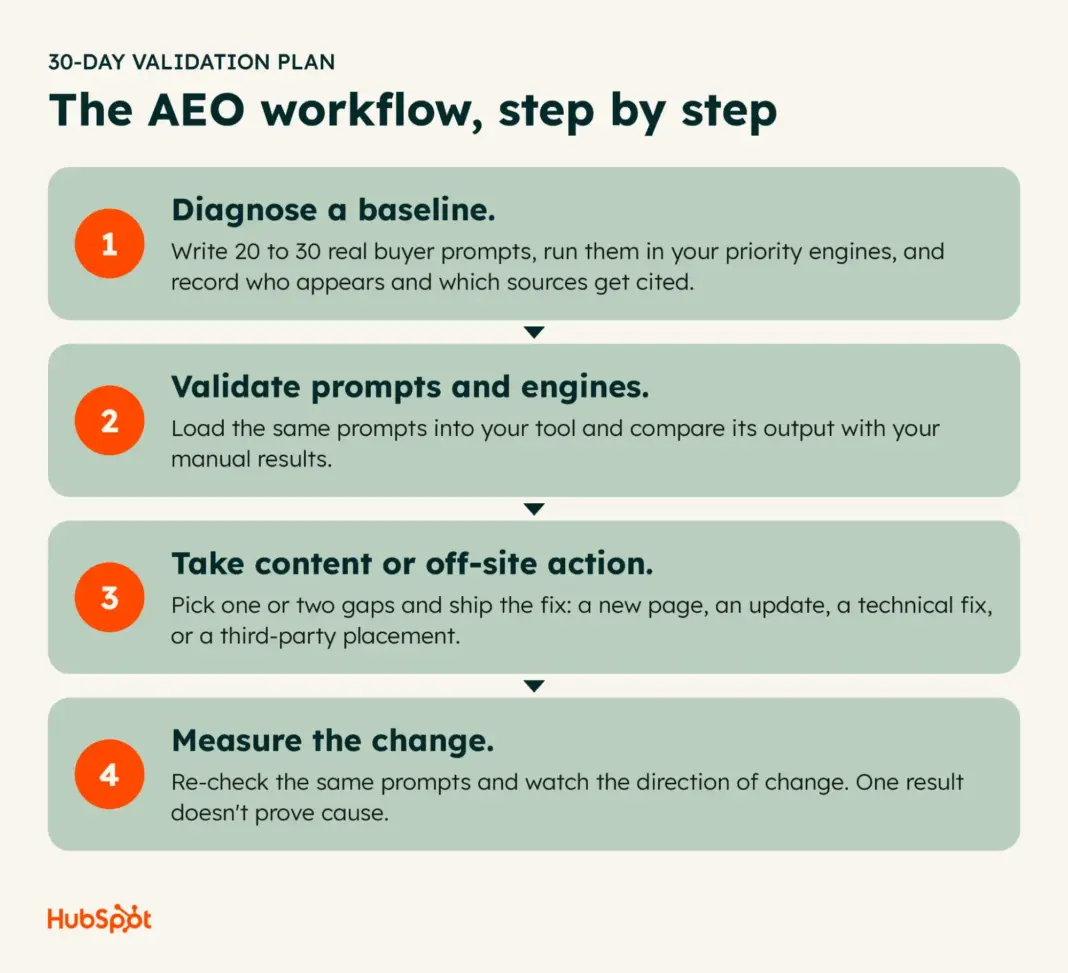
A 30-day AEO validation plan
Days 1 to 7: baseline. Write 20 to 30 prompts that reflect real buyer questions. Run them manually in your priority engines and save the answers. Record which brands appear and which sources get cited.
Days 8 to 14: validate. Load the same prompts into your shortlisted tool or tools. Compare the tool’s output to your manual results for engine coverage and citation detail. Note gaps and ask the vendor about them.
Days 15 to 24: act. Choose one or two gaps. For each, decide whether the fix is a new page, a page update, a technical fix, or an off-site opportunity, then ship it.
Days 25 to 30: measure. Re-check the affected prompts. Look at the direction of change, and don’t claim causality from a single result, since AI answers vary from run to run. Repeat the cycle with the next set of gaps.
If you want ongoing tracking, competitor comparison, citation analysis, and prioritized recommendations connected to your HubSpot workflow, HubSpot AEO is the place to start. If you’re not ready for ongoing monitoring, the AEO Grader gives you a free, one-time snapshot of how ChatGPT, Perplexity, and Gemini describe your brand, based on its own queries. It’s a starting point, and it doesn’t replace a controlled tool comparison.
Frequently Asked Questions About Scrunch vs. Ahrefs
Which engines and surfaces should I prioritize first?
Prioritize the engines your buyers already use, which you can learn from referral data, sales calls, and customer conversations. For most B2B categories, that means ChatGPT, Perplexity, and Google AI Overviews first. Add Gemini, Copilot, and Google AI Mode next. Add surfaces like YouTube and Reddit when your category depends on video or community discussion.
How do I connect AI visibility to pipeline in practice?
Track AI-referred visits and conversions in your analytics, add a “how did you hear about us” field to forms, and review prompt-level visibility alongside campaign data. Expect partial coverage. Many AI answers influence a buyer without producing a click, so the data shows correlation and not complete attribution. Compare visibility trends and pipeline trends over the same windows, and treat changes as signals to investigate.
Do I need both an SEO suite and a dedicated AEO tool?
Sometimes one is enough. If your SEO suite includes AI monitoring that covers your priority engines and citation needs, one tool may be enough. Add a dedicated AEO tool when you need capabilities the suite doesn’t offer, such as edge delivery to AI bots, product-level shopping tracking, or agency pitch workspaces. AEO and SEO share foundations, so many teams run both.
How often should I refresh prompts and re-check citations?
Review your prompt set quarterly, and add new prompts whenever you launch a product, enter a market, or see new competitors in answers. Check citations at least monthly for your highest-value prompts, because AI answers and their sources shift between runs. After you publish a fix, re-check the affected prompts within a few weeks.