

‘Our Super Bowl moment’ – what can WSL learn from booming US league?
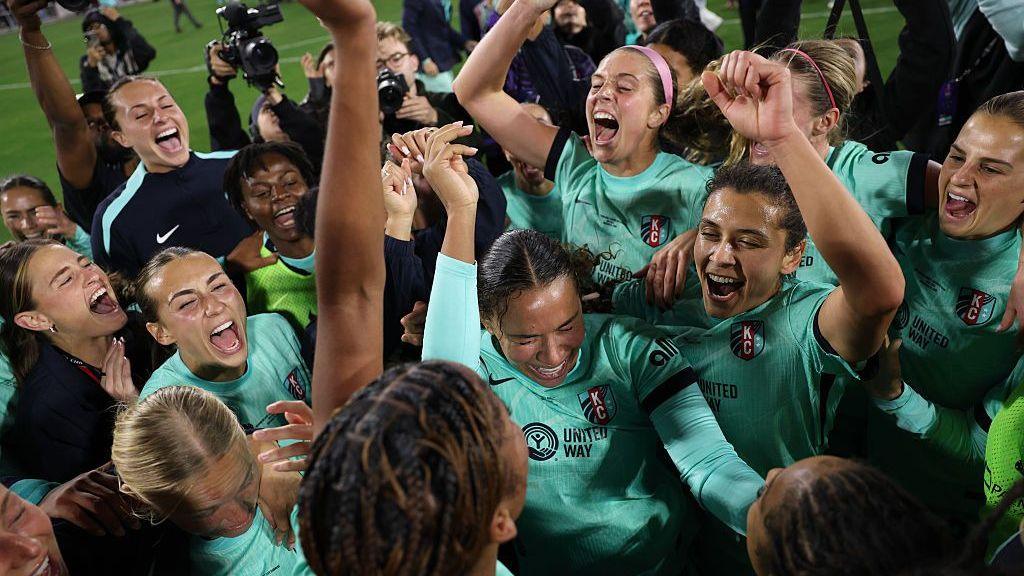 Image source, Getty Images
-
Published
“It’s turning into our Super Bowl moment.”
Sarah Jones Simmer, chief operating officer of the National Women’s Soccer League (NWSL), could not wait for the championship game between Washington Spirit and Kansas City Current on Saturday night.
The NWSL showpiece was played out in front of a sellout crowd of more than 19,000 at Audi Field in Washington DC, with tickets retailing at more than $300 (£229).
Ultimately, the Current triumphed 2-1 to clinch their first title, condemning Spirit to an unwanted record of three lost finals in a row.
Just a few hours earlier on this side of the Atlantic, Alexia Putellas, who last month was crowned the best player in the world for the third time at the Ballon d’Or ceremony, was scoring twice for London City against Crystal Palace in front of 4,000 people in Bromley.
It is a totally unfair comparison. After all, a championship final is the type of jamboree the USA does particularly well.
Nevertheless, women’s football is booming in America at the moment, with attendance figures at record highs, more franchises joining the league and club retail sales double those of 2025.
So what is behind the explosion in popularity?
And what can the Women’s Super League learn from it?
A unique history of popularity
The US is the most successful nation in women’s international football.
The four-time World Cup winners (1991, 1999, 2015 and 2019) and five-time Olympic gold medallists, the nation of Mia Hamm, Alex Morgan and Megan Rapinoe, has a history of winning – and the domestic game is key.
“If anything, soccer is more seen as a women’s sport [in the USA],” says broadcaster Jacqui Oatley, who currently commentates on the NWSL for ESPN.
“Women have won World Cups and Olympic Games – and the men have been nowhere near as successful.”
While teams in the United States became professional in 2001 – for WSL teams it was 2018 – the top flight has taken several different guises over the years.
The current NWSL kicked off in 2013 as an eight-team competition, and has since expanded to 16 franchises, with two more joining from 2028.
There is no relegation and Kansas City’s victory on Saturday means the league has had eight different winners since its iteration.
As the below graph shows, the ownership picture for these sides is far more varied than in the UK, with American sides much less dependent on their male counterparts.
Indeed, Kansas City are blazing a trail. Established in December 2020, unaffiliated to a men’s side and backed by ambitious owners that include Brittany Mahomes – the wife of NFL quarterback Patrick Mahomes.
Winning the championship is the crowning achievement for an ambitious franchise and such success is something independent London City hope to emulate in the UK. They are four points from the WSL summit nearly halfway through the 2026-27 season.
Kansas City were also the first club to build a bespoke stadium solely for women’s football and the demand for seats at their 11,500-seater CPKC Stadium is huge. Earlier this year, Brighton announced their own purpose-built venue, planned for 2030-31.
“I think our independence is a hallmark of the league,” says the NWSL’s Jones Simmer.
“It is something we are very proud of. It allows us to invest in our own growth, prioritise the women’s game and ensure resources are flowing to it.”
It is markedly different from the UK set-up, where all WSL teams bar London City are, at least, affiliated and more often financially reliant on the men’s side.
But that presents just as much of an opportunity, according to Jones Simmer.
“I know Nikki [Doucet, chief executive of the WSL] and I admire what she is building,” she says.
“There’s a really unique opportunity to build on the legacy of these 100-year-old men’s clubs that are household names, to build women’s brands that embrace the legacy but also have their own identity.”
-
Bespoke women’s football stadiums? Why US sides are making the move
-
Published15 March
-
-
Brighton plan Europe’s first purpose-built £80m women’s stadium
-
Published28 April
-
An on-pitch product that delivers
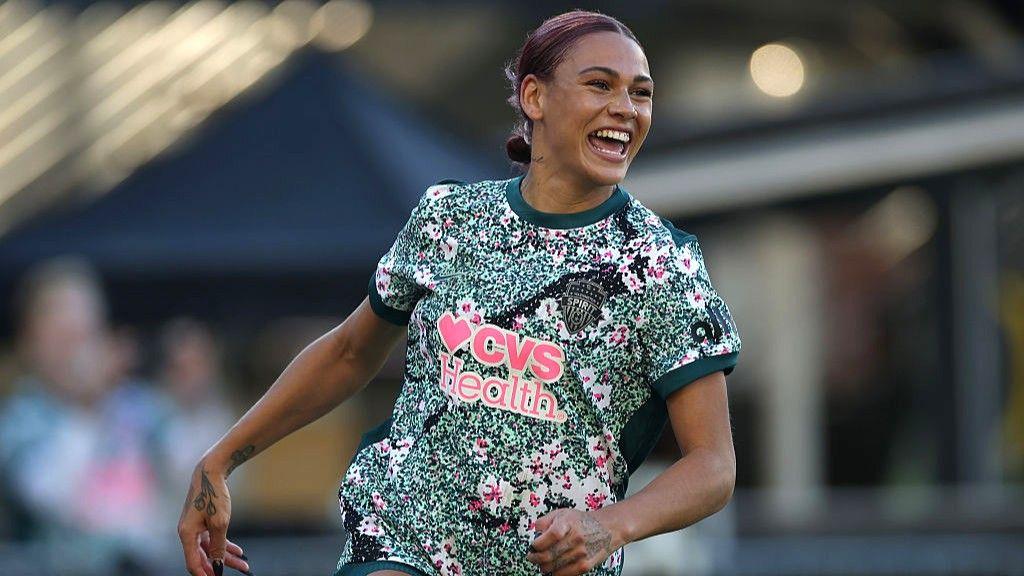 Image source, Getty Images
Fans of both the NWSL and the WSL are spoiled when it comes to talent.
Most of the US national team play their club football at home, with the likes of Trinity Rodman, Mallory Swanson and Rose Lavelle household names.
International stars such as Malawi’s Temwa Chawinga at Kansas City, who came 10th in the 2026 Ballon d’Or rankings, and former Chelsea striker Sam Kerr further enhance the league’s quality.
“Where it starts is the product on the pitch,” says Jones Simmer. “The quality of football has to be incredible and we have the best players in the world.
“And they are incredibly engaging with our fans. For so many supporters, their entry point to the league is they care about a particular player.”
Provided the standard of competition is present, Jones Simmer says fans will return – and her confidence is backed up by the numbers.
In 2026, the average gate for an NWSL match has been more than 11,000 – only Arsenal in the WSL consistently receive a higher attendance than that, albeit the US is almost five times more populous than the UK.
On Thursday, the final few tickets for the NWSL’s showpiece were retailing at $300 on ticket site Viagogo, with Jones Simmer suggesting resale tickets could be purchased at six times market value in advance of the match.
As London City and Washington Spirit owner Michele Kang put it: “The answer could not be clearer that there is an audience for the women’s game.”
“It’s our job to hook fans by making sure they have a great experience watching a game in a venue and that’s about the quality of the product,” Jones Simmer adds.
“Once folks have that experience, it’s a really easy yes to tune in again.
-
Families v loyal fans – women’s football’s attendance dilemma
-
Published30 October
-
Not that quality is an issue in the WSL where high-class footballers abound. Take Putellas, goal machine Khadija Shaw and most of England’s double European Championship-winning squad for example.
Amercian stars such as Alyssa Thompson and Naomi Girma at Chelsea, and Manchester City’s Sam Coffey, have also swapped the US for the WSL in the past two years.
Broadcaster Oatley, who has been covering women’s football since the 2005 World Cup, is keen for such players to be more visible off the pitch.
“I would love to see WSL players on mainstream TV shows, podcasts, social media platforms, not just on women’s football programmes where the audience already knows everything about them,” she says.
“It would not be for everyone, but for those who are comfortable, who have the biggest personalities, I think we could use that much more to grow our audience.”
A matchday experience that matters
Oatley has been covering NWSL games for the past four seasons and she believes US clubs have mastered putting on events.
“When you’re trying to promote a product in sport, you can’t guarantee the team is going to play well and win,” she says.
“But you can ensure the people who come to the game have a great experience.
“I love the enthusiasm, the positivity, the vibe of ‘let’s make this big’. It’s a brilliant experience.”
It is a balance the WSL wrestles with. With attendances plateauing this season, questions have arisen around its target audience and whether to market matches such as the north London derby between Tottenham and Arsenal as a rivalry or a family-friendly event.
Oatley’s perspective is that it ought to be both, while recognising the different challenges in this country.
“I didn’t understand that criticism,” she says, “because they weren’t saying: ‘Only come to this game if you’re a family’. It was being promoted all round.
“I don’t think it’s one size fits all marketing wise – the main thing is awareness.”
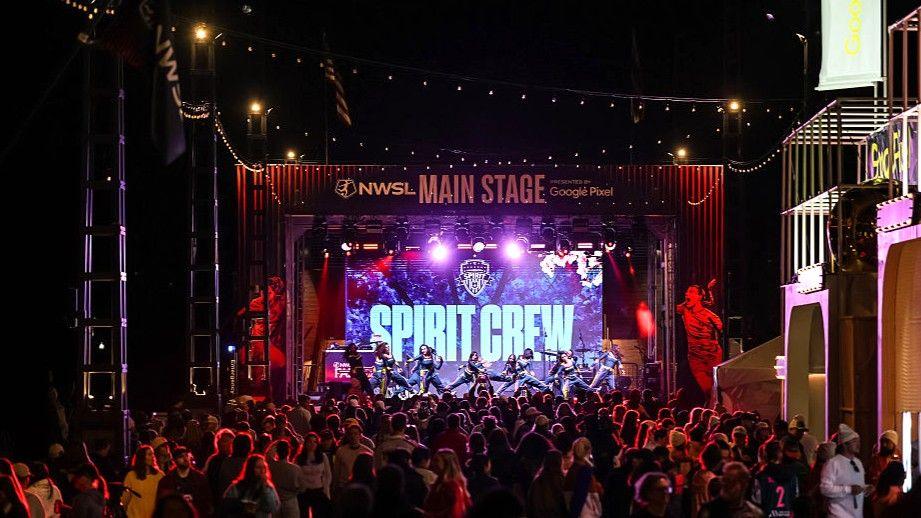 Image source, Getty Images
It is a challenge the NWSL has embraced, and seen attendances rise accordingly.
“We want to ensure that we provided a big enough tent where everyone can feel welcome and included, whether they’re there for the rivalries and the competitive tactics, or they’re experiencing it for the first time,” says Jones Simmer.
“To grow the sport, all fans need to be able to come to an NWSL game and have a great experience.”
This season, league finalists Current and Spirit played at a remarkable 17 different times between them, reflecting the four timezones and vast nature of the USA.
It is all part of the country’s sporting landscape, but given the WSL’s continued conundrum about fixture scheduling, it is interesting that NWSL supporters manage to find the matches regardless.
“I have a lot of sympathy with schedulers because men’s football got there first,” Oakley says.
“Maybe the solution is deciding certain time slots are for women’s football and sticking with them.”
It does not appear the growth in the NWSL will slow down any time soon.
The Women’s World Cup in Brazil next summer will feature the USA as one of the favourites and women’s soccer will feature at the Olympic Games in Los Angeles in 2028.
The US will also host the 2031 Women’s World Cup.
“It is amazing how the NWSL is cracking into culture,” Jones Simmer says.
“We get excited about these catalytic opportunities to expand the community engagement, awareness and relevance of the NWSL.”