
Prime minister Keir Starmer has described as “completely wrong” US president Donald Trump’s threat to impose 10% tariffs on the UK due to its opposition to his plan to take over Greenland.
Trump announced the tariffs on Saturday saying that he wants “complete and total purchase” of Greenland to protect US and global security.
Due to their opposition to his demands, the president said the UK, Denmark, Norway, Sweden, France, Germany, the Netherlands and Finland would be charged a new 10% tariff on their exports to the US from 1 February, rising to 25% on 1 June if a deal on Greenland is not reached.
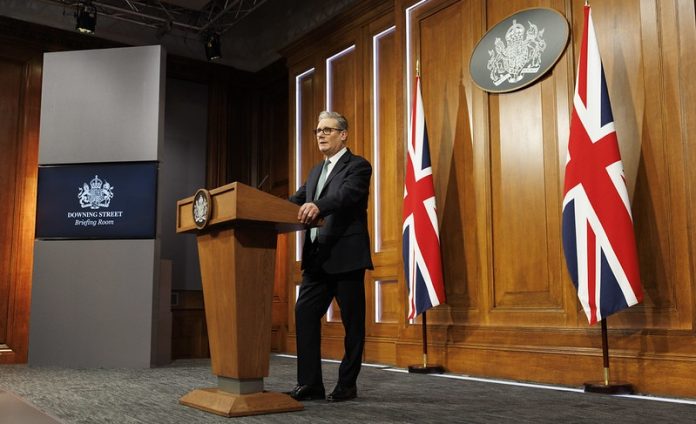
In a hastily arranged Downing Street press conference, Starmer said Trump’s threat is “completely wrong” and “not the right way to solve differences within an alliance”.
Asked if he would respond with retaliatory tariffs, he said: “I want to avoid a trade war. A trade war is not in our interests. My first task is to ensure we don’t get to that place.”
As Prime Minister, I will always act in the United Kingdom’s national interest. pic.twitter.com/ZkveFmD1R1
— Keir Starmer (@Keir_Starmer) January 19, 2026
The prime minister’s approach has been welcomed by business groups.
British Chambers of Commerce director general, Shevaun Haviland, and director of international trade, Steve Lynch, met with minister Chris Bryant and discussed the tariff threat.
Speaking afterwards Haviland said:
“Throughout tariff developments, the government has kept a cool head and continued to negotiate. That’s seen us establish a competitive advantage over many other countries in the US market for goods like steel and pharmaceuticals.
“We are still in the foothills when it comes to these new tariff proposals from the president and there is some way to go before we will have final clarity on them.
“But should the worst-case scenario come to pass, then the impact would be significant. A £6bn hit at the end of January, rising to £15bn in June.
“If that happens, orders will drop, prices will rise, and global economic demand will be weaker as a result. That would be a lose-lose situation for everyone.
“The UK is not without influence, our bilateral trade with the US is worth £300bn, we have £500bn invested in its economy and it has £700bn tied up in ours. There is a high-level of co-dependency.
“The government should keep everything on the table during talks. Many firms, especially SMEs, will now be facing difficult decisions and we urge it to consider its contingency plans for support should the worst happen.
“The existing 10% tariff means that many businesses have already negotiated with their US customers on managing the impact and we would suggest they continue this dialogue.
“Last year, enhanced credit and financial support was offered through UK Export Finance and the British Business Bank to cushion the effect of tariffs, and this is another option.”
European Union reaction
European Union diplomats met on Sunday to discuss reviving a plan to levy tariffs on €93 billion of US goods. This was suspended after the EU agreed a trade deal with Trump last summer.
Another option is the “anti-coercion instrument“, also known as the “trade bazooka”. This so far untested measure, which aims to protect the EU and its member states from economic coercion by third countries, would impose trade restrictions on the US.
German finance minister Lars Klingbeil said: “We Europeans must make it clear: The limit has been reached. Our hand is extended but we are not prepared to be blackmailed.”