
Marketing leadership decisions used to be about where to allocate resources between known channels like paid, content, events, and email. Each of these channels has established performance benchmarks and predictable customer acquisition cost (CAC) ranges. But now, that framework is getting harder to trust as more buyer discovery moves to answer engines.

The most valuable buyers actively researching solutions in your category are increasingly asking answer engines first. Buyers get a summary, a short list of credible vendors, and a frame for the problem before they visit anyone’s website. If your brand isn’t showing up accurately and favorably in those answers, you’re already behind.
Marketing leaders optimizing for AEO early are building AI visibility into their existing reporting stacks and connecting AEO activity to the pipeline metrics they’re already held to.
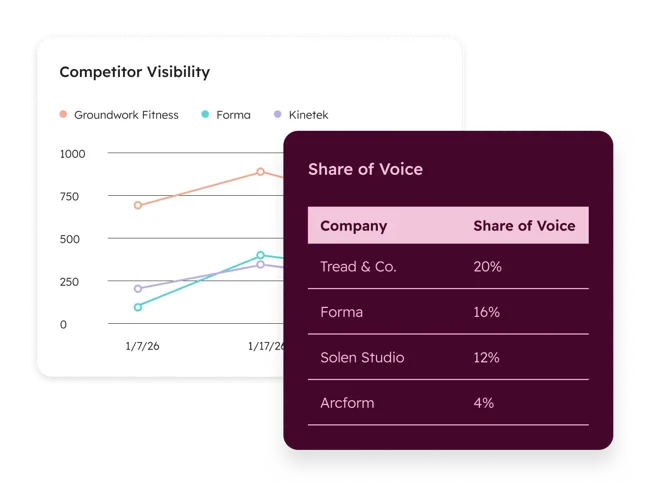
Get a high-level view of your brand visibility vs. competitors.
Competitive analysis in traditional search is a known discipline with established tools, benchmarks, and a shared understanding of what winning looks like. AEO competitive intelligence is newer, and most marketing leaders don’t have a clear picture of where they stand relative to their competitors in AI answers. You might be ahead, behind, or invisible in answer engines, but the marketing team has no reliable way to know.

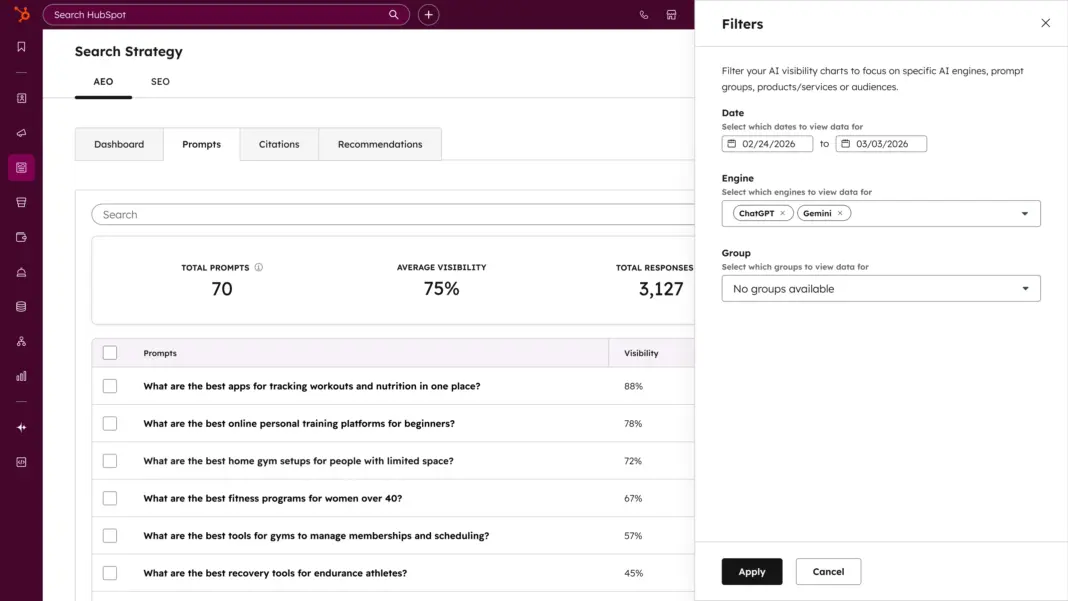
HubSpot AEO’s Brand Visibility Dashboard includes share of voice, which shows how a brand’s citation frequency compares to competitors across the prompts that matter to their category. The brand visibility score gives a single number to track over time, while the competitive view shows if that number represents a lead, a lag, or a gap that needs closing.
Once you have a visibility data foundation, you can make the investment case by connecting metrics to investment and return.
Build a business case for AEO investment with real data.
Stakeholders usually view new channels as experimental, so initial investment is usually small, attribution is unclear, and the ask gets deprioritized against channels with cleaner ROI stories. That’s where AEO is in most marketing organizations right now. But competitors moving earlier already have compounding brand authority that’s expensive to overcome.

If a competitor earns consistent citations for the 10 prompts that describe your category, buyers will see them as the default answer. HubSpot AEO gives teams the data to build a real business case: Current brand visibility score, share of voice against named competitors, citation trends over time, and recommendations for which specific investments will close the gap. With solid data, teams can present leadership with a gap, a trajectory, and a plan.
According to HubSpot’s internal research, AEO customers generate 2.7x more MQLs.
Once there’s buy-in for AEO, teams need to show ROI by tying activity to the revenue outcomes.
Track how AEO activity translates to pipeline and revenue.
Marketing leaders who can’t connect AEO to revenue outcomes will eventually face the same pressure that hits every new channel: Prove it or cut it. Leadership wants to know whether the investment changed pipeline velocity, increased MQL volume, or improved close rates, so the measurement framework needs to speak that language from the start.
HubSpot lets teams connect AEO performance to their CRM data. Once marketers tag AI-referred contacts and build the reporting views, teams can track how buyers who discovered the brand through answer engines move through the pipeline, from first AI-referred visit to MQL to closed deal. That puts the answer in the same reporting stack leadership already reviews, rather than a separate tool.
The window to build AEO into your marketing infrastructure successfully is narrower than it looks. Establish measurement and competitive baselines now, so you have the data advantage when the board starts asking why the organic pipeline looks different than it did three years ago.