
This post was originally published on this site.
Brand tracking tools help growth marketers gauge what people say about the brand, whether it’s good or bad, and why they choose competitors, all at scale. Brand monitoring also reveals AI share of voice and what you should improve to be cited more by LLMs.

However, as with everything in marketing, brand tracking software isn’t a single tool. Brand trackers vary by metrics, AI tracking features, a company’s growth stage, use cases, and pricing.
This post breaks down the differences between brand tracking and brand monitoring, how to choose the best brand tracking tools, like HubSpot AEO, and how to confidently run a brand tracking survey. Let’s dive into the details so you can confidently choose the best-fit brand tracker.
Table of Contents
What are brand tracking tools?
A brand tracking tool is software that measures brand health across channels over time. Modern brand tracking tools collect data from social platforms, search signals, PR coverage, web analytics, customer feedback, answer engines, and brand tracking surveys.
In 2026, the biggest shift is AI visibility. For brand teams, this changes the old workflow. A brand tracker no longer sits only inside quarterly brand perception research. It now integrates survey data, social listening, search demand, AI citations, customer feedback, and CRM reporting into a single decision-making dashboard.
For AI brand tracking, growth teams use HubSpot AEO to monitor how a brand appears across ChatGPT, Perplexity, and Gemini, including AI visibility scores, competitor comparisons, prompt tracking, and citation analysis. With HubSpot AEO, teams clearly understand which sources and content types AI engines cite most.
But before measurement begins, the brand foundation must be clear. Use HubSpot’s Free Brand Building Guide to document positioning, voice, and visual identity before measuring whether the market understands them.
Brand Tracking Tools vs. Brand Monitoring
Brand tracking measures longitudinal changes in brand awareness, perception, consideration, preference, and loyalty. Brand monitoring focuses on live detection of brand mentions across the web, social channels, media, forums, reviews, and answer engines. Each solves a different problem:
- Brand tracking answers what’s going on overall. Are target buyers more aware of us this quarter? Do they prefer us over competitors? Are campaigns shifting perception?
- Brand monitoring answers what’s going on today. Who mentioned us today? Did sentiment spike? Which creator, journalist, customer, or AI answer changed the conversation?
Continuous listening captures ongoing brand mentions and sentiment shifts between survey waves. A brand tracking survey adds structured feedback that listening tools cannot capture on their own.
Scaling companies, oftentimes, need both to run in parallel. Brand monitoring spots a signal such as a spike in Reddit mentions, for example. Brand tracking proves whether the signal changes market perception. AI brand tracking shows whether answer engines started repeating that narrative when buyers ask for vendor recommendations.
Here is a clear distinction between brand tracking and brand monitoring for decision-makers.
Which brand tracking metrics matter?
The right brand tracking metrics show how visible, trusted, preferred, and commercially useful a brand has become. These are the core metrics worth tracking first.
- Brand awareness measures whether the market knows the brand exists.
- Consideration measures whether buyers would include the brand in their shortlist. A crucial metric since awareness without consideration creates expensive reach and weak demand.
- Share of voice gauges how visible the brand is compared with competitors across media, social, search, PR, and other defined channels.
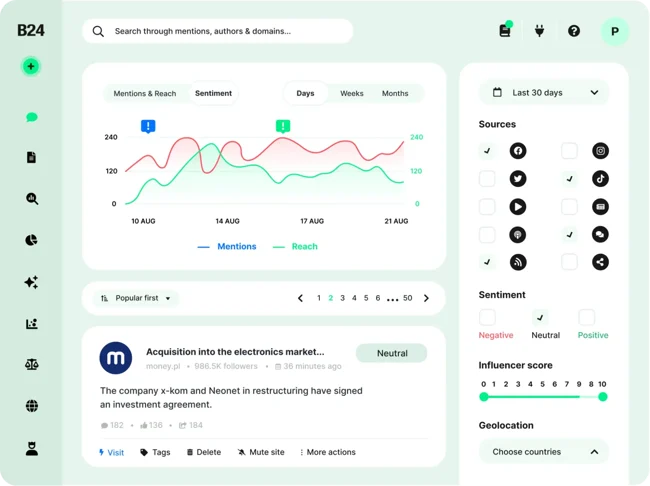
- Sentiment analyzes whether brand mentions are positive, neutral, or negative.
- Brand preference measures whether buyers choose the brand over alternatives.
- Share of search measures branded search demand against competitors.
- AI share of voice tracks how often a brand is mentioned in AI-generated answers compared with competitors across tracked prompts and topics.
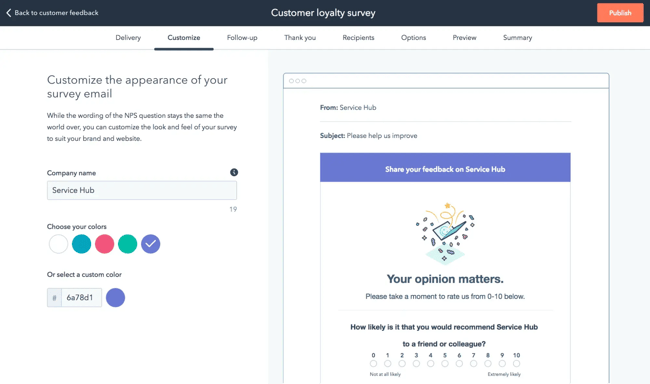
- NPS (Net Promoter Score) measures customers’ willingness to recommend the brand.
- CSAT (Customer Satisfaction Score) gauges satisfaction following a specific interaction with a brand, product, or service.
- Pipeline influence measures whether brand visibility correlates with business outcomes, including branded search, direct traffic, demo requests, MQLs, SQLs, win rate, deal velocity, and retention.
Brand strength rarely fails in one place, so all these metrics matter. For example, share of voice can grow because of negative coverage — and marketers definitely want to know this.
HubSpot’s Customer Feedback Software helps revenue teams collect NPS, CSAT, and CES surveys, then view scores, sentiment, and response volume in dashboards. Surveys can be distributed via email or embedded on web pages, creating a smooth experience for your customers.
AI Brand Tracking and Predictive Alerts
AI brand tracking measures how often, how accurately, and how favorably a brand appears in AI-generated answers. It tracks whether answer engines mention the brand, which competitors appear in the same responses, which prompts trigger visibility, and which sources shape the answer.
This matters because AI visibility now sits upstream of traffic. A buyer can ask ChatGPT, Gemini, or Perplexity for the best tools in a category and get a shortlist before ever visiting a website. Traditional SEO dashboards cannot fully capture that moment, as the brand can appear in an answer without earning a click. Core AI brand tracking use cases include:
- Anomaly detection, which flags sudden drops or gains in AI visibility before traffic or pipeline changes appear.
- Sentiment shifts that shows whether AI answers describe the brand more positively or negatively over time.
- Competitor spikes that reveals when competitors start appearing more often for the same buyer prompts.
- Executive briefs which turns prompt-level data into leadership-ready summaries with clear next actions.
- AI visibility that shows where the brand appears, where it is absent, and which sources influence the answer.
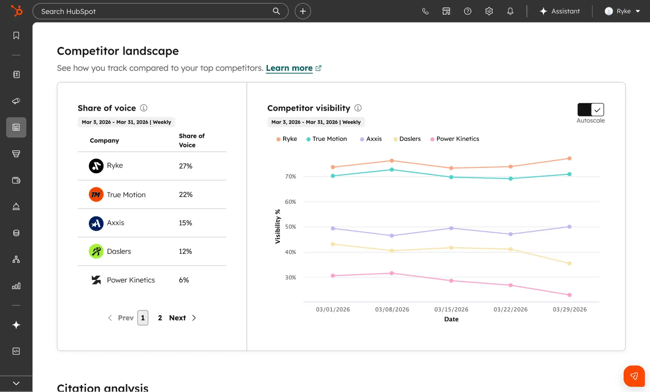
Run HubSpot AEO to see how often your brand appears against competitors across ChatGPT, Perplexity, and Gemini. Your dashboard populates automatically with your brand visibility score, share of voice percentage, and sentiment score.
How to Choose Brand Tracking Tools
Brand tracking tools should match the decision the company needs to make. Early-scale teams usually need fast signals and clean dashboards. Mid-market teams need integrations and repeatable reporting. Enterprise teams need governance, multi-market tracking, and research rigor. Before comparing tools, teams should agree on what brand tracking software must help them answer:
- Which audience are we trying to understand?
- Which competitors should we track every month or quarter?
- Which metrics will leadership actually use?
- Which channels shape buyer perception in our category?
- Which brand signals should connect to CRM, pipeline, or retention data? Why?
- Which team owns the follow-up when the data changes?
- Which reports need to be shared with executives, sales, PR, and customer teams?
Once you’ve written down the answers, it’s easier to map out the list of features that solve your problem. I shortlisted a handful of necessary features for a complex brand health monitoring.
Survey-based Brand Health Measurement
Survey-based tracking measures what buyers think, remember, and prefer. A brand tracking survey captures structured feedback from the audience a company seeks to influence. The tool should support unaided and aided awareness, familiarity, consideration, preference, trust, purchase intent, and brand associations. For B2B companies, it should also support audience filters to capture answers from the real buying committee:
- Job title.
- Seniority.
- Company size.
- Industry.
- Market.
- Buying role.
Questions to ask vendors:
- Can we measure unaided and aided awareness separately?
- Can we segment by job title, industry, company size, geography, and buying role?
- Can we track the same core questions across waves?
- Can we compare awareness, consideration, and preference against named competitors?
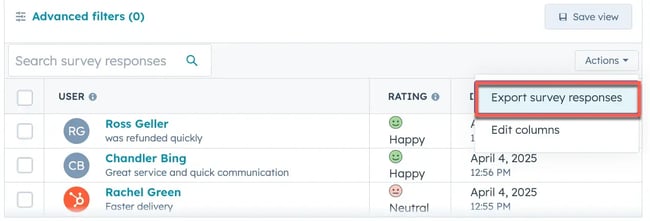
- Can we export raw data for deeper analysis?
- How does the vendor source respondents?
- How does the vendor prevent low-quality survey responses?
Brand Monitoring Coverage
Brand monitoring coverage shows where brand mentions happen outside structured surveys. This includes social media, news, forums, reviews, blogs, podcasts, videos, communities, and AI answers.
Since consumers are increasingly less likely to share feedback directly with companies, that means passive listening and multi-source monitoring are more important for brand health.
Questions to ask vendors:
- Which sources are covered natively?
- Does the tool track Reddit, YouTube, podcasts, review sites, blogs, and news?
- Does it show the original mention with source context?
- Can it separate owned, earned, paid, review, social, and community mentions?
- Can it detect mention spikes by topic, channel, and competitor?
- Can it filter by geography and language?
- How quickly do mentions appear in the dashboard?
AI Visibility and AI Share of Voice
AI visibility and share of voice belong in brand tracking now because answer engines influence the shortlist before a buyer reaches a website.
AI visibility shows whether answer engines mention the brand when buyers ask category, comparison, or recommendation questions. AI share of voice measures how often the brand appears in AI-generated answers compared with competitors across the same tracked prompts.
Questions to ask vendors:
- Which answer engines does the tool track?
- Can we define prompts by product, market, audience, and buying stage?
- Does the tool show exact AI responses?
- Does it track competitor mentions inside the same prompts?
- Does it separate mentions from citations?
- Does it recommend actions based on missing prompts or weak citations?
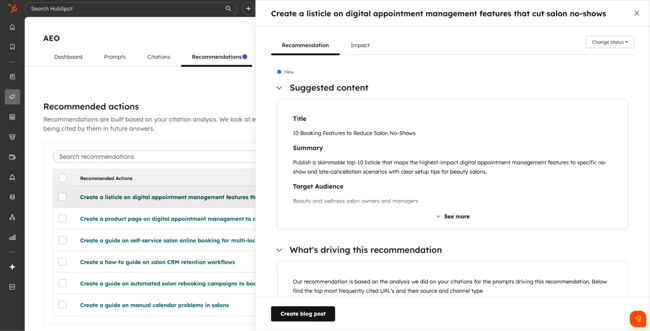
HubSpot AEO is the smartest solution on the market that tracks brand visibility, sentiment, prompt performance, competitor presence, and citations across ChatGPT, Gemini, and Perplexity. It surfaces which sources and content types AI engines are citing in your category, then gives you prioritized recommendations on what to create or improve to increase your share of voice.
Customer Feedback and Experience Signals
Collecting customer feedback belongs to the customer support teams, but separating brand tracking from customer reality is shooting yourself in the foot. A company may improve awareness while customer frustration weakens trust, reviews, referrals, and retention.
Ideally, a brand tracking tool comes with a suite of features for measuring customer satisfaction. Or, you may need to buy and connect a standalone tool.
Questions to ask vendors:
- Can the tool collect NPS, CSAT, and CES?
- Can feedback be tied to customer records?
- Can teams segment feedback by lifecycle stage, product, region, or account type?
- Can customer comments be analyzed by topic and sentiment?
- Can feedback trends be viewed beside retention, expansion, or support data?
HubSpot Customer Feedback Software can do all of the above as the tool connects NPS, CSAT, and CES surveys to the customer record inside HubSpot.
CRM, Campaign, Search, and Social integrations
The tool should connect brand metrics to CRM data, campaign performance, search trends, social engagement, customer feedback, and web analytics. Only then do growth teams understand what impacts the brand health score and act accordingly.
Questions to ask vendors:
- Does the tool integrate with our CRM?
- Can brand metrics be viewed next to campaigns?
- Can we connect branded search and direct traffic trends?
- Can we compare visibility movement with pipeline or conversion changes?
Competitor Benchmarking
A strong brand tracking tool should let teams track named competitors across the same audience, markets, channels, and metrics. For AI visibility, this means tracking the same prompts and seeing whether answer engines recommend the brand, competitors, or no vendor at all.
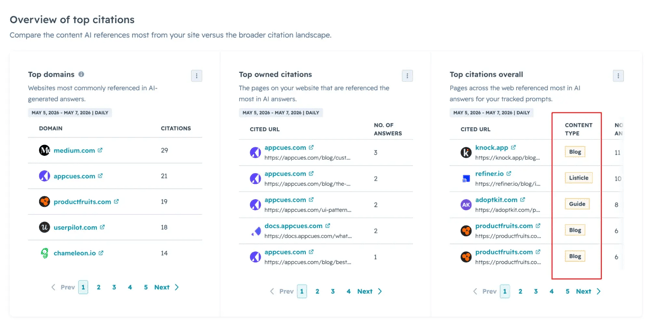
For example, HubSpot AEO tracks selected prompts to analyze how competitor presence in AI answers shifts week over week. Marketers use this data to understand which content types drive the most citations.
Questions to ask vendors:
- How many competitors can we track?
- Can competitors be grouped by market, product line, or region?
- Can we compare awareness, consideration, preference, and sentiment?
- Can we compare AI share of voice across the same prompts?
- Can we see which sources cite competitors but not us?
Sentiment and Topic Analysis
A brand tracker should identify themes such as pricing, product quality, customer support, onboarding, integrations, security, ease of use, or brand trust. It should also show whether sentiment is positive, neutral, or negative and whether it differs by channel.
Questions to ask vendors:
- Can we see the original mention behind the sentiment score?
- Can sentiment be grouped by topic?
- Can sentiment be filtered by channel and source type?
- Can the tool detect sudden sentiment shifts?
Reporting and Governance
A good brand tracking tool should support role-based dashboards, scheduled reports, permissions, annotations, exports, and clear trend history.
Questions to ask vendors:
- Can dashboards be customized by role?
- Can teams annotate major campaigns, PR moments, launches, and incidents?
- Can raw data be exported?
- Does the tool keep historical trend data?
Pricing and Total Cost
Pricing for brand tracking tools can look simple on the pricing page and become complicated during implementation. Total cost depends on:
- Markets.
- Audience segments.
- Competitors.
- Survey sample.
- Mention volume.
- Tracked prompts.
- Users.
- Historical data.
- Dashboards.
- Integrations.
- Onboarding and support.
Teams should ask vendors to price the actual use case.
One important caveat: Brand teams may not need all features at once, but they should not buy tracking software only to “measure brand” either. The tool needs to show what changed, where it changed, why it likely changed, and what the team should do next.
Best Brand Tracking Tools by Growth Stage
Brand tracking software is split into three groups: lightweight survey and feedback tools, mid-market listening and AI visibility tools, and enterprise research suites. The best choice depends less on feature volume and more on whether the tool can answer the next business question.
Early Scale Teams: Brand Tracking Tools Shortlist
Early-stage teams usually need quick and accurate answers to the three questions: Whether buyers know the brand, what they say about it, and whether AI answer engines include it in their recommendations.
1. HubSpot AEO
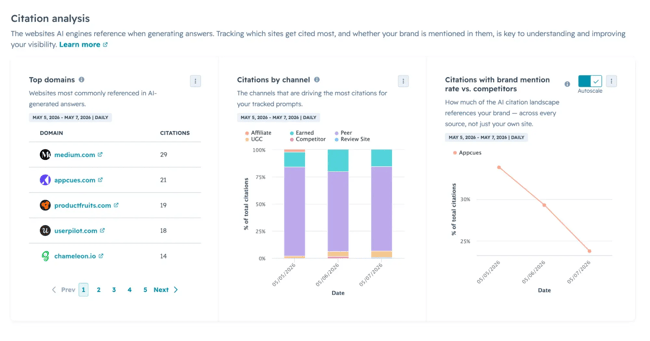
HubSpot AEO is built for marketers who need to know whether their brand shows up when buyers ask answer engines for category recommendations. It tracks visibility across ChatGPT, Gemini, and Perplexity, then shows whether the brand appears, how it compares with competitors, and which sources influence those answers. HubSpot AEO also analyzes AI visibility gaps by showing:
- Which prompts mention the brand.
- Which prompts mention competitors instead.
- Where the brand is absent.
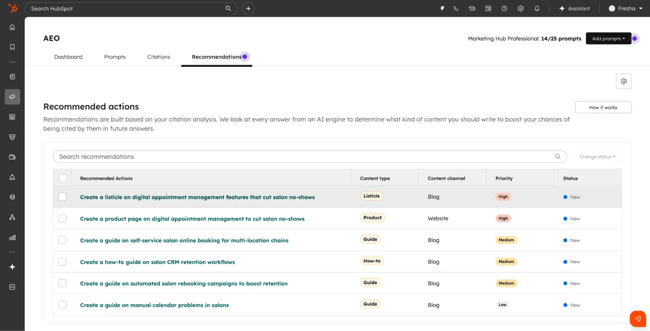
It also turns these gaps into practical recommendations, like updating owned content, building a comparison page, pitching a third-party source, or strengthening social signals.
Key Features
- Brand visibility score across ChatGPT, Gemini, and Perplexity
- AI share of voice benchmarking against competitors
- Sentiment analysis for AI-generated brand mentions
- Prompt tracking and prompt suggestions
- Citation analysis by source, domain, and content type
- Prioritized recommendations to improve visibility
- CRM-informed prompt suggestions in Marketing Hub
What I like: HubSpot AEO treats AI visibility as a brand measurement problem and provides a brand visibility score, along with actionable recommendations, all within the same workflow. For lean teams, this cuts the time between “we are invisible” and “this is what we should publish or improve.”
Pricing
- Free trial: 28 days with 25 prompts across ChatGPT, Gemini, and Perplexity
- HubSpot AEO: $50/month
- Free with Marketing Hub Pro & Enterprise plans: Gives access to connect AI brand mentions to CRM data
Best for: Growth marketers, brand managers, SEO leads, and revenue teams that need to track AI share of voice and understand why competitors appear in answer engines.
2. HubSpot Customer Feedback Software
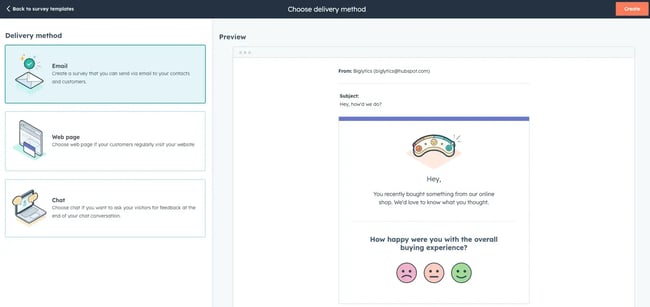
HubSpot Customer Feedback Software helps teams create NPS, CSAT, and CES surveys inside HubSpot’s Service Hub. It works well when brand perception needs customer experience context, especially after support, onboarding, or renewal moments.
HubSpot Customer Feedback Software also connects to the contact, company, ticket, and lifecycle data that explain why the feedback happened. An essential feature for the timely detection of pipeline leaks and appropriate action.
Key Features
- CSAT surveys
- NPS surveys
- CES surveys
- Custom surveys
- CRM connected customer records
- Unlimited questions
- Multi-language survey support
- Integrations with Slack, Jira, dashboards, and HubSpot Smart CRM
What I like: Feedback sits close to the customer record, which makes it easier to connect poor experience, account risk, and brand perception.
Pricing
- Service Hub Professional: $100 per seat/month or $90 per seat/month billed annually
Best for: Customer marketing, CX, and service teams that want to measure how customers feel about the brand after real interactions.
3. Typeform
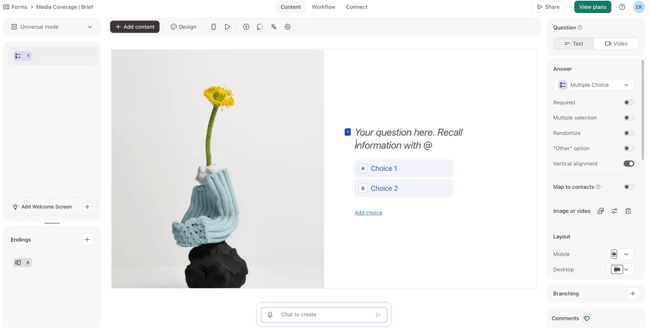
Typeform works well for lightweight brand tracking surveys, campaign recall surveys, message testing, and post-event research. It gives lean teams a clean way to collect structured feedback without buying a dedicated research platform.
Key Features
- Unlimited forms on paid plans
- Unlimited questions per form
- Monthly response limits by plan
- Custom branding on higher plans
- Contact and automation add-ons
What I like: Typeform offers fast, branded surveys where the completion experience matters. It works well for campaign lift questions, message testing, and simple awareness checks.
Pricing
- Basic: $39/month
- Plus: $79/month
- Business: $129/month
Best for: Early scale teams that need simple survey collection before investing in a dedicated brand tracker.
Mid-market Teams: Brand Tracking Tools Shortlist
Mid-market teams usually look for tools that connect social, search, AI visibility, survey data, and repeatable reporting. They need team workflows and enough integrations to keep brand, growth, and leadership aligned.
4. Sprout Social
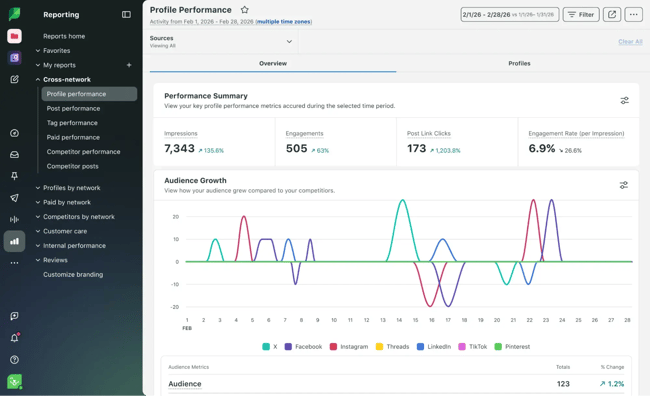
Sprout Social is well-suited for teams that need brand monitoring to be closely aligned with social media marketing execution. It combines publishing, scheduling, Smart Inbox, review management, keyword monitoring, reporting, and team workflows.
Key Features
- CSAT or NPS surveys on social platforms
- Keyword and location monitoring
- Publishing and scheduling
- Spike Alerts on the Advanced plan
- Review management
What I like: Sprout Social is good for social teams that need action and reporting in one place.
Pricing
- Standard: $199/seat/month
- Professional: $299/seat/month
- Advanced: $399/seat/month
- Enterprise: Custom
Best for: Mid-market social and brand teams that need publishing, monitoring, and executive reporting.
5. Latana
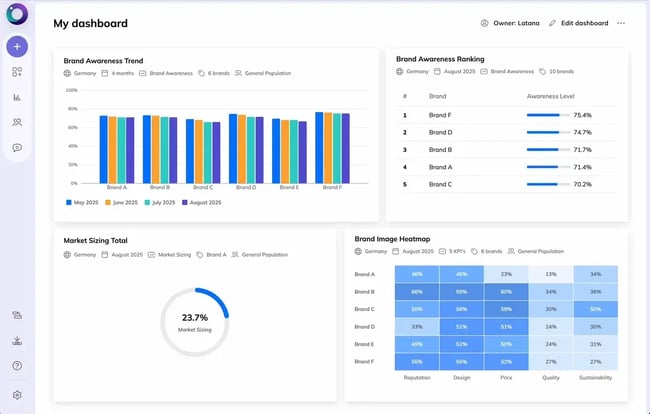
Latana is a dedicated brand tracking platform for teams that need structured survey-based measurement across awareness, consideration, perception, and audience segments. It makes sense when brand leaders need more than ad hoc surveys and want a repeatable view of how the brand performs across markets, competitor sets, and customer segments.
Key Features
- Awareness tracking
- Brand tracking across custom segments or audiences
- Monthly updates
- Segmentation with margin of error visibility
- Consideration and perception metrics
- Trend-line models and KPI predictions
What I like: Lantana offers statistically grounded tracking without having to build a research operation from scratch.
Pricing
- Essential: €7,900 per market/year
- Pro: €18,900 per market/year
- Custom: Quote-based
Best for: Scale-ups and mid-market brands that need awareness, consideration, perception, and preference tracking by market.
6. Brand24
Brand24 is a brand monitoring and social listening tool for teams that need to track mentions, reach, engagement, sentiment, sources, and influencers across online channels. It fits brands that need broader visibility into where people talk about them, especially across social platforms, news, blogs, Reddit, LinkedIn, Medium, Quora, and YouTube.
Key Features
- Mention volume tracking
- Engagement tracking
- Reach tracking
- Source analysis
- Influencer analysis
- AI sentiment analysis
- Trending hashtags and word cloud analysis
What I like: Brand24 has been recommended for a long time and still delivers high-quality social listening data.
Pricing
- Individual: $249/month
- Team: $349/month
- Pro: $499/month
- Business: $699/month
- Enterprise: from $1,499/month
Best for: Brand, PR, social, and agency teams that need to track mentions, sentiment, and sources across social and web conversations.
Enterprise Teams: Brand Tracking Tools Shortlist
Enterprise teams need stronger governance, broader market coverage, greater historical depth, and reporting that can withstand executive scrutiny. At this stage, brand tracking often informs market strategy, PR planning, category positioning, investor narratives, and budget allocation.
7. YouGov BrandIndex
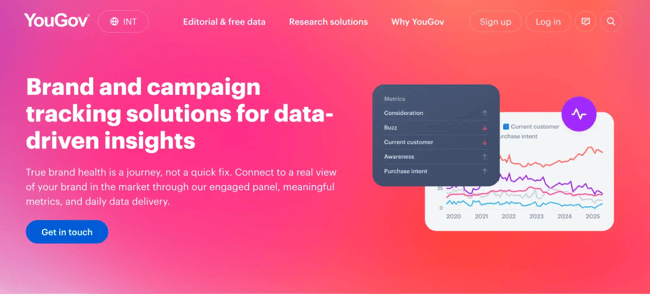
YouGov BrandIndex is an always-on brand tracker with daily tracking across 16 brand health metrics. It covers 56 markets, more than 30 million panel members, and more than 27,000 brands tracked daily. The product is useful when teams need to understand not only whether brand health moved, but also how news, campaigns, or competitor activity affected perception over time.
Key Features
- Daily brand performance tracking
- Competitor benchmarking
- 16 brand health metrics
- News impact analysis
- Over 18 years of historical data
- Sector-level insights
- API or platform-based data delivery
What I like: The tool is great for competitive benchmarking at scale. Daily tracking helps enterprise teams see whether news, campaigns, or competitor moves changed brand health.
Pricing: Custom
Best for: Enterprise brand monitoring, getting deep insights, and market research.
8. Talkwalker
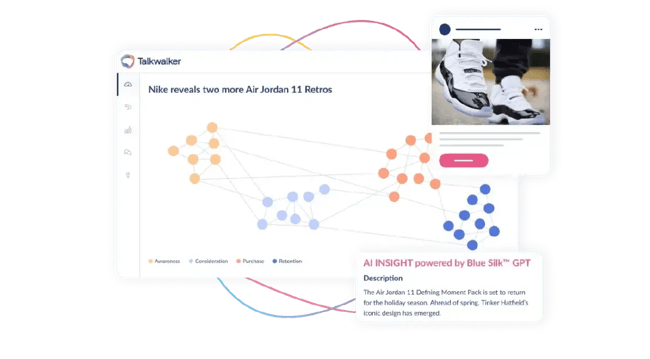
Talkwalker combines social listening, media monitoring, AI summaries, forecasting, peak detection, and LLM insights. Talkwalker is built for enterprise social listening, media monitoring, and consumer intelligence.
Key Features
- Social listening
- Media monitoring
- Topic and channel analytics
- Custom dashboards
- Peak detection
- Forecasting
- AI summaries
What I like: Talkwalker is good for global brand monitoring because LLM insights now sits beside social listening and media monitoring.
Pricing: Custom
Best for: Enterprise comms, PR, and consumer intelligence teams that need broad media and social coverage listening at scale.
9. Meltwater
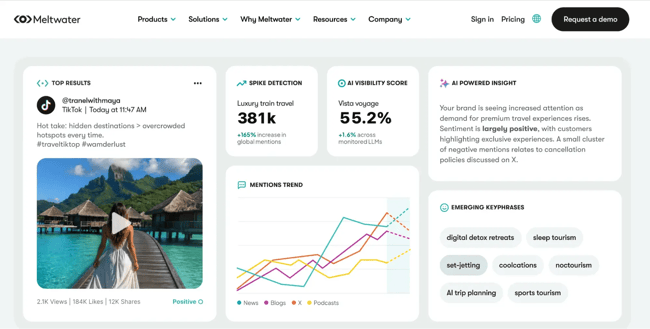
Meltwater offers media intelligence, social listening, consumer intelligence, influencer marketing, real-time alerting, reporting, and GenAI Lens LLM Tracking.
Key Features
- AI presence monitoring
- Competitor monitoring
- Source and citation analysis
- Sentiment trends
- Risk detection
- Media and social intelligence connections
What I like: I like Meltwater for PR heavy teams that need media coverage, social listening, and AI visibility in one vendor relationship. If LLMs rely on specific publishers, journalists, or third-party sources, the team can see where brand narrative work should happen.
Pricing: Custom
Best for: Enterprise PR, communications, reputation, and executive visibility teams that need to understand how media coverage influences AI answers.
10. Brandwatch
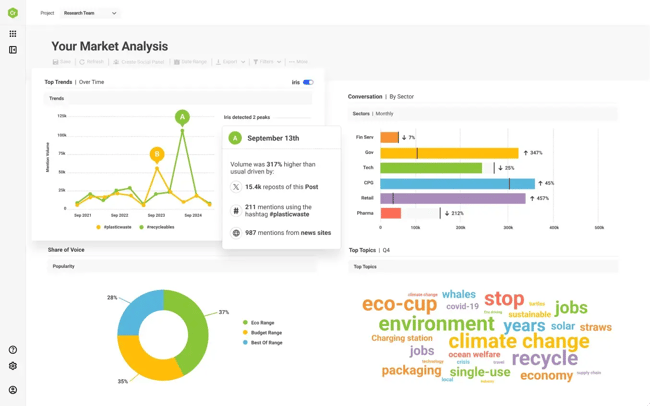
Brandwatch is a consumer intelligence and social listening platform for enterprise teams that need to analyze large volumes of online conversation. Its Consumer Intelligence product is built for researchers and analysts who need to search consumer opinion, segment audiences, build customizable dashboards, and analyze data with AI.
Key Features
- Consumer intelligence
- Social listening
- Audience and conversation segmentation
- Custom dashboards
- AI analysis
- Automated reporting
- Alerts
What I like: Brandwatch is a great tool for mature research teams needing depth in social data and audience segmentation.
Pricing: Custom
Best for: Enterprise research, insights, social intelligence, and brand teams with high conversation volume and complex reporting needs.
How to Run a Brand Tracking Survey
A brand tracking survey is a structured research survey that measures brand health over time. It adds structured feedback that brand monitoring tools cannot capture because most buyers don’t publicly post every opinion that shapes a shortlist.
A good brand tracking survey measures awareness, familiarity, consideration, preference, associations, purchase intent, and competitor comparisons. Here is a practical workflow for designing a brand tracking survey.
1. Start with the decision the survey needs to support.
Start with the business question. A launch survey might ask whether the campaign increased awareness. A repositioning survey might ask whether buyers now associate the brand with a new category. Every question should connect to a decision someone can act on.
“When you script the survey, give it to people to see and test it. It’s a really important point that cannot be overlooked. We did several iterations on our programming, and with each one, there was an improvement,” shares Daniel Koomson, Senior UX Researcher at News UK.
2. Choose the audience before writing questions.
Sampling should match the market the company wants to influence.
For B2B brand tracking, the sample should reflect the buying committee. That may include job title, seniority, department, company size, industry, geography, buying role, budget authority, and category involvement. For B2C, the sample may depend on age, region, income, category usage, purchase frequency, lifestyle, or brand familiarity.
If the budget is tight, prioritize the most important segment instead of spreading the sample too thin. A smaller but relevant sample beats a larger audience that cannot buy.
3. Keep the core questions stable.
A brand tracker needs stable questions across waves. If the team changes the questions every quarter, trend data becomes hard to trust. However, teams can add rotating questions for campaigns, messaging, product launches, new markets, or competitor moves, but keep the core intact.
4. Separate unaided and aided awareness.
Unaided questions ask respondents which brands come to mind in a category without showing a list. Aided questions ask whether they recognize specific brands from a list. Unaided awareness should come before aided awareness so that later answers aren’t influenced and inflate recall.
- Ask which brands come to mind first.
- Ask which brands respondents have heard of from a list.
- Ask which brands they know well enough to consider.
- Ask which brands they would choose and why.
This structure mirrors how buyers move from memory to recognition to evaluation. It also helps teams see where the brand breaks down.
5. Set the frequency.
Quarterly works for most scaling B2B companies. Monthly works when paid media, PR, or category competition moves quickly. Daily or weekly tracking usually belongs to enterprise programs with sufficient budgets and sample sizes.
6. Track competitors in the same survey.
Brand metrics need a competitive context. Awareness, preference, and sentiment mean more when compared against the brands buyers also evaluate.
The competitor list should include direct competitors, category leaders, and any substitute solutions that often appear in sales calls or customer research.
6. Reduce bias before the survey goes live.
Randomize answer order, avoid leading language, screen for category relevance, and keep competitor lists balanced. Bias often enters brand tracking through wording, order, sample quality, or timing — and it doesn’t always look obvious.
- A cleaner question asks: “Which of the following words do you associate with Brand X?”
- A biased question asks: “How innovative is Brand X?”
A quick bias check for marketers to run before launch:
- Keep wording neutral.
- Randomize answer options where possible.
- Rotate competitor order.
- Ask unaided questions before showing brand names.
- Avoid adjectives that flatter the brand.
- Separate customers from prospects.
- Avoid running the survey only after a major campaign unless that is the point.
- Remove speeders and low-quality responses.
- Keep the survey short enough to avoid fatigue.
- Use the same question wording across waves.
If the company just launched a major campaign, earned a viral mention, or dealt with a support issue, annotate the wave. That context helps explain movement later.
Koomson highlighted another major point that can derail your brand teaching survey — it’s captcha: “You want to captcha bots and unplug them to make sure only real new people are answering the survey.”
7. Connect survey data to business data.
Survey results should sit beside CRM, traffic, pipeline, campaign, and sales data. This turns brand health monitoring into revenue-linked decision-making. Save the list of signals to compare after each wave:
- Awareness and branded search volume.
- Consideration and demo requests.
- Preference and win rate.
- Trust and sales cycle length.
- Sentiment and customer feedback.
- NPS and retention.
- CSAT and support experience.
- AI share of voice and AI referral traffic.
- Share of voice and direct traffic.
- Brand associations and campaign message recall.
HubSpot allows growth teams to monitor customer feedback with Customer Feedback Software and AI visibility with HubSpot AEO, both connected to HubSpot’s Smart CRM, so insights sit alongside the customer and contact data that give them context.
Frequently Asked Questions About Brand Tracking Tools
How often should you run a brand tracking survey?
Scaling companies should run a brand tracking survey quarterly. Monthly tracking makes sense when the company spends heavily on paid media, enters a new market, changes positioning, or faces fast-moving competition.
HubSpot Customer Feedback Software can run CSAT, NPS, and CES surveys continuously, providing teams with a customer sentiment layer between formal brand-tracking waves.
What does brand tracking cost for scaling companies?
Costs range from low monthly survey tools to custom enterprise programs:
- Typeform starts at $29 per month.
- SurveyMonkey’s Standard Monthly plan is $99 per month.
- HubSpot AEO is $50 per month or accessible through Marketing Hub Professional and Enterprise editions.
Who should own brand tracking in the organization?
Brand tracking should usually sit with brand marketing or growth marketing. Revenue leaders, product marketing, customer success, and PR should feed into the dashboard because brand perception affects pipeline, retention, category position, and customer trust.
Do I need both brand monitoring and a brand tracker?
Yes, once the company has enough market activity to create public signals. Brand monitoring catches live brand mentions, sentiment spikes, and AI visibility changes. A brand tracker measures whether those signals shift awareness, consideration, preference, and brand loyalty.
How do I prove the ROI of brand tracking?
ROI comes from connecting brand movement to business outcomes. Track brand metrics beside campaign spend, branded search, direct traffic, conversion rate, pipeline, win rate, retention, and customer feedback.
HubSpot AEO helps connect the dots by showing where the brand appears in answer engines, which prompts cite competitors, and which recommendations can improve visibility. For teams on Marketing Hub Pro or Enterprise, HubSpot AEO also layers in CRM data, so teams can connect AI visibility to the campaigns and contacts driving pipeline.
Turn brand visibility into decisions leaders can act on.
Brand tracking in 2026 has moved beyond quarterly awareness charts. The strongest teams now combine structured surveys, brand monitoring, customer feedback, social listening, search demand, AI visibility, and CRM reporting. It’s likely teams will need a few tools from the list, at least for social listening and AI visibility.
HubSpot AEO is the most relevant addition to the brand monitoring stack for teams looking to understand how the brand appears in answer engines, which prompts create visibility gaps, and which sources influence the answers.
Pair it with HubSpot Customer Feedback Software and attribution reporting, and brand measurement becomes more useful to revenue teams because it connects market perception, customer sentiment, and campaign performance, so decision leaders can act on the data right away.
And for small teams sharpening their brand foundation, HubSpot’s Free Brand Building Guide is a practical place to start.