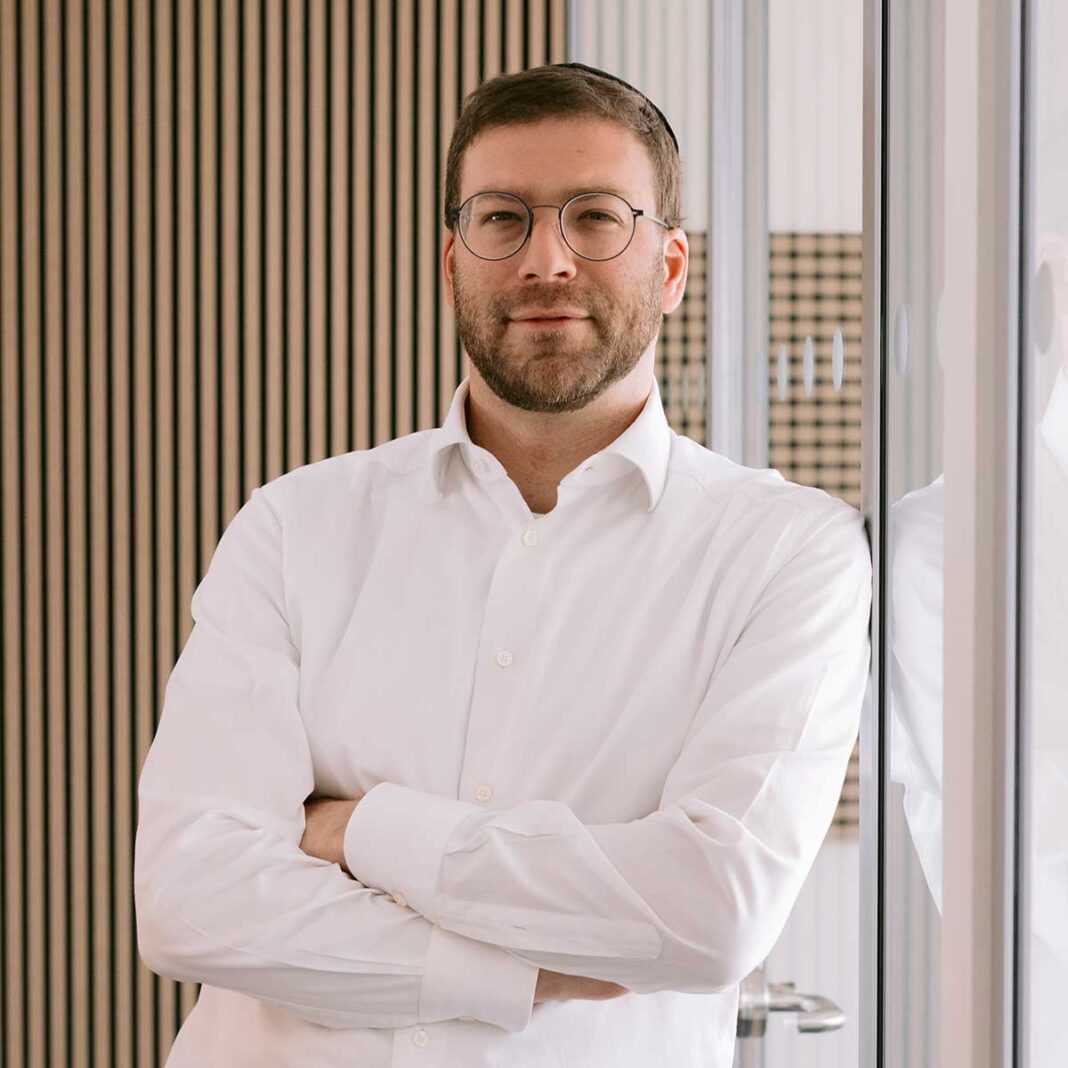

Chaim Grunfeld co-founded Prime Connect, a London telecoms company, with business partner Chaim Berkowicz in 2011, and has since built specialist services including SIMSINLIFTS for the lift industry and Landlord Connect for landlords and their tenants.
Prime Connect is a finalist in the Technology Entrepreneur of the Year category of the 2026 Great British Entrepreneur Awards, with winners announced at Grosvenor House in London on 16 November. He tells Business Matters why his best ideas start with something that annoys him, and why he wishes he had specialised sooner.
What do you currently do at Prime Connect?
I am the co-founder and Director of Prime Connect, a telecommunications company I started with my business partner, Chaim Berkowicz, in 2011.
My role has evolved considerably over the years. Today, my main focus is identifying and developing specialist vertical markets where we can solve a particular problem and build sustainable recurring revenue.
Examples include Landlord Connect, which provides managed broadband solutions for landlords and their tenants and which we launched to the wider market in March this year, and SIMSINLIFTS, our specialist managed connectivity service for the lift industry. We are also currently developing a WhatsApp Business communication platform to help companies manage customer conversations, broadcasts and automated processes more effectively. Prime Connect is now an approved Meta Technology Provider for the WhatsApp Business Platform.
I remain closely involved in the commercial direction of the company, particularly developing new ideas, understanding what customers need and turning those opportunities into scalable services.
What was the inspiration behind your business?
There was not really one grand inspiration behind Prime Connect. At the time, we were working in property, but it was not keeping us busy enough, and we came across an opportunity to enter the telecommunications market.
What attracted me was the recurring-revenue model. I liked the idea of a business where every new customer adds a relatively small amount at first, but over time those customers build into something substantial. Telecoms also had an enormous addressable market because virtually every business needs connectivity and communications.
We took the opportunity and learned as we went along. Over time, we became much more focused on developing specialist services for particular vertical markets, rather than trying to sell general telecoms products to everyone.
Most of our best ideas begin with something that has annoyed me: a landlord waiting weeks for broadband, a lift company struggling with the analogue-line switch-off or a customer needing three emails to achieve something that should take one click. I tend to question things that people have simply accepted as normal and ask: surely there is a better way of doing this?
Who do you admire?
I most admire my grandparents. They were Holocaust survivors who endured concentration camps, lost most of their families and emerged from the war with virtually nothing.
Despite everything they had experienced, they rebuilt their lives from the ground up. They created a family, earned a living and built something meaningful while remaining committed to their values and faith.
Their story gives me perspective. Business setbacks can feel extremely serious when you are in the middle of them, but they are nothing compared with having to begin again after losing your family, security and everything you owned.
Their resilience taught me that difficult circumstances do not have to define your future. What matters is having the determination to move forward, rebuild and create something for the next generation. Their strength and ability to start again with nothing are qualities I deeply admire and try to carry into my own life.
Looking back, is there anything you would have done differently?
I would have moved into niche markets much sooner.
For many years, we operated as a more general telecommunications provider and accepted almost every opportunity that came our way, including residential customers. Looking back, our greatest successes came when we focused on a particular industry, understood its problems properly and created a specialist solution that generated recurring business.
SIMSINLIFTS is a strong example. We identified a specific need within the lift industry and built a service around it. Its multi-network SIMs connect a lift’s emergency phone to the strongest available network. We are now following a similar model with Landlord Connect.
I have also learned the importance of saying no. Every no is a yes to something else, and every yes is a no to something else. Taking on the wrong customer or opportunity can consume the time and resources that should have been devoted to the right one.
If I were starting again, I would focus much earlier on clearly defined B2B markets where we could become genuine specialists, solve a repeatable problem and build long-term recurring revenue.
What defines your way of doing business?
Honesty, paying our bills on time and treating everyone with respect.
I believe your reputation is one of the most valuable assets you have in business. Customers, suppliers and employees should know that you will be straightforward with them and honour your commitments.
I am direct and do not like smoke and mirrors. If something has gone wrong, I would rather acknowledge it and work towards a solution than hide behind technical language or blame somebody further down the supply chain.
We also try to be practical. We have what we call a “happy customer pot”, which allows us to resolve smaller customer issues without wasting hours arguing over who was technically responsible. Sometimes it is better to absorb a relatively small cost, keep the customer happy and protect the long-term relationship.
Clear boundaries are also important. My business partner and I have a rule that there should never be two people sitting on the same seat. Our responsibilities are clearly defined, which allows each of us to operate confidently within our own area. That clarity has been an important part of maintaining a successful partnership for 15 years.
What advice would you give to someone starting out?
Just get started.
Many people spend too long preparing to launch. They think they need the perfect office, website, logo, branding and business cards before they can begin. You need something presentable, but none of those things replaces speaking to customers and making sales.
I call it ABS: Anything But Sales. People will do almost anything to avoid picking up the phone and contacting a potential customer. My alternative is ABC: Always Be Calling.
When I returned to London in 2010, we bought our first property at auction just 31 days later. I had no experience of buying at auction, so I researched how the process worked, went into the room and bought the property with one bid. We did not even have the company or banking structure fully established at that point, but we worked it out and completed the purchase on time.
That experience reflects my general approach: research properly, make a decision and move. You will never have every answer before you begin.
Start with what you have, find out whether customers genuinely want what you are offering, listen to their feedback and improve as you go. You will learn far more from your first 10 customers than you will from months spent planning behind a desk.
I once asked a mentor whether I should find a job or work for myself. His advice was to work for myself, which I took literally. Looking back, I think the deeper message was to be yourself, stay in your own lane and not become distracted by what everyone else is doing.