
Measuring success is a leading challenge for answer engine optimization (AEO) that marketers report today. In HubSpot’s State of AEO 2026 report, it was the top challenge among B2B marketers at 23%; among B2C marketers, 26% cited it, behind only understanding how AEO works at 29%.

Traditional search metrics still matter, but they answer different questions. Clicks and impressions in Google Search Console, and even website visits, don’t show whether answer engines mention or cite a brand, or how often that happens compared with competitors.
This guide lays out a repeatable process for benchmarking AEO using citation rate, share of voice, platform-level normalization, and executive-ready reporting. Together, those measures turn one-off prompt checks into a benchmark marketing teams can track and explain to leadership.
Table of Contents
Why SEO Rankings Alone Do Not Benchmark AI Search Performance
Ranking well in traditional search means a page appears on a search engine results page (SERP). A user can then click a result to visit the source.
HubSpot distinguishes AEO mentions from citations this way: A mention names a brand in an AI-generated answer without a linked source, while a citation is an attributed source reference or linked URL. For this guide, a brand-level citation means an attributed source or linked URL from the brand’s domain.
Answer engine optimization measures a different layer of search visibility: whether and how a brand or its content appears inside synthesized answers. AI-generated search features can also change click behavior. Ahrefs found that the presence of a Google AI Overview correlated with a 58% lower average click-through rate for the top-ranking page in its December 2025 data.
Traditional SEO metrics measure how pages perform in search results. AEO metrics measure whether brands and sources appear inside AI-generated answers.
Featured resource: AI and SEO: What AI means for the future of SEO [Expert Tips & Interview].
The following table shows common SEO metrics alongside AEO benchmarks. I cover the AEO benchmarks in more detail in the next section.
AEO benchmarking measures how often a brand appears or is cited across answer engines relative to a defined competitor set. Because generated answers can vary from run to run, these measures are estimates based on a defined set of prompts, platform, and collection window, not fixed rankings.
For Google AI Overviews specifically, BrightEdge’s analysis found that about 17% of cited sources also ranked in the organic top 10, meaning roughly five out of six citations came from outside page 1. BrightEdge reported 24% top-10 overlap in healthcare and 11% in finance. That does not make organic rankings irrelevant; it shows that organic ranking and AI Overview citation overlap can differ substantially by industry, so teams should measure both.
Which Benchmarks Matter for AEO and How to Calculate Them
The four benchmarks below help measure and organize visibility in answer engines. They do not measure website or revenue impact on their own, so use them alongside traffic, conversion, and pipeline measures rather than treating them as replacements.
In an experiment involving more than 500 queries across 20 platforms, Robert Carnes found that AI chatbots performed better on some direct-action prompts and could build arguments for opinion-based queries. At the same time, traditional search remained useful for specific and local information. The mixed result matters for benchmarking: Some AI interactions can satisfy a query without a click, but traditional search still plays an important role.
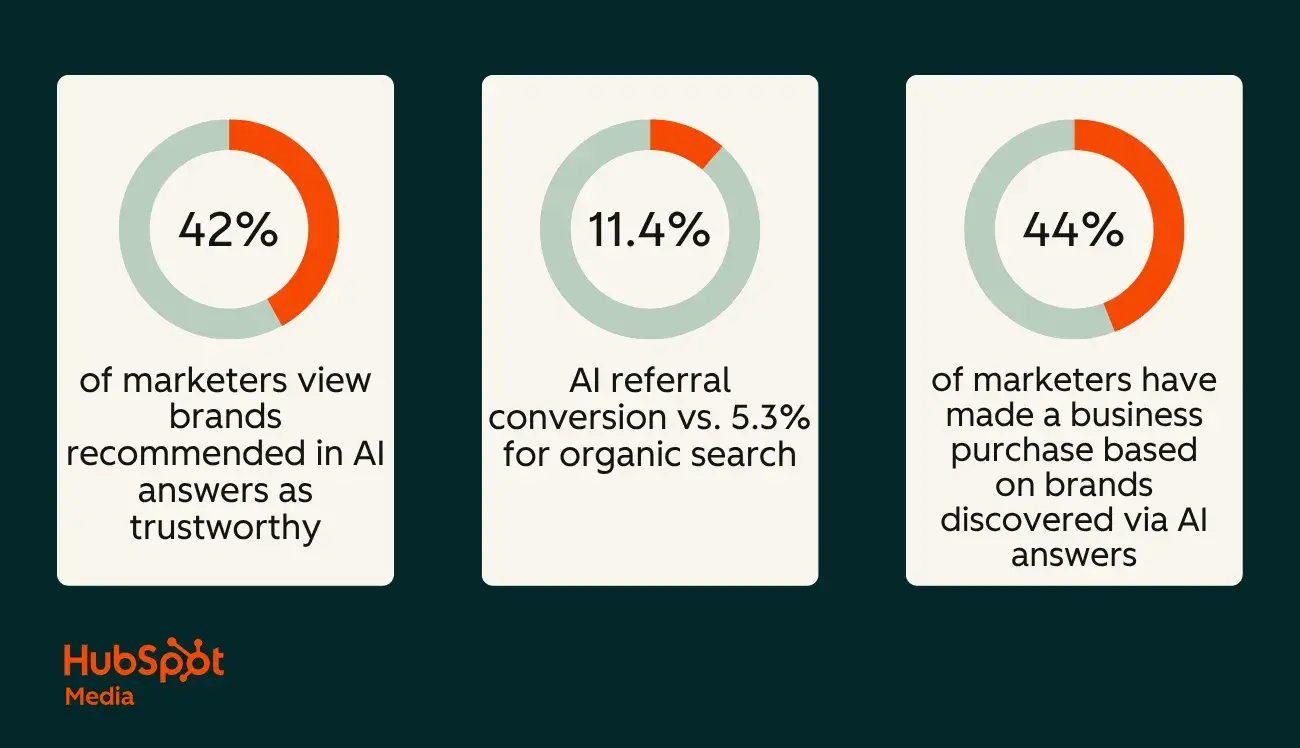
Separately, HubSpot’s State of AEO 2026 report says 44% of surveyed marketers have made a business purchase based on brands they discovered through answer engines.
In a separate survey of more than 200 B2B decision-makers, 42% said an AI recommendation made a brand seem “more trustworthy — if AI recommends it, it’s probably vetted.” The research on B2B decision-makers and AI search found only 11% said an AI recommendation made a brand seem less trustworthy.
As Amanda Sellers, a former SEO and AEO strategist at HubSpot, puts it in the State of AEO report, “Answer engines can achieve a level of personalization not possible with traditional search, which aids in the consideration process along a path to purchase. By the time these buyers land on a web page, they are much more qualified.”
The takeaway is not that AEO replaces SEO. It is that brand discovery and evaluation can happen before a website click, so marketers need visibility measures for answer engines alongside traditional SEO metrics.
Citation Rate
Citation rate indicates how often a brand or domain is explicitly cited in answer-engine responses within a defined set of prompts.
Citation rate = (Number of prompts where the brand or domain is cited ÷ Total number of prompts) × 100
Use the citation rate as a baseline to determine whether attributable visibility is increasing or decreasing. Read it alongside share of voice, so you don’t interpret a percentage without competitive context.
Share of Voice
Share of voice compares a brand’s mentions with named competitors across the same prompt set.
Share of voice = (Brand mentions ÷ Total mentions for the brand and tracked competitors) × 100
A 20% share of voice, compared with 8% for the next tracked competitor, indicates stronger relative visibility within the defined competitor set. It does not establish category leadership beyond the brands and prompts included in the benchmark.
Platform-Level Visibility
For this benchmark, platform-level visibility means calculating citation rate and share of voice separately for each answer engine, such as ChatGPT, Gemini, and Perplexity.
Platform-level visibility = Citation rate or share of voice calculated for one answer engine at a time
This prevents a blended average from hiding meaningful differences between platforms. A brand could have strong visibility in Perplexity and weak visibility in ChatGPT even when the overall average looks stable.
Query-Set Segmentation
For this benchmark, query-set segmentation means grouping tracked prompts into useful categories, such as topic, buyer stage, use case, or product line, and calculating the citation rate or share of voice within each group.
Segment-level visibility = Citation rate or share of voice calculated for one defined prompt segment
Segmentation helps expose gaps that an aggregate rate can hide. A brand might have healthy overall visibility while rarely appearing in high-intent comparison prompts.
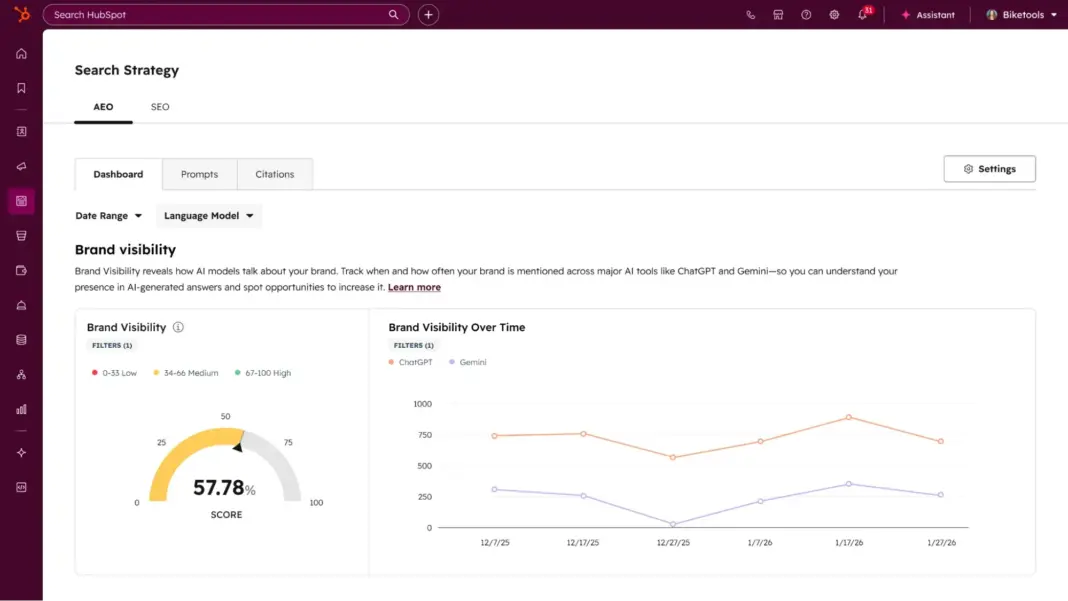
HubSpot AEO can automate prompt tracking, brand visibility, competitor share of voice, citation analysis, sentiment, and prioritized recommendations across ChatGPT, Gemini, and Perplexity. In Marketing Hub Pro and Enterprise, CRM data powers more specific recommendations. Standalone HubSpot AEO starts at $50 per month, or $45 per month when billed annually. It is also included with Marketing Hub Pro and Enterprise.
Featured Resource: AI SEO: How to use AI to improve your SEO workflow
How Do I Benchmark My AI Search Performance Against My Industry
Industry benchmarks are useful only when you compare like with like. Compare a brand’s citation rate using the same metric across a consistent prompt set, competitor set, answer engine, and collection window.
AI Search Sensor provides industry-level context for answer-engine visibility trends. The free public dashboard tracks estimated visibility, citation share, AI-referred traffic, citation patterns, and answer-engine volatility across ChatGPT, Gemini, and Perplexity.
Do not compare a brand’s citation rate directly with AI Search Sensor’s visibility score or citation share as though those metrics were interchangeable. Use the industry data as category context, then evaluate the brand with consistent brand-level metrics.
Here’s a look at visibility scores across the marketing industry:
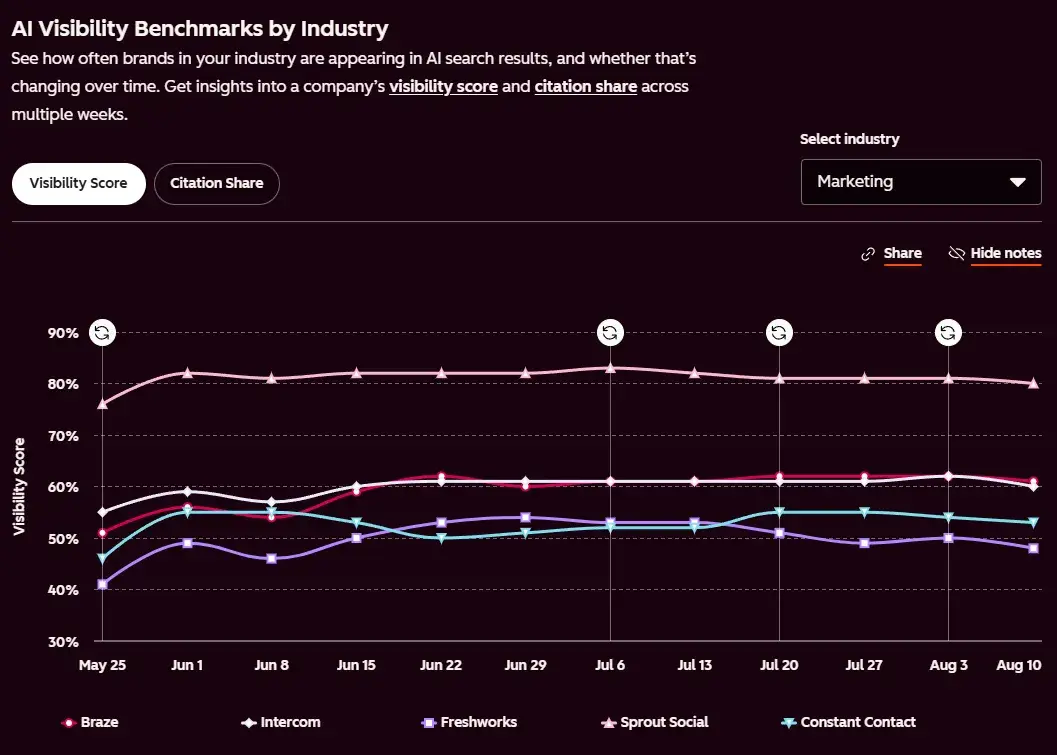
AI Search Sensor is a free public dashboard currently in beta. It tracks industry-level and market-wide patterns across ChatGPT, Gemini, and Perplexity rather than reporting a specific brand’s own performance. Marketers can use it in four ways.
- Check AI-referred traffic trends: Review directional weekly estimates of traffic that ChatGPT, Gemini, and Perplexity send to websites. The figures are based on anonymized HubSpot customer data and represent directional trends, not exact traffic counts.
- Review AI visibility benchmarks by industry: Compare estimated visibility scores and citation share for representative companies across 10 industries. These benchmarks provide category context rather than a direct measurement of the reader’s brand.
- Track citation-share trends by content type and channel: See which content formats and source channels are appearing most often in AI-generated answers each week.
- Monitor the Answer Engine Volatility Tracker: Use the daily 0–100 score and its Calm, Moderate, Elevated, and Extreme ranges to see whether citation, mention, and AI-referred behavior are shifting broadly across answer engines.
Tip: AI Search Sensor does not report a brand’s own visibility or citation share. For brand-specific prompt tracking and competitor comparison, HubSpot AEO adds that layer.
For brand-specific benchmarking, HubSpot AEO includes:
- Brand Visibility Score: The percentage of tracked prompts in which the brand appears.
- Share of Voice: How often the brand is mentioned compared with tracked competitors across the same prompts.
- Competitor & Citation Analysis: Competitor visibility plus the domains, pages, and content types appearing in citations.
- Sentiment Analysis: Whether AI describes the brand positively, negatively, or neutrally, measured on a scale from -100 to +100.
Industry data provides context; brand-specific data shows what is happening to the individual brand. HubSpot’s AI Search Grader is a free, one-time check that provides a snapshot across ChatGPT, Perplexity, and Gemini, including visibility, sentiment, and competitive positioning. Here’s how AI Search Grader looks:
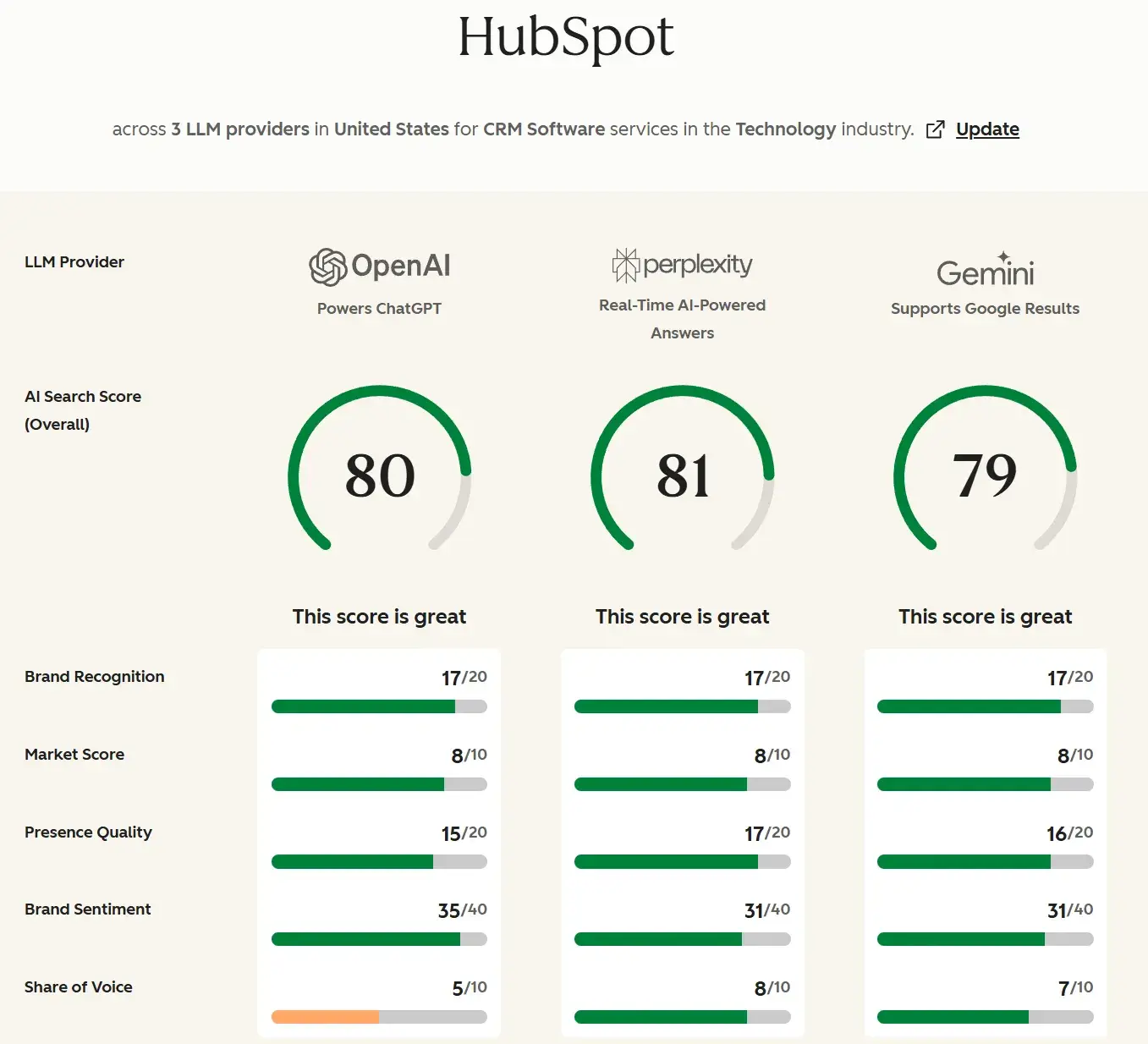
AI Search Grader is useful as a one-time baseline, but an ongoing benchmark needs a defined query set, competitor set, and rerun cadence.
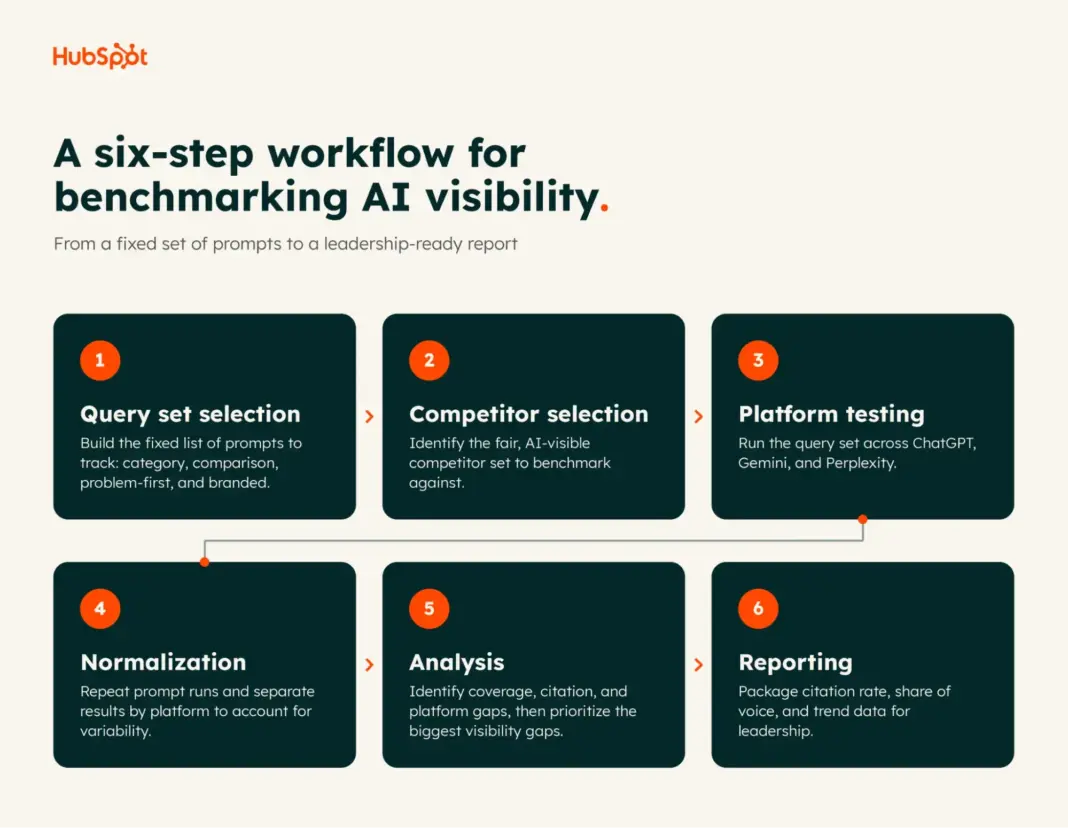
A query set is the list of prompts used to calculate citation rate, share of voice, and related benchmarks. It should reflect questions buyers actually ask in the category, not just the brand’s preferred keywords. A useful starting set should cover several types of prompts:
If you are testing manually, start with a set small enough to rerun consistently and treat the result as directional. For a more comprehensive audit, Discovered Labs’ AEO benchmarking guide recommends mapping 50–200 high-intent questions and notes that statistical confidence can require hundreds of query variations across multiple platforms and repeated tests.
Next, build a fixed competitor set. Run the query set first and record the brands that recur in mentions and citations. Then choose a named group that includes direct competitors and other AI-visible peers that buyers are genuinely likely to compare.
Keep the query and competitor sets stable within a reporting cycle. When a material product, market, or competitor change requires an update, version the benchmark and record what changed so earlier results remain interpretable. Label Studio’s guide to evolving AI benchmarks explains that standardized task sets make results comparable across runs and that benchmark strategies should evolve as systems mature.
Track the benchmark weekly to notice trends. Review the query and competitor lists quarterly, or sooner after a material category, product, or competitive change, rather than rewriting them between every benchmark run.
Pro tip: Manual tracking can work for an initial benchmark. As the number of prompts, platforms, and repeated runs grows, automation reduces the burden of collection and logging. HubSpot AEO is one option for ongoing prompt, competitor, visibility, and citation tracking.
How do I normalize results across answer engines and prompts?
Raw citation counts from ChatGPT, Gemini, and Perplexity are not directly comparable on their own. Normalize the testing process first, then report each platform separately. Account for two kinds of variation.
- Within-engine variability: The same prompt can produce different answers or sources across repeated runs. Do not treat a single response as a stable probability estimate.
- Between-engine variability: Different answer engines can return different source mixes, mention patterns, and citation frequencies for the same prompt.
Do not solve that variation by combining all platforms into a single blended number. Calculate citation rate and share of voice separately for each engine. For example, a 30% citation rate on Perplexity and an 8% citation rate on ChatGPT are two platform-level results, not inputs to be averaged.
To compare large language models (LLMs) fairly for AEO benchmarking, use the same fixed prompt list, the same market or location settings where possible, a consistent collection window, and repeated runs when resources allow. Discovered Labs’ AEO benchmarking guidance notes that one-off manual checks are vulnerable to answer variability and personalization. A stable testing set and a documented benchmark version make changes over time easier to interpret.
How do I turn benchmarks into an improvement plan?
A benchmark becomes useful when it changes what the team does next. Once you’ve established citation rate, share of voice, platform-level visibility, and query-set segmentation, move from measurement to prioritization.
Start with the prompt segments where the brand is weakest. For each missed prompt, inspect the URLs, domains, source channels, and content types the answer engine actually cites. Use those observed patterns rather than assuming that a particular prompt type will always favor a particular format. Classify each priority gap.
- Coverage gap: The brand lacks a page that directly answers the important question or use case.
- Citation gap: Relevant brand content exists, but other sources are receiving the citations. Review which pages, domains, content formats, and third-party sources are appearing instead.
- Platform gap: Visibility is materially weaker on one answer engine than on the others for the same prompt segment.
Prioritize gaps based on business relevance and repeatability, rather than trying to fix every missed prompt at once.
For more guidance on creating source-worthy content, see How to Write Content that Generative AI Search Engines Will Cite, According to Experts. For additional ideas on adapting content strategy as search changes, see 6 Steps Bloggers are Taking to Prepare for AI in Search [New Data].
HubSpot AEO supports this ongoing stage by tracking brand visibility, competitors, citations, and prompts over time and turning those patterns into prioritized recommendations.
How do I report industry benchmarks to leadership?
An executive-ready benchmark report should summarize the decisions the data supports, not reproduce every prompt and platform result. Include:
- The brand’s current citation rate and share of voice against the named competitor set.
- A trend showing whether those metrics are rising, falling, or holding steady over the reporting period.
- The largest visibility gaps by platform or prompt segment and the actions underway to address them.
- Relevant industry context when the benchmark uses the same or clearly comparable metric.
- Downstream measures such as AI-referred traffic, conversions, or pipeline where those data are available.
Leadership usually does not need the full prompt log. Keep that working-level detail with the marketing, SEO, or AEO team.
Marketing and SEO should own the query set, competitor set, citation analysis, and content response. Bring revenue operations (RevOps) into the reporting process as the team begins connecting AI-referred traffic and other marketing activity to CRM definitions, pipeline, and revenue reporting.
HubSpot AEO tracks prompts, brand visibility, competitors, citations, and recommendations. When AEO is used inside Marketing Hub Professional or Enterprise, CRM data also powers more specific recommendations. Marketing analytics and dashboards can report on website, campaign, CRM, and revenue outcomes, and teams can pair those results with AEO visibility metrics, using the AEO dashboard or HubSpot’s beta AEO API, so leadership sees business results next to visibility.
For a team without a brand-specific benchmark, AI Search Sensor offers a free starting point for industry context. It tracks broad AI visibility, citation, traffic, and volatility trends across ChatGPT, Gemini, and Perplexity. It does not show the individual brand’s own visibility or pipeline impact, so treat it as category context rather than a substitute for brand-level measurement.
Frequently Asked Questions About AI Search Benchmarking
How often should we update our query set and competitor list?
For an active benchmarking program, rerun the benchmark weekly to notice trends. Review the query set and competitor list quarterly, or sooner after a material product, category, or competitive change. When the set changes, document the new version so you don’t treat pre- and post-change results as perfectly comparable.
What team should own AI search benchmarking and why?
Marketing and SEO should usually own the day-to-day benchmark because they define the prompts, track visibility and citations, and turn gaps into content or distribution work. A dedicated AEO team can own the process where one exists. Bring revenue operations into the reporting layer when AI-referred traffic, CRM data, pipeline, or revenue become part of the benchmark story.
How do I validate the accuracy of AI citations detected by tools?
Spot-check a sample of detected citations by running the same prompts manually and confirming that the reported brand mention or linked source appears. Match the answer engine, prompt, and testing conditions as closely as possible. Because generated answers can vary between runs, an occasional difference between a tool’s recorded result and a later manual check does not automatically mean the tool was wrong.
When should we invest in automation versus stay manual?
A small, infrequent benchmark can stay manual as long as the team can rerun it consistently and keep a clean record of the results. Automation becomes more useful when repeated runs across multiple engines, larger prompt sets, competitor tracking, and result logging start consuming enough time that the team cannot maintain a consistent benchmark manually.
Turning AI Search Benchmarks Into a Program, Not a One-Time Project
A useful AI search benchmark turns “we seem to show up sometimes” into a repeatable measurement program. Keep the query and competitor sets consistent, separate results by answer engine, track citation rate and share of voice over time, use industry data as context, and report visibility alongside traffic and pipeline outcomes.
AEO does not replace traditional SEO measurement. The two answer different questions, and teams need both to understand how brands are discovered across search results and AI-generated answers.
For teams ready to automate ongoing brand-level measurement, HubSpot AEO tracks visibility, prompts, competitors, citations, and prioritized recommendations across ChatGPT, Gemini, and Perplexity.