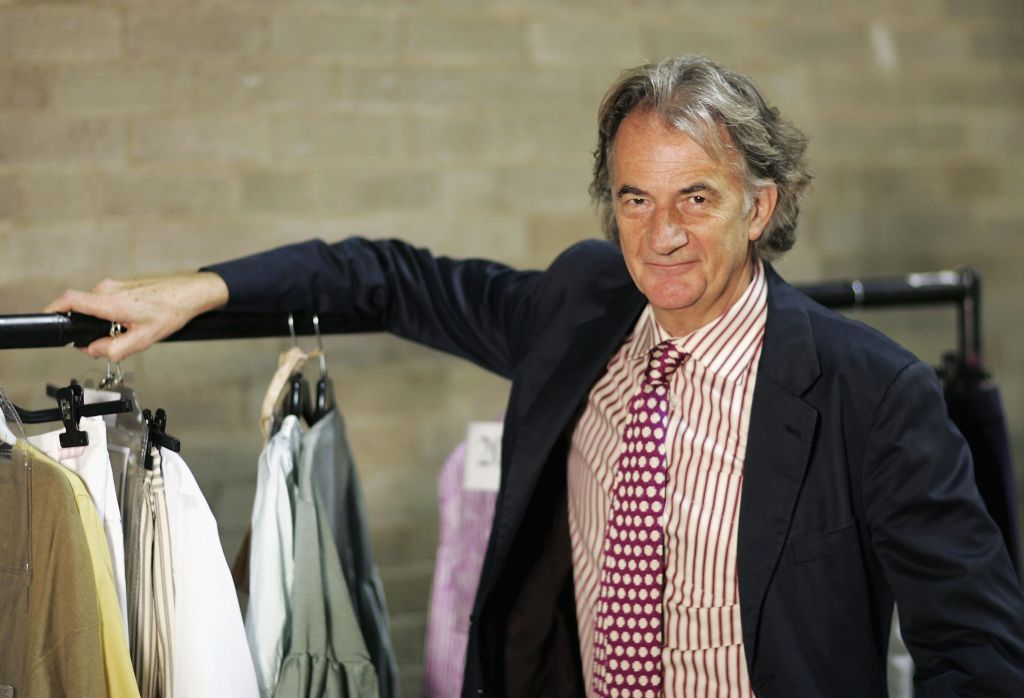

In Paul Smith’s new memoir, Threads, My Life in Style, he recalls how he went to his deserted offices during the Covid lockdown dressed in a suit in an effort “to make life seem more normal”. There he found 18 containers of milk burst on the floor and spent three hours mopping it up. He found himself thinking: “I wonder if my friend Giorgio Armani is doing something like this now? Or Tom Ford?” When he recounted this to his colleagues, “they all said the same thing: ‘Oh no! Only Paul Smith…’”. He took it as a compliment.
Smith’s “can-do” attitude and infectious “joie de vivre” have always been a feature of his work, says the Financial Times. He’s “the perfect ambassador for the soft power of tailoring – both in person and as founder and designer of his namesake business”. The atmosphere around him is one of such “merry eclecticism and creativity” that it’s hard to believe he turned 80 in July.
Paul Smith on opening his first ‘boutique’ in 1970
Smith – who opened his first shop in Nottingham in 1970 – declares he doesn’t think of the birthday as a milestone because “if you put too much importance on it, it becomes a burden. Like: ‘Oh, I’m old now.’” Smith remains in charge of his destiny. The business, which now has about 120 shops around the world, remains independent and he is the majority shareholder with a 69.5% stake. Tailoring remains Paul Smith’s “north star” and the label has recently been emphasising the “practical” qualities of the suit – dubbing its latest men’s collection, shown in Milan in June, “Suits in Unsuitable Situations”. Fashions change and cycles come and go – recent years have been as punishing for Paul Smith as any other luxury brand. But the bread-and-butter business is still socks: “the brand sells 700,000 pairs a year”.
Sign up to Money Morning
Don’t miss the latest investment and personal finances news, market analysis, plus money-saving tips with our free twice-daily newsletter
Don’t miss the latest investment and personal finances news, market analysis, plus money-saving tips with our free twice-daily newsletter
“I always joke that I used to think VAT was vodka and tonic,” Smith says of his own business acumen as a young entrepreneur. It’s one reason why he set up the Paul Smith Foundation to offer practical advice to people in the creative industries. But in fact, clothes were in his blood. His father, Harold, sold clothes and linens door to door on credit. Born in 1946 in Nottingham, Paul Smith left school at 15 with no qualifications and began working in a clothing warehouse as an errand boy, says Vogue. At 17, a serious accident put an end to his cycle-racing ambitions, but the upside of a six-month stint in hospital was that he made friends with the local art-school crowd, who introduced him to the world of art and fashion. After taking courses in tailoring, encouraged by his artist wife Pauline, Smith opened his first “boutique” in 1970 in a tiny back room in the city centre, says The Guardian.
The secret to Paul Smith’s success
The 1970s were an exciting time to be building a fashion brand. Having made his name in London, Smith opened a shop in New York and was soon hanging out with the Studio 54 crowd – selling suits to Jack Nicholson and David Bowie. A big fan of the work of Yves Saint Laurent, a seminal moment for him was the launch of “Le Smoking”, the first woman’s tuxedo from a major couture house. His own moment came when “suits got a boost thanks to the Big Bang in the 1986”, says the FT. Young urban professionals would head to Smith’s shop in Covent Garden and find “Prince of Wales checks made with innovative colours and unexpected jacket linings”. They might also pick up a Filofax – one of the first of the many design objects that Smith has sourced or collaborated on over the years.
In the 1990s, the brand peaked, says The Guardian. “We’re definitely not as relevant as we used to be,” says Smith of the brand’s recent struggles, but “my company motto is ‘never assume’ and that’s helped me enormously over the years”. Longevity, he concludes, is about hard work, reassessing and never thinking you’ve “made it”. “Nobody cares how good you used to be.”
This article was first published in MoneyWeek’s magazine. Enjoy exclusive early access to news, opinion and analysis from our team of financial experts with a MoneyWeek subscription.