
The dyed palm in my hands is not quite doing what I want it to. Two fronds, one blue and one red (my selection), are in knots. At our folding table in a big yellow room, my fellow cruisers are engaged in what I can only describe as dexterous braiding, but they’re also commiserating with me: Their work is as bad as mine; none of us has the hang of it. Our instructor, Jair Palma, a gentle woman in a long skirt, comes around correcting mistakes and then curlicuing the result into a spiraling ring she then slides onto a finger of its maker, as if she were an officiant at some woven wedding. When she reaches my seat, she inspects my work for a moment before pocketing it and presenting me with its flawless equal, now coiled into a ring that she slips upon my finger. A merciful act.
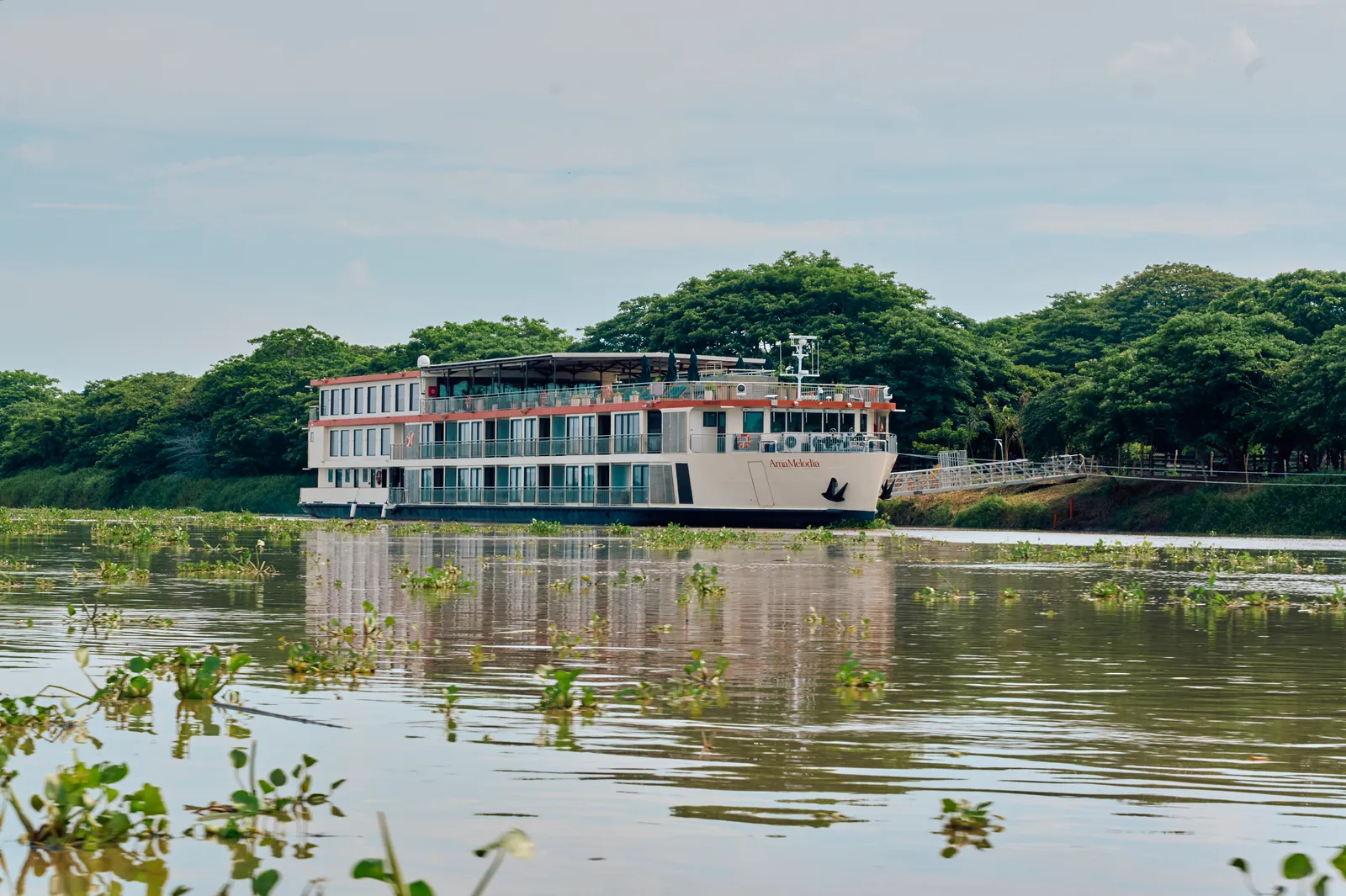
It’s the penultimate day of my cruise on AmaMelodia between Cartagena and Barranquilla along Colombia’s Magdalena River, a new itinerary from AmaWaterways that’s as novel as it is special. Passenger boats have not passed through these parts since the days of the steamship petered all the way out some 60 years ago. Gabriel García Márquez’s novel Love in the Time of Cholera, namely the final chapter (set in the 1930s), depicts not just the sad decline of romantic river travel as Florentino Ariza and Fermina Daza take their long-awaited honeymoon but also the communities of Colombians its end left behind. Our low, bargelike vessel drifts serenely, unhurriedly along the brown river. Unlike the traffic you might encounter on a cruise along, say, Europe’s Danube or Rhine, here the only other passenger ship we pass is our vessel’s sister ship, AmaMagdalena.
This is an optional excursion to Usiacurí, a town about an hour outside Barranquilla, where skilled weavers of iraca palm work with or without the lucrative presence of international tourists to create handsome objects like bags, baskets, and fans, as well as earrings, necklaces, and more. Tours are led by river guides—on our ship there’s Eric, Camila, and Mateo, all from Colombia—who liaise and often translate for locals on the ground in the places we’re stopping in, including Palenque and Calamar. Ama’s managing director for Colombia, Beno Atan, who spent the past five years scoping out towns along the river for this itinerary, recalls his first scout as such: “I rented a boat from a local…and I had an ice chest with beer and sandwiches and fruit, and I just went out and started talking to people.”