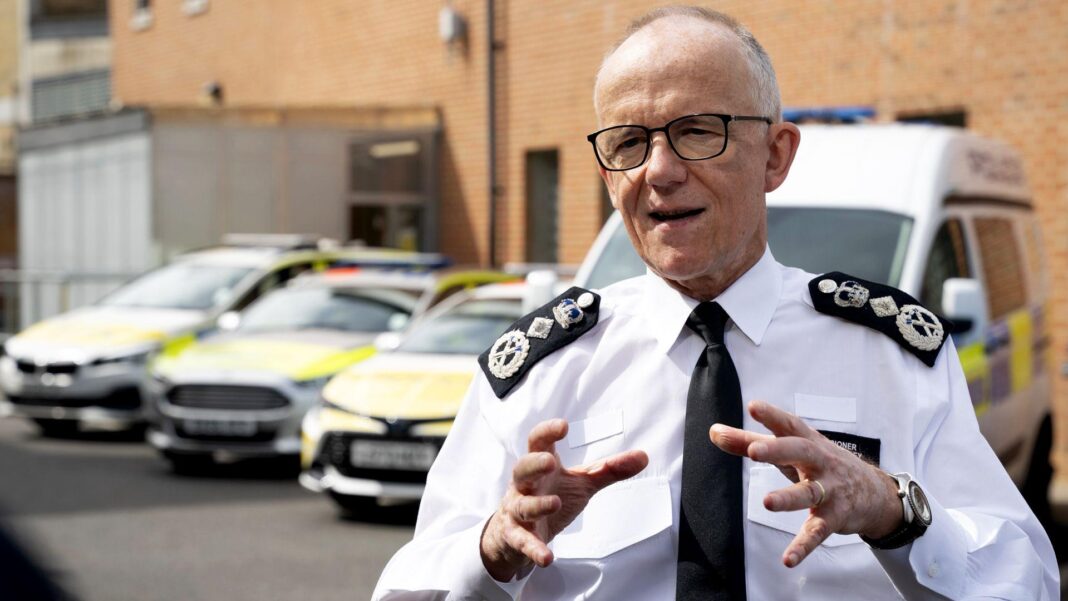

Policing needs reform to cope with modern criminals, Met Police chief warns
-
Published
The police system in England and Wales cannot cope against sophisticated modern criminals without urgent reform, the head of the Metropolitan Police has said.
In a speech on Friday, Sir Mark Rowley argued the system was “heading for failure” without change.
He is proposing eight to 10 regional police forces, supported by hundreds of local policing commands and a new national force, in what would be the biggest overhaul of policing since the 1960s.
The changes would replace the 43-force structure with three tiers: local teams dealing with neighbourhood issues, regional forces sharing specialist resources and a National Police Service tackling the most serious crimes.
In January it seemed that the many senior police officers were in favour of creating a National Police Service, and that organising into much larger regional forces had won the argument.
Home Secretary Shabana Mahmood produced a white paper that aligned with their ideas and asked the former Metropolitan Police Commissioner Lord Hogan-Howe to look at what the force boundaries might be.
But everything changed in July when Andy Burnham became prime minister. So far, Burnham has not spoken publicly about the plans, and the police chiefs are nervous that they may not have his backing. That may be why they have come out so strongly today, warning of the potentially apocalyptic effect of doing nothing.
As well as pushing hard for large regional forces, they are also making an argument about money which is familiar from the defence funding argument.
Sir Mark also pointed out that police funding in England and Wales has fallen from 0.9% of GDP to 0.7%. Implicit in that is that while the slice of the cake being allocated to defending the country is growing, the slice being allocated to defending people’s communities and their homes is getting smaller.
-
Labour wants to shake up the police – but will that solve ‘everyday crime epidemic’?
-
Published24 January
-
-
Number of police forces to be cut in major shake-up
-
Published22 January
-
-
Court system under massive strain, warns Met chief
-
Published12 October
-
In his speech, Sir Mark said organised crime groups, fraud networks, cyber-criminals and those involved in online child abuse increasingly operate across regional and international borders, while police forces remain organised around local areas.
“The victim remains local but increasingly the threat does not,” he said citing the example of children who are “groomed by predators on another continent”.
He argued that the current system is struggling to keep pace with these threats, saying: “We have 43 overstretched forces trying to do too much, with too little.”
Merging forces would reduce duplication and could free up thousands of roles to be redirected towards front line policing, he believes.
Speaking on BBC Breakfast prior to his speech, Sir Mark said crime had changed a lot over the years but the police was largely organised how it was 60 years ago.
“Obviously the world’s moved on a long way in that time.”
His proposals follow a consultation launched by Home Secretary Shabana Mahmood in January. This included plans for a National Police Service to tackle the most complex crimes and a possible merger of the 43 forces into fewer, larger forces.
However some rural police and crime commissioners have described the plans as “political manoeuvring” by larger forces to “load the dice in their favour”.
Dorset Police and Crime Commissioner David Sidwick reiterated his strong opposition to proposals to merge the forces.
“My concern is simple. If funding is diverted away from frontline services in Dorset to establish new national structures, local communities could end up receiving less rather than more.”
In addition, Kent’s Conservative police and crime commissioner Matthew Scott said: “[Sir Mark believes] policing should suffer a decade of disruption, that local policing services should be cut back and made more remote, and that this can all be done without ever asking the public what they want from their local police force.”
The Association of Police and Crime Commissioners (APCC) has also questioned whether merging forces is the best way to improve policing.
It said: “The case for modernisation and a National Police Service is clear. The case for reducing 43 forces to nine regional ‘mega-forces’ is not.”
Asked on Breakfast what would happen if the reforms were not put in place, Sir Mark said: “the risk is failure”.
“Failure means solving fewer crimes, less local presence, when you get exceptional incidents like a certain outbreak of disorder like we saw in Hampshire.”
In September police clashed with anti-migrant protesters in Portsmouth when 120 migrants arrived in a single dinghy.
“Standing still looks like a degradation of policing day by day, struggling even more as criminals outpace policing because we’re not organised to meet it,” Sir Mark added.
A Home Office spokesperson defended the plans, saying: “Our current model of policing has not changed since the 1960s and is no longer fit for purpose.”
Sir Mark has also highlighted the financial pressures facing policing, saying that spending on policing had fallen from about 0.9% of GDP to 0.7% since 2010, which he said was as “a big hit”.
“We do need investment as well, but if you threw loads of money at the current system it’s still not going to fix the fundamental problem, it’s not designed to meet today’s challenges,” he told the BBC.
“Throwing money at the current system isn’t going to work.”
Sir Mark said in his speech that years of underinvestment has left forces relying on ageing technology, and officers are increasingly diverted from neighbourhood policing to deal with other demands, including mental health and social care.
He also pointed to falling police performance, saying positive outcomes nationally are now less than half the level they were 12 years ago, while public confidence has fallen by 9%.
Additional reporting by Olivia Ireland
-
Court system under massive strain, warns Met chief
-
Published12 October
-

Get our flagship newsletter with all the headlines you need to start the day. Sign up here.