

Over the past few months, the HubSpot Blog team has been testing and comparing various AEO tools, including Scrunch vs. Semrush, and here’s the high-level takeaway if you’re trying to choose: Scrunch is a dedicated answer engine optimization (AEO) tool built to monitor how your brand shows up in AI answers, while Semrush folds AI visibility tracking into the SEO suite many teams already run.

Which tool is best for your team depends on your needs. This guide compares Scrunch vs. Semrush across four criteria that make a great AEO tool: answer engine coverage, citation tracking and auditability, reporting and export, and integration and workflow. Each comparison closes with a neutral verdict on who the tool serves best, and the guide ends with a validation plan you can run during free trials before you commit.
Table of Contents
Why AEO Matters in Scrunch vs. Semrush
AEO is the practice of improving how often, and how accurately, an AI answer engine like Perplexity or ChatGPT names your brand or cites your website in its answers. Measuring AEO is a different job from tracking search rankings. Instead of ten blue links, an answer engine gives a single written response that may cite several sources or none at all, so visibility means being named or cited in that response. A tool built to measure it has to read the answers themselves rather than watch a rankings table. That’s why AEO carries its own metrics and its own tools, separate from the keyword and backlink work covered in AEO vs. SEO.
Scrunch and Semrush both measure AEO, but they specialize in different areas. Check out the comparison table before diving into the details below.
Verification note: The claims in this comparison come from each vendor’s current first-party documentation, last checked in October 2026. AEO tools change their features, coverage, and pricing often, so confirm the specifics before you buy.
Scrunch vs. Semrush on Answer Engine Coverage
Engine count is an easy first comparison across answer engine optimization tools, and Scrunch’s list is longer. Scrunch’s documentation names nine engines it can query: ChatGPT, Claude, Gemini, Perplexity, Google AI Mode, Google AI Overviews, Meta AI, Microsoft Copilot, and Grok. Semrush’s AI Visibility Toolkit reaches five: ChatGPT, Gemini, Perplexity, Google AI Overviews, and AI Mode.
But engine coverage within the same tool varies by plan. Scrunch’s Core plan, at $250 per month, covers four engines (ChatGPT, Perplexity, AI Overviews, and Copilot), and the remaining five require Enterprise. Semrush divides its engines by report instead, which is where coverage type comes in.
Coverage type. This describes where the answers behind a metric come from. Scrunch’s visibility metrics trace to prompts you choose, gathered through browser automation or official APIs, depending on the engine. Semrush blends three sources. Prompt Tracking runs your own prompts daily on ChatGPT Search, Google AI Mode, or Gemini, desktop only. Its discovery reports query an AI prompt database that Semrush compiles from clickstream records of AI searches plus Google keyword data tied to AI Overviews. Brand Performance works from a separate repository of brand-related queries that Semrush runs through each engine, and it is the only report that covers Perplexity. Semrush describes these metrics as directional signals rather than exact counts.
Prompt controls. Scrunch lets you assign each prompt to one engine, several, or all, and can generate prompts from customer personas with their own geography; Core includes 125 prompts. Each Semrush Prompt Tracking target runs on one engine chosen at setup, and prompts can be typed, imported from a file, or picked from suggestions, then tagged. The toolkit alone tracks 25 prompts, and Semrush One raises the cap to 100 on Pro+. For Advanced, Semrush’s help center lists 200 prompts, while its pricing page lists unlimited prompts by quote.
Geography and language. Scrunch tracks prompts in any country and language, though country-specific answers show up on engines that geolocate results, such as ChatGPT, AI Overviews, and Perplexity. Semrush Prompt Tracking supports 220+ countries and territories, while its discovery reports cover 42 countries plus a worldwide view.
Run frequency. Scrunch queries new prompts daily for 14 days, then every 72 hours, and a “New Response” button forces a refresh. Semrush updates Prompt Tracking and its database reports daily and Brand Performance weekly.
Pro tip: Get the engine list for the exact plan in your quote, not the vendor’s full roster.
How can you verify the engines a tool actually tracks?
During a trial, first open the engine selector when you create a prompt. Scrunch’s free trial runs on the Core plan, which includes Perplexity, Copilot, ChatGPT, and AI Overviews.
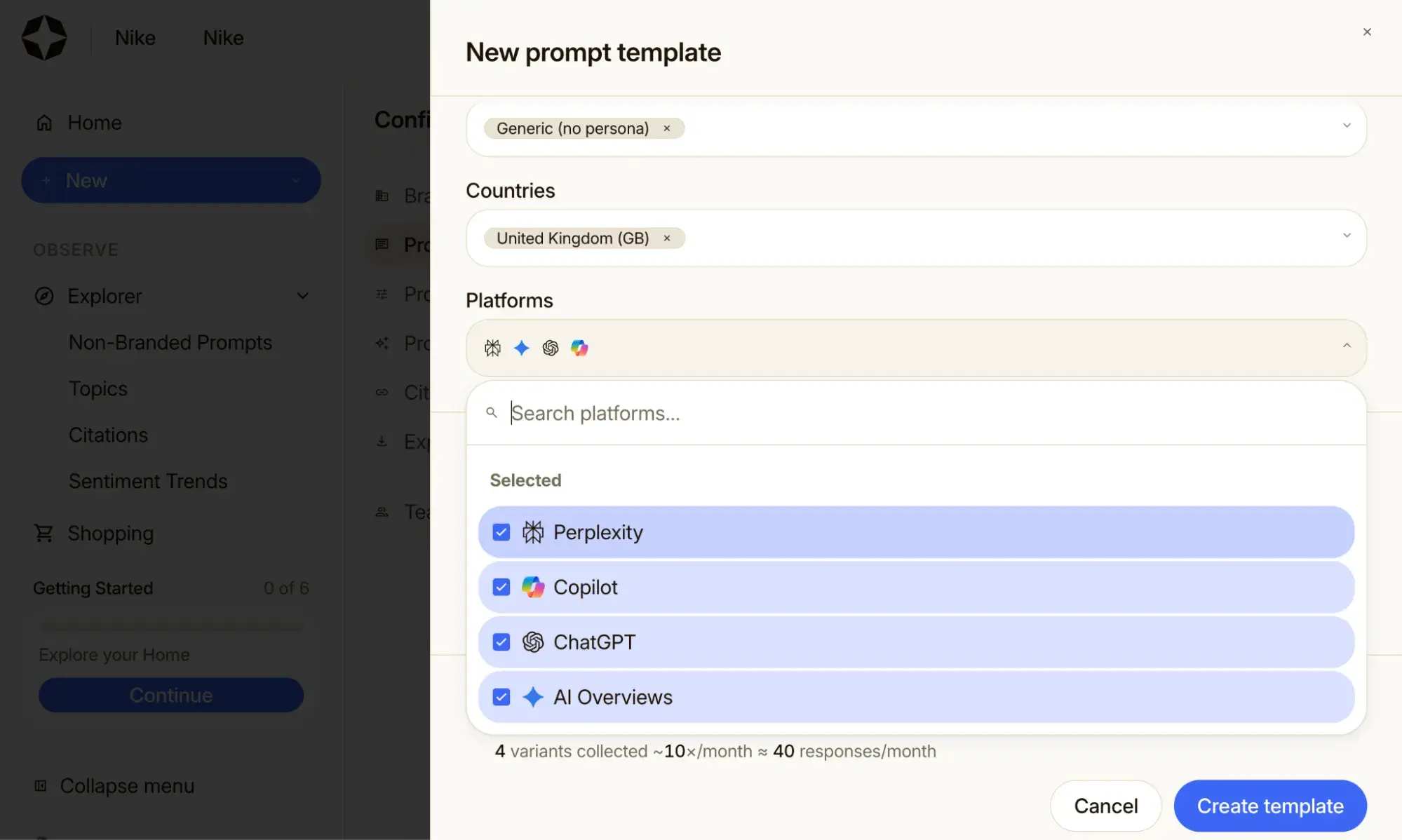
Second, point one prompt at a non-US market and confirm the stored answer is localized. As you can see in the Scrunch example below, I’ve selected ChatGPT as the engine and the United Kingdom as the location.
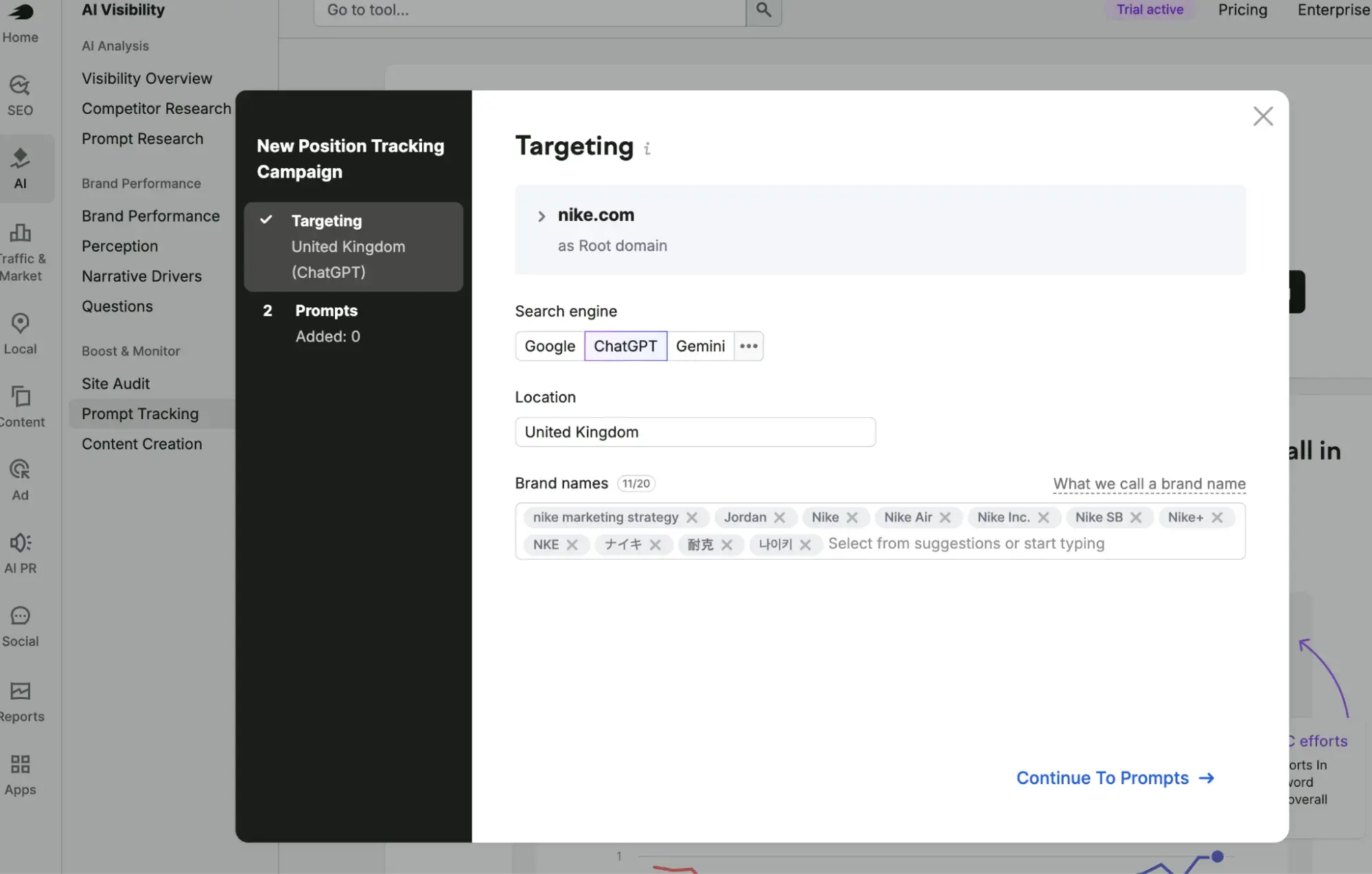
Third, ask each vendor which reports use your prompts, how it collects each engine’s answers, and how many responses it samples per prompt. Citation accuracy is the next test.
Scrunch vs. Semrush on Citation Tracking and Auditability
Citation tracking improves the auditability of AI visibility measurement: It shows which sources an answer engine pulled from and lets you confirm the exact response. Scrunch and Semrush both do this, but these AI visibility tools expose the underlying data differently.
Source detail. Scrunch records citations at the URL and domain level and tags each cited source as owned, competitor, or third-party, flagging mixed-ownership domains that host both. Semrush surfaces the external domains cited in AI answers and groups them so you can see which favor rivals over you, including gaps where a domain cites competitors but not your brand.
Competitor views. Scrunch auto-detects competing brands appearing alongside yours and benchmarks share of voice, response position, and sentiment against them. Semrush runs a side-by-side competitor report and flags high-consensus prompts where rivals appear and you don’t.
History. Scrunch defaults to a 12-week trend view for visibility and citation shifts but doesn’t carry the multi-year keyword and backlink archives of a legacy SEO suite. Semrush pairs rolling AI-visibility trends with its long-standing SEO database in one login.
Inspection. Both Scrunch and Semrush let you open the raw answer. Scrunch’s response reader shows the unedited output next to the cited URLs, competitors mentioned, and assigned sentiment. Semrush opens a split view that separates cited sources into your pages and everyone else’s.
What is the best way to validate citations before a purchase?
Answer engines are probabilistic, so it’s not like SEO where the same Google search should receive the same results (barring personalization based on the data Google knows about you). With an LLM, the same prompt can return different citations run to run. Before you pay, take four steps:
- Ask each vendor how many runs it executes per prompt cycle; multiple runs produce a steadier score than a single daily snapshot.
- Open the raw-response view during a trial and confirm the cited URLs match live citations in ChatGPT or Perplexity.
- Set a free baseline first. HubSpot’s AI Search Grader scores your brand presence, sentiment, and share of voice across ChatGPT, Perplexity, and Gemini in a one-time read, giving you an independent reference to weigh against a paid trial.
- Check GA4 or your server logs for referral traffic and AI-crawler visits to the pages each tool flags as top-cited.
Scrunch vs. Semrush on Reporting and Export
Both Scrunch and Semrush track the same core AEO signals, but they differ in how you get those signals out to a stakeholder.
Dashboards and exports. Scrunch’s dashboards are built around AEO views for brand presence, citations, and agent traffic, with an in-platform button that saves the current view as a PDF and CSV exports of the time-series data behind whatever filters you have applied. Semrush places its AI Visibility Toolkit inside Semrush One, next to rank tracking, audits, and backlinks, so AI visibility reports sit alongside the SEO metrics leaders already track. Trend windows were covered earlier; the real split is delivery.
Scheduled reports and stakeholder effort. Semrush’s My Reports is a drag-and-drop builder that emails white-labeled PDF reports on a recurring daily, weekly, or monthly schedule, adds AI-generated summaries, and pulls in 20-plus outside sources. Scrunch centers on in-platform snapshot exports; for recurring stakeholder delivery, it routes data outward through its Looker Studio community connector, which ships pre-built templates and can blend GA4 for unified reporting, or through its Query and Responses APIs. Getting a branded client report to an inbox takes fewer manual steps in Semrush.
Connectors. Both Scrunch and Semrush expose a Model Context Protocol server, so you can query visibility data from Claude or ChatGPT without exporting first.
How do you turn AEO insights into content workflows?
Collecting AEO data is only half the job. Let’s look at how Scrunch and Semrush turn a flagged gap into published content.
Scrunch keeps a person in the loop. Its Content Gaps view flags prompts where buyers are asking, competitors are cited, and your brand is absent, generates a structured brief you approve, and recommends re-auditing 30 to 60 days after publishing to confirm the gap closed. You can hand the brief to your team or, through Scrunch’s MCP, to an AI assistant like Claude to draft.
Semrush can keep the work inside its platform, but only with the Content Toolkit, a separate subscription that costs $60 per month and isn’t included in Semrush One. With it, a flagged topic moves into a chat-driven editor that drafts long-form content from Semrush keyword and prompt data and a brand voice you set once, and you publish straight to WordPress through its plugin.
The trade-off is in the specialist-versus-suite split: Scrunch fits teams that want to approve each gap and route work into existing content ops, while Semrush fits teams that want to draft and ship without leaving one platform and are willing to add a second toolkit to do it.
Scrunch vs. Semrush on Integration and Workflows
An AEO tool’s integrations determine what your team can do with it, which is often what determines whether the tool sticks. Here’s how Scrunch and Semrush compare in integrations.
SEO-suite context. Scrunch is a dedicated AEO tool for monitoring how a brand appears in AI answers, built to complement an SEO suite rather than replace one. Semrush folds its AI Visibility Toolkit into Semrush One, where AI metrics run under one login alongside keyword research, position tracking, and site audits.
Marketing-system connections. Both tools push their data to outside systems. Scrunch MCP lets you query AI-visibility data in plain language inside ChatGPT or Claude and pull it into your own workflow. Semrush MCP does the same for Semrush’s keyword and traffic data across ChatGPT, Claude, Gemini, and Perplexity.
Content execution and handoffs. This is the sharpest split. Scrunch’s Content Gaps surfaces the prompts you’re missing from, writes a brief, and leaves it to you to decide what to act on and who should build it. Semrush closes the loop in-suite: A flagged gap can move into the Content Toolkit, a separate add-on which drafts the article and publishes it directly to WordPress.
Stack complexity. Scrunch adds AEO depth without disturbing your existing marketing technology stack, but it is yet another tool to manage. Semrush trades specialization for a suite that bundles SEO and AI visibility on one subscription, though sub-user seats and prompt add-ons still grow with team usage.
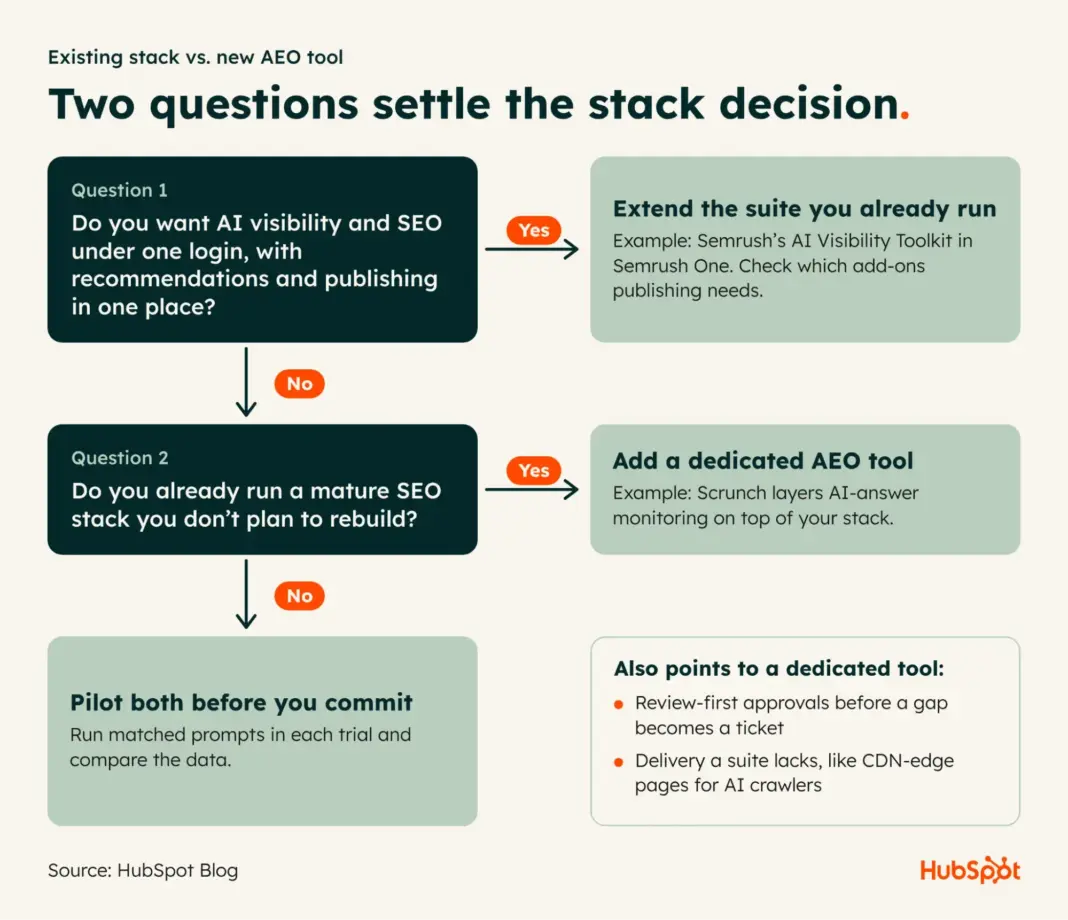
When should you use your existing stack vs. add a new tool?
The decision comes down to two questions, mapped in the flowchart below: Do you want AI visibility and traditional SEO under one login, with recommendations and publishing in the same place? See if you can extend the suite you already run. Do you already operate a mature SEO stack you have no plans to rebuild? A dedicated tool like Scrunch layers AI-answer monitoring on top without touching it. Scrunch also fits teams that want a review-first model, where a strategist approves each gap before it becomes a ticket, or that need delivery a suite doesn’t offer, such as serving AI crawlers a separate page version at the CDN edge.
How to Validate Your AEO Data Before You Buy
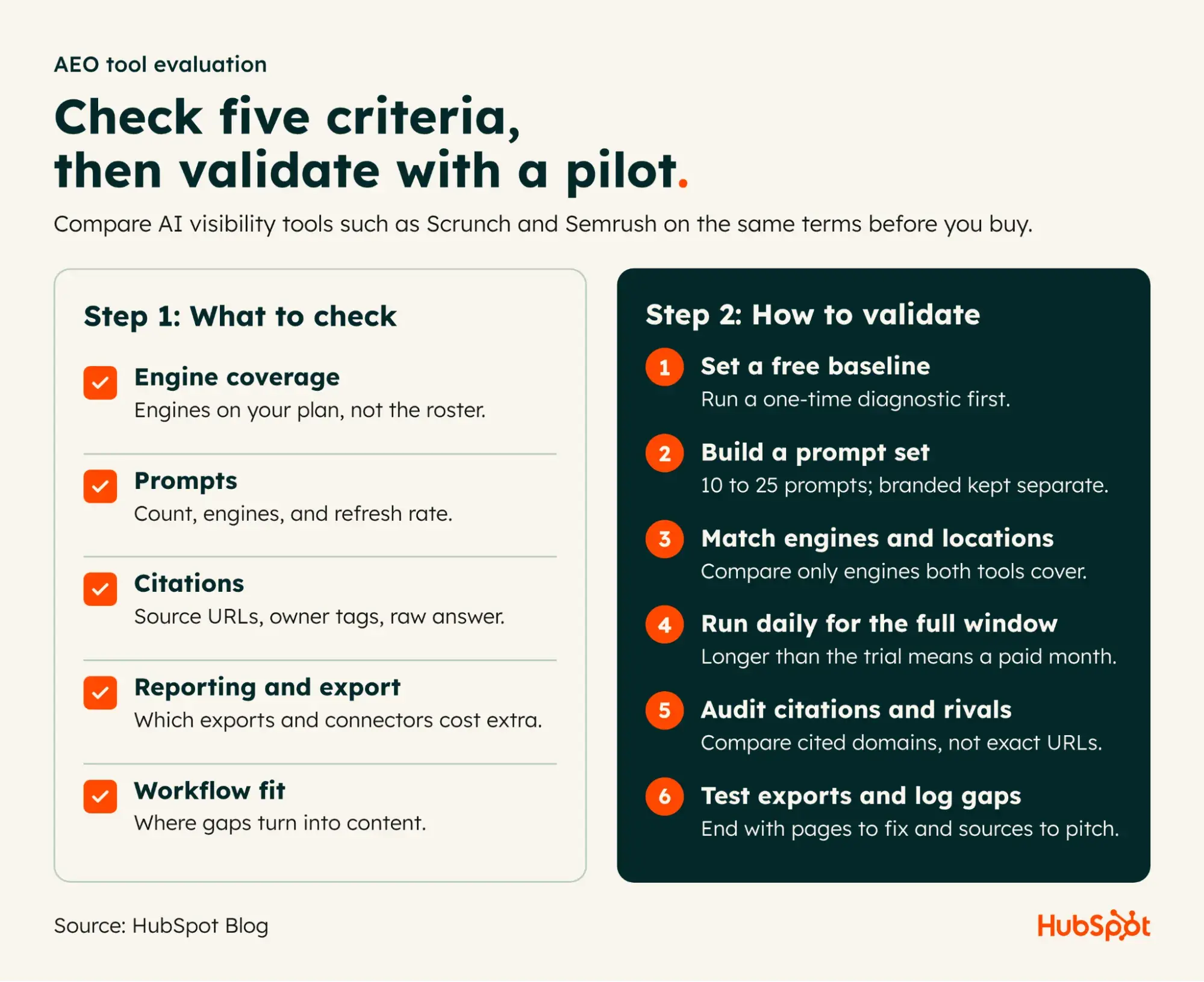
A single query proves nothing about a tool’s data quality. To judge it, run the same structured pilot across both vendors on identical terms during your trial windows, using this six-step protocol:
- Build a representative prompt set. Choose 10 to 25 prompts spanning your funnel: awareness questions, comparison queries like “Scrunch vs. Semrush,” and high-intent feature or pricing prompts. Keep branded prompts in their own group, since they almost always surface a mention that pulls a generic visibility score upward.
- Match engines and locations. Compare only engines both plans run your prompts on. At entry level, that means ChatGPT, plus Google AI Overviews if you add the same queries as keywords in Semrush’s Position Tracking. Keep country and language settings identical, and log every other engine as single-tool coverage.
- Use the full seven days. Both trials last a week, and both tools query newly added prompts daily, so expect roughly seven data points per prompt. Treat that as an early signal; a stable trend needs a longer run, covered below.
- Review citations and competitors. Apply the raw-response and crawler-log checks from the sections above, then load three to five rivals to spot domains that cite a competitor but not you.
- Test exports and connectors. Pull a sample CSV to confirm row caps and formatting, and try any Looker Studio or MCP connection you plan to rely on.
- Document the gaps. A useful pilot ends in a prioritized list of pages to fix and third-party sources to pitch.
What is the best way to pilot with minimal risk?
Run the AI Search Grader first for a one-time reference point, then start both trials on the same day so their data windows line up. Scrunch’s trial runs on its Core plan. Semrush’s AI Visibility Toolkit has no trial of its own, so use the 7-day Semrush One trial and choose Starter. Pro+ raises the prompt cap from 50 to 100 and adds SEO capacity such as more tracked keywords and sites, but a 25-prompt pilot won’t reach either cap. Both trials need a payment card and convert to paid plans unless you cancel before they end. If seven days leave the results inconclusive, ask each vendor whether it will extend the trial, or pay for one month on monthly billing before you sign an annual contract.
Who Each Tool Serves Best Today
The choice between Scrunch vs. Semrush comes down to how your team treats AI visibility: as its own discipline, or as one more report inside the SEO suite you already run.
Scrunch
Best for: Brand, web, and growth teams running AEO as a standing practice on top of an existing SEO stack
Scrunch serves teams seeking a dedicated AEO workflow. It leads on transparency and depth: You can inspect the unedited answers that engines return, and it adds a CDN-edge delivery layer that logs AI-crawler visits and can serve retrieval bots a separate page version, which Semrush does not offer. Its integrations run outward through connectors rather than into a native content pipeline, and it carries no traditional keyword, rank, or backlink data, so it fits teams that already own a mature SEO stack and want AEO layered on without rebuilding it. The trade-off is stack cost: Scrunch adds another contract, login, and set of seats to manage.
Semrush
Best for: In-house SEO teams and agencies that want one subscription covering both SEO and AI visibility tools
Semrush AI Visibility Toolkit adds AI visibility measurement to an established SEO suite. It reports AI metrics under one login next to rank tracking, audits, and backlinks, and it leads on reporting: My Reports emails white-labeled, recurring PDFs that a specialist tool matches only through external connectors. Its AI metrics also sit on top of an established SEO dataset, adding historical context a specialist tool can’t. Its AEO depth is shallower than Scrunch’s, and costs grow with usage: extra seats, Brand Performance domains, and prompt blocks are add-ons, and content drafting and scheduled reports each need separate subscriptions.
How to Decide
Choose Scrunch when AEO is a distinct workflow you want to inspect and route deliberately; choose Semrush when a single subscription covering SEO and AEO matters more than specialist depth.
For teams whose stack is already built around HubSpot, a third path sidesteps the specialist-versus-suite trade-off by measuring AI visibility inside the same system their content and customer data already run through. Learn more about HubSpot AEO.
Resolve the trade-off with an integrated AEO path.
For a team whose stack is already built around HubSpot, the specialist-versus-suite decision changes shape. Scrunch and Semrush both sit outside the system that holds your customer data and campaign reporting, so acting on a gap and proving its impact means working across separate tools. AEO in Marketing Hub Professional and Enterprise measures AI visibility inside that same system, which is where it resolves the trade-off. It tracks the same three engines covered above, ChatGPT, Perplexity, and Gemini, so engine breadth is not where it competes. Three things set AEO in Marketing Hub apart from Scrunch and Semrush:
- CRM-informed prompts. AEO in Marketing Hub suggests prompts to track from what HubSpot already knows about your accounts and buyers, and sharpens them as your pipeline changes, so the prompt library truly reflects the business you run.
- Connected workflows. When the data shows your brand missing from a prompt, you act on the recommendation inside HubSpot’s content and social tools, drafting a blog post or a LinkedIn or Reddit response without moving to a separate tool.
- Campaign alignment. Because that work sits beside your campaign metrics, you can connect a visibility fix to the traffic it influences; on Marketing Hub Enterprise, attribution can tie AI-referral sessions to contacts and deals.
Best for: Teams already on Marketing Hub Professional or Enterprise, or actively moving to HubSpot, whose main bottleneck is acting on what they find and who need AI visibility connected to pipeline. Teams running a mature non-HubSpot stack, needing engines beyond the core three, or needing CDN-edge delivery to AI crawlers are better served by Scrunch or Semrush. For everyone in the first group, learn more about HubSpot AEO.
Frequently Asked Questions About Scrunch vs. Semrush for AEO
Which answer engines should B2B teams prioritize first?
Start with ChatGPT, Perplexity, and Gemini. ChatGPT is the largest by reach, having reached 1 billion monthly active users by June 2026; Perplexity is search-native; and Gemini surfaces across Google’s ecosystem. These three also match the engines HubSpot’s free AI Search Grader covers. Add niche or regional engines only after you have data on the big three.
How can I validate AI visibility coverage without paying for a full subscription?
Layer three free steps. First, run a free, one-time baseline diagnostic for a zero-cost read on your presence across ChatGPT, Perplexity, and Gemini. Next, run the no-cost trials: Scrunch’s 7-day trial and a Semrush One trial. Finally, check GA4 referral sessions and server logs against each tool’s top-cited pages.
When should I add a dedicated AEO tool instead of relying on my SEO platform?
Add a dedicated tool like Scrunch when you already run a mature SEO stack you won’t rebuild and need AEO depth your platform lacks, such as raw-answer inspection, owned-versus-competitor citation tagging, or CDN-edge crawler logging. Stay with your SEO platform when a single login covering SEO and AI visibility matters more than specialist depth.
What is the best way to align AEO metrics to pipeline?
Tag AI-driven visits as their own channel in your analytics, then pass that source into your CRM so a later conversion keeps its origin. HubSpot does this on every plan, recording visits from engines like ChatGPT as AI Referrals on contacts and their associated deals (HubSpot). Deal and revenue attribution reports on Marketing Hub Enterprise then show how much pipeline each source influenced. For HubSpot teams, AEO in Marketing Hub places AI visibility data next to campaign results, so content fixes and their outcomes share one system.
Do I need to track every geography and language from day one?
No. Start with the countries and languages where your buyers actually search, then expand coverage as you enter new markets. Both tools scale with you: Scrunch tracks prompts in any country and language, and Semrush’s Prompt Tracking spans 220+ countries and territories. Tracking everything upfront inflates cost and dilutes the signal.


